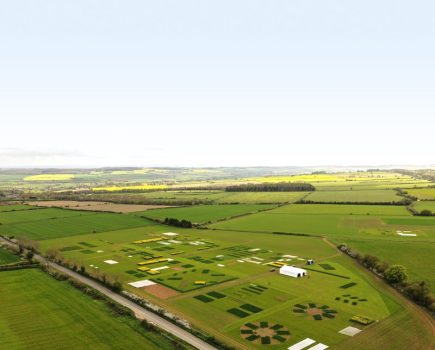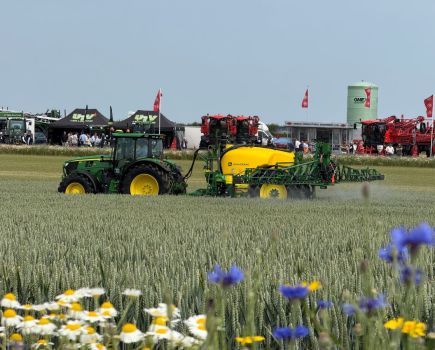


Ten years after the Cherry family introduced the industry to Groundswell, more than 10,000 regen aficionados flocked to Lannock Farm for the annual two-day event. CPM attended a host of sessions to pick over the bones and reveals the pros and cons of farming more regeneratively.
“I now don’t worry about tramlines, take-all and slugs have disappeared, and water draining from our wheat field is clean.” SIMON COWELL
By Mike Saull
Groundswell is impressive and the enthusiasm of its visitors infectious. Where else could someone embrace early morning yoga, rub-up alongside min-till focused folk of the soil, and end the night with a drum and bass DJ set?
This year, organisers went above and beyond, even erecting a screen to show England’s toil against DR Congo in the World Cup, before inviting the ‘great and the good’ of the press to cut a 10th birthday cake at a champagne reception.
However, to talk shop, an annual feature at Groundswell is the Soil Farmer of the Year awards, with the accolade this time going to modest Lancashire-based field vegetable grower, Chris Molyneux. Utilising legume-rich cover crops, strip tillage and controlled traffic farming, Chris has improved structure, drainage and biological activity on his 200ha of organic black sands.
PIVOTAL MOMENT
His regenerative farming conversion started after a visit to Australia where a wheat farmer host described his plough-and-plant approach as ‘so 19th century, mate’. This was compounded when Chris’ wife stopped riding-out on the compact, wet, wheat land after harvest, preferring the looser and easier going pea stubbles. Now he has soils that support high yielding, high value vegetable crops including kale and chard.
“We started working with min-till and cover crops and this transformed our soils. Then, when the maize boys introduced strip tillage, we adopted their kit and approach. As a result, where we couldn’t get onto ground due to slumping and compaction, we now drill direct whatever the weather, in conditions that wouldn’t have been conducive under our previous approach,” explained Chris.
When it comes to nutrition, Chris said he utilises clover, which he’s recently added to the cover crop mix as a source of nitrogen. “It builds fertility, fixing enough nitrogen for itself – graze it and it comes back even stronger. Finally, we harvest it and use it as a source of slow-release nitrogen and a means of reducing the weed burden in our kale crop.”
In accepting the award, Chris said he felt humbled as there were so many people at the show doing amazing things. “I don’t quite feel like the winner yet as there’s still more I’d like to do, it’s a real learning process.”
Runner-up was Paul Baker who farms both organic and conventional systems in Devon, while third place went to Colin Chappell from Lincolnshire.
Bringing a sense of pragmatism to the show, farm business consultants Andersons fired a warning that while the regenerative farm model is less volatile than it was, it, like many other similar conventional farms, is often reliant on SFI or diversification projects for profitability.
The consultancy shared findings from its model regen farm – which comprises 600ha of combinable crops; 240ha owned and 360ha on farm business tenancies. Managed by the owner and one full time worker, it uses cover crops before spring barley grown every other year, and benefits from third-party livestock.
Six years after introducing regen practices, the fictitious farm has fully transitioned and yields have stabilised; no soil is moved and being on clay loam it uses rotational mole ploughing to improve drainage.
Farm business consultant, Amelia Rome, suggested that after profits were curtailed by a wet 2024 and dry 2025, an upturn in commodity prices should see the farm make a positive surplus in 2026. Working on wheat yields of 8.65t/ha sold at £185/t for feed this year, the farm gross margins are predicted to be £65/ha higher than last year at £896/ha.
“Outputs are generally 10% below what they’d be for a conventional farm and while input costs are 10% down, it’s still very sensitive to commodity price shifts. While ag inflation has dropped from its highs of 2020, it continues to erode profits. This and the Iranian conflict mean that a large number of farmers aren’t making a profit,” explained Amelia.
“If it wasn’t for SFI, the farm wouldn’t be in business. Like many others of a similar size, it’s effectively drawing upon reserves and eroding their balance sheet going forward.”
TOUGH CLIMATE
For next year, Andersons warned that it’ll remain difficult to make profits from production alone, and SFI payments are most likely to decrease. Therefore regen farmers, like other commercial crop businesses, will have to look at doing things differently, notably reassessing machinery expenses.
On the topic of machinery, specifically tillage, various soils gurus concluded that occasional operations shouldn’t take a system back to square one. Instead, carried out effectively, they can restructure compacted areas, improve rooting, and cut the risks of run-off and soil losses.
Soil consultant Philip Wright pointed to Australian research showing that the negative effects are usually short lived. “A zero-till system produces a soil that can better cope with some tillage. As a result, recovery can occur after six months, maybe less, depending on how long you’ve been using regenerative practices,” he said.
Additionally, Niab head of farming systems research, Dr Liz Stockdale, said it’s important to identify exactly where compaction is and only operate in that area. “Look at the size of soil aggregates, how they’re arranged and where roots zig-zag their way to depth. Examine sites where water is ponded or where there’s run-off; this is often a symptom of compaction leading to a wet topsoil while the soil can be bone dry below.”
If restructuring is required, Philip’s advice was to use low intensity cultivations that bring minimal surface disturbance. “If you can get away with just one operation, that’s brilliant, and rather than disturbing the whole profile across the entire field, look to tillage zones and restrict the disturbance to these areas alone. Don’t maul the mycorrhiza and always default to less,” he said.
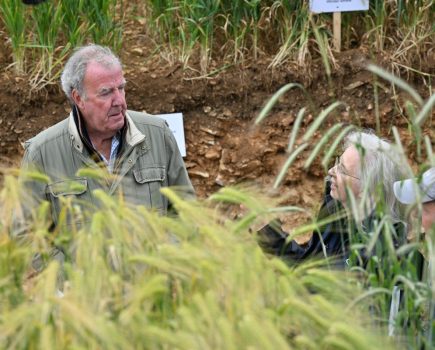
Contributing to the conversation, Essex Farmer Simon Cowell has been direct drilling for 20 years and believes he’s earned the right to carry out some cultivation when required. “Our heavy clay soil is very resilient and organic matter levels have risen from 3.5% to 7-8%,” he said. “I now don’t worry about tramlines, take-all and slugs have disappeared, and water draining from our wheat field is clean.”
He suggested that occasional inversion cultivation could also help to redistribute autotoxins and alleviate phosphate build-up in the surface soil as well as reduce blackgrass issues.
Then, over in another knowledge exchange session, Niab’s Dr Aoife O’Driscoll highlighted that all growers should be aware of the increasing susceptibility of wheat to yellow rust and the growing pressure of septoria on farm. Her advice to those going down the regen route was to box clever with fungicides and bio-fungicides, and cut risks by adopting the most resistant varieties within wheat blends.
Her recommendation for selecting mixes on-farm was to check the lineage of varieties and avoid those with past parents that had previously been quick to breakdown. This is because many popular wheat varieties have yellow rust-susceptible Oakley in their genetics.
To further the discussion, Cope Seeds confirmed they’re processing 600-700t of wheat every year for use in blends and said that the market is increasing. Seed manager, Simon Travers, added that at the same time as cutting management risks in regen farming systems, blends are finding increased favour with end-users.
“Variety mix depends on end-market, but millers are getting good results from combining Group 2 and Group 1 wheats and accept that farmers gain agronomic advantages as well,” he suggested.
This year, Cope has sold blends using the Group 1 KWS Vibe and the high gluten content German E winter wheat Nelson, mixed with Group 2 varieties with complementing agronomic traits. At 14% protein, these mixes have secured additional £15/t premiums over typical milling wheats.
However, Simon warned farmers against home-saving blends as while a three-way mix at 1/3, 1/3, 1/3 is drilled in the autumn, it’s unlikely to be the same combination at harvest.
PREMIUM MARKET
Emma Teasdale, farming community manager at Wildfarmed, confirmed an increasing number of buy-backs for wheat blends grown using regenerative practices. Wildfarmed currently has 110 farmers growing blends on farm – one of the most successful utilises Nelson, Group 2s Palladium and BYDV-resistant RGT Goldfinch, alongside Group 1 variety Cheer.
The company uses such a blend for their own flours and bespoke products as well as selling to Tesco, Waitrose and independent bakers. ASK Italian and Franco Manca also use white flour from blends in their pizza doughs.
“Major end-users increasingly talk to their customers about what our approach means for their health, biodiversity, watercourses and the climate,” highlighted Emma. “We pay a premium to farmers, and the end-user also pays more for the product.”
Shifting to one of the most notorious pests in UK agriculture, ADAS’ Duncan Coston said cabbage stem flea beetle remains a concern for many oilseed rape growers. “The problem is that unlike most other flea beetle species, CSFB turns up at the same time OSR is emerging. With increasing pyrethroid resistance, farmers have to be careful they don’t build increasingly resistant populations.”
Therefore it’s a case of altering farm management to avoid or disrupt the pest, suggested Duncan. Methods include drilling early to get the crop off to a good, vigorous start so it copes with subsequent CSFB attacks, or, drilling late and bypassing the period when pest activity is at its worst.
Then, more growers are trialling companion crops drilled at the same time as the OSR, using a separate hopper on the drill. Duncan highlighted that a three-year research project on farms across Sweden and the UK is aiming to confirm best practice.
The companion crop seed mix currently being tested consists of around 50% buckwheat, berseem clover at 18% and 30% of the curry plant fenugreek. Peterborough-based, Tom Martin is one of the UK farmers trialling the companion crop mix. “Pigeons, slugs, and poor establishment can be a problem, but I’m not afraid of flea beetle,” he said.
Based on heavy clays, he aims to drill early using a mix of conventional OSR varieties to minimise the risk from just one type. Within the companion crop, clover and buckwheat are relatively frost sensitive, so die off over-winter, while fenugreek brings rooting benefits to depth, helping to maintain soil structure, he explained.
“Luckily the pest has a poor field of vision and can be fooled into hitting the larger green target of the companion plants. I’m not entirely convinced our crop smells of curry as others have suggested, but it appears to work keeping the pest at bay.”
This year, Tom is upping the rate of buckwheat to 11kg/ha with 2 and 3kg/ha each of fenugreek and clover, respectively. “We’re told there could be an allelopathic effect from buckwheat on blackgrass, so this could be another benefit from the companion crop that we’re looking to test.”
Tom shared that he also employs an early applied silica-based spray, to strengthen cell walls, enabling healthier growth. “It interferes with the digestive system of CSFB,” he said.
Thinking more on weeds, with six cases of glyphosate-resistant ryegrass now confirmed in the UK, ADAS weed science consultant John Cussans stressed to attendees that with no other total weed control product available, the industry is at a tipping point.
He pointed out that in wild populations there are individuals capable of surviving – therefore every farm could have resistant grassweeds, so repeatedly using the same herbicide programme is likely to select for these more resistant individuals.
“It’s a case of keeping a good equilibrium. Think big and ask yourself, is there a weed management approach that I’m not using, and if so, why not? Don’t rule out mechanical weeding, optimise chemical control, and use diverse application programmes and sequences. Also, don’t reapply a herbicide that doesn’t work in the field,” he urged.
This article was taken from the latest issue of CPM. Read the article in full here.
For more articles like this, subscribe here.
Sign up for Crop Production Magazine’s FREE e-newsletter here.