
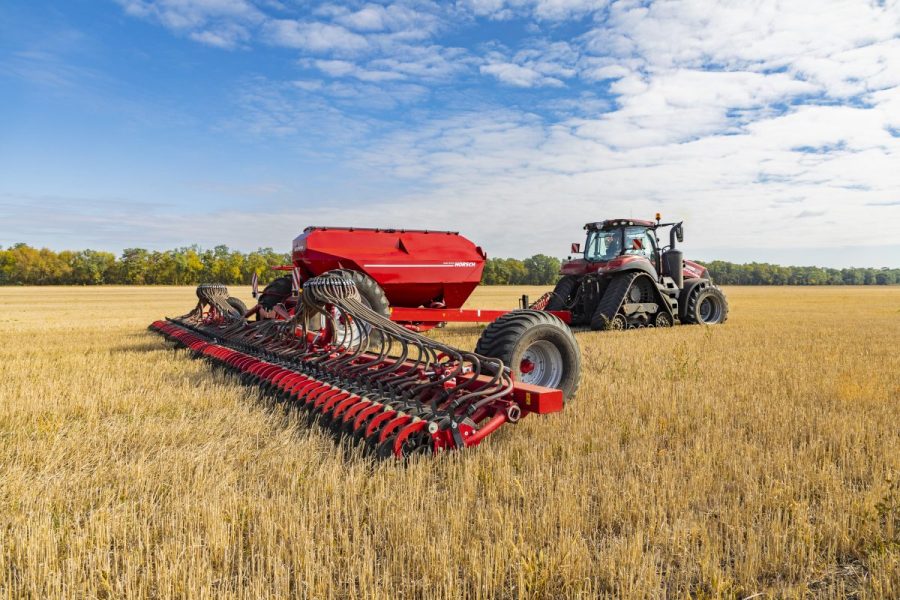
A philosophy that combines flexibility, operational synergies and an uncompromising drive for output has led one Hertfordshire business to invest in the UK’s first 18m Horsch Avatar drill. CPM finds out more…
“Drilling is the most important job on the farm; if I know it’s gone in right, well-sown is 60% grown.” JAMES ASHLEY
By Rob Jones
Since it began in 1957, Hertfordshire-based farming enterprise AT Bone has always taken carefully calculated risks, seized opportunities to expand, and been prepared to invest in new areas.
The business began life as a pig unit, but now decades later, stands as a multi-faceted diversified operation, including thriving property and construction divisions. While risk is spread considerably across the different aspects of the enterprise, farming around 4400ha of arable land and environmental schemes means there has to be a clear strategy, highlights operations manager, James Ashley.
And while some large-scale operations centre their approach around Controlled Traffic Farming, AT Bone has gone against the grain. In fact according to James, committing to strict CTF restricts flexibility and forces a business to carry significant capital overheads when expanding.
“We don’t like controlled traffic, but we love to control the traffic. We’re not CTF, but our tram lines are in the same place every year using RTK. They have to be; that’s just common sense,” he says.
“Farming has very tight margins as it is, and the bigger you get, when you’re committed to a specific width, the more kit you have to buy. If you jump from 5000 to 10,000ac (2000 to 4000ha), you have to commit yourself to another drill or two, another combine easily. Financially, that can’t work.
“But you can commit to maybe one bigger drill and stretch it longer, because no matter how much money you save with controlled trafficking, it can’t make up for the opportunity to take on an additional 5000ac,” explains James.
The farm’s cultivation strategy is highly adaptable, driven by operational efficiency and the demands of their clients. With eight contract farming agreements, AT Bone must cater to different landlords; what works for one, may not be preferred by another, stresses James. “We’re not purely direct drillers – we won’t commit to one thing, we require flexibility,” he notes.
Furthermore, the farm’s sheer volume of fieldwork, including extensive baling and spreading 50,000t of organic matter, creates significant field traffic that requires remedial cultivation. “We sit down every year and create a cultivation plan [in May or June] for after harvest, but nobody knows what the weather’s going to do. For instance, if a dry summer creates natural, deep cracks in the soil, the team avoids unnecessary subsoiling, saving time and money. Conversely, a wet summer causing soil pans requires intervention,” he says.
More than 50% of the farm’s land is drilled with winter wheat with second wheat, with the remaining rotation featuring oilseed rape, winter barley and spring oats. It’s due to the latter that ploughing remains a vital tool in the arsenal, raises James. With a considerable area gluten-free spring oats in the mix, rigorous winter ploughing is often required to bury wheat or barley volunteers to avoid the entire crop being rejected.
However, when it comes to drilling, to help manage the business’ expanding area and maintain output during tight weather windows, the team had to re-evaluate their machinery. Previously relying on three drills – a 12m tine drill and two 8m disc drills – AT Bone made the somewhat bold decision to replace one of its 8m drills with an 18m Avatar, the first of its size in the UK.
“The Avatar is marketed as a direct drill but as a cultivated drill, it’s fantastic. We may put in another pass behind the subsoiler to level it out, but the cost to do that with a 12m cultivator is minimal. Our 12m Cruiser will leave it level enough that we can go straight in behind,” explains James.
The decision to go for the 18m Avatar was largely driven by output and weather resilience, he adds. During the exceptionally wet autumn of 2023, pulling a 12m drill resulted in too many visible wheel marks, says James.
“We don’t like wheel marks. So, what can we do in those conditions to go wider? We’re on 36m tramlines so when we’re drilling at 18m, you have just one wheel mark, then you’re on a tramline.
“If it’s a real wet one, you sacrifice the width of the track that you don’t bury the seed, but then you always have a little 3m power harrow in the shed to cover the seed up. It was just more efficient. We had to take the plunge, it was the only way we could do it,” he comments.
James urges that the Avatar wasn’t deployed straight out of the box without careful consideration. The farm opted for a few custom modifications, specifically changing the star wheels and covers to prevent blockages caused by the stony land in some of their fields.
Being an early adopter of the 18m model also has meant navigating a few practical and technological realities. “The drawbar to wheel is a long distance, so you can ground out where the jack is. As such, we simply knocked out a few cambers in gateways with a mini digger.”
Currently, the drill features two nine-metre sections rather than individual coulter or narrow-width shut-off. This results in an estimated 8% overlap, increasing seed costs. “I should think the next generation you’ll be able to get half-width sections, which is down to where you want to be really, in an ideal world,” he suggests.
For James, who operates the drill, seed-to-soil contact is key for maximum output, and the investment in the Avatar is essential to the farm’s continued success. “Drilling to me is the most important job on the farm. If I know it’s gone in right, well-sown is 60% grown,” he comments.
Having planted around 2200ha this past season with the Avatar, during some very challenging conditions, James is still evaluating its performance, although says he’s happy with operations so far. Equally, a neighbouring farm noted it was pleased with its 12m Avatar, even in a wet season, and it wasn’t direct drilling either, says James.
“All you want is just the top to dry out, you’re not moving any soil, you just need it to hold you. The coulter pressure will allow you to punch it in. We really liked the Horsch Serto, but it wasn’t wide enough, while the Avatar offered 18m plus still has a 3m transport width.”
Despite the positive review, a primary concern of James’ has been preserving headlands. “If you look at people’s field yield maps, it’s always the first 15m that let you down because that’s where you’re turning with everything. It gets a pounding but with the Avatar, you’re 9m from the edge which reduces compaction.”
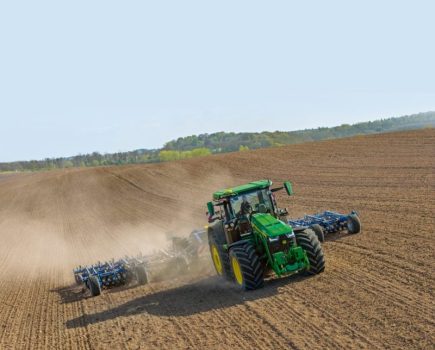
Pulled by a 410hp John Deere 8RX on tracks due to a lot of flint on the farms, James has noted that not requiring huge horsepower has been another benefit. “It’s a great combination, and only needing a 20t tractor helps to keep diesel costs down.
“I’m doing 55ac/hr (22ha/hr) at 13kph; I’m not going fast or stressing. I’m not ruining tractors by pushing them to the limit, and I’m burning just 50-60 litres of diesel an hour; it’s a dream.”
Although moving to 25cm spacing wasn’t a driver for purchasing the Avatar, James has noticed that the crop has ‘tillered out beautifully’ with no increase in weeds. “The spacing definitely helped with weeding,” he suggests.
Another challenge to ponder has been logistics – operating a machine of this size across a vast area comes with its own unique considerations. This is because AT Bone farms a 30-mile radius including land inside the M25.
“The biggest problem is traffic,” admits James, noting the difficulty of moving agricultural machinery through heavily populated areas near London. “I think there comes a point we wouldn’t want to go any further than we are now. We’re not at our stretch by any means, but I think life becomes very inefficient.”
When it comes to the 18m Avatar itself, transport has been surprisingly straightforward, he says, because the drill folds neatly to 3m. “Honestly, it’s no different to towing a trailer.”
While the Avatar has been a roaring success, James has decided to keep an 8m disc drill, stating it’s still the ideal tool to follow the plough, especially when preparing ground for the farm’s gluten-free oats. And with second-hand values being relatively low, retaining it for specific jobs is a logical choice, he concludes.
This article was taken from the latest issue of CPM. Read the article in full here.
For more articles like this, subscribe here.
Sign up for Crop Production Magazine’s FREE e-newsletter here.