
As hotter, drier harvests bring machinery fires increasingly into focus, protecting the combine is becoming about far more than the value of the machine itself. CPM speaks to a Northamptonshire grower about why fire suppression has become another layer in his farm’s harvest defence.
“The system provides yet more peace of mind that we’re doing all we can to prevent fire.” FRED HILSDON
By Charlotte Cunningham
There was a time when 30oC during a British harvest was enough to make headlines. But as prolonged spells of hot, dry weather become an increasingly familiar feature of the summer months, they’re also changing the risk profile of getting crops safely from field to store.
While dry conditions can make for easier combining, tinder-dry crops and an inevitable build-up of dust and debris aren’t always comfortable bedfellows with hot engines, exhausts and hydraulics. Add in temperatures which are now commonly creeping towards the high 30s, and the potential for a small ignition to quickly become something much more serious is difficult to ignore.
But perhaps just as significant as the immediate fire risk is what happens afterwards. At the height of harvest, losing a combine isn’t simply about the cost of replacing or repairing the machine. It can mean losing days – or even weeks – of capacity during what could prove to be the season’s most valuable weather window.
This is something Northamptonshire grower Fred Hilsdon has become increasingly conscious of during recent years. Fred is the third generation of his family to farm at Harrowden Farms near Wellingborough, where the business grows combinable crops across around 809ha of mixed soils.
Like many arable businesses, fire has always been considered an inherent harvest risk,but Fred says the changing conditions experienced during recent summers have pushed it much further up the agenda. “During the past couple of seasons we’ve been experiencing higher temperatures at harvest and fire has become a lot more relevant,” he explains. “We’ve had combine fires in the past, but 30oC of heat used to be a talking point. Now we’re pushing up towards 40oC, so we’re getting towards other parts of the world where fire is a major, major consideration.”
Thankfully, the farm hasn’t experienced a serious combine fire, but that doesn’t mean there haven’t been warnings, he continues. “We’ve had small fires most harvests, luckily detected early and dealt with when very small. Sometimes it was a handful of dust smouldering and it was put out with a drinks bottle, which sounds a bit like an anti-climax but that’s often where these big fires start.”
At the same time, Fred had watched neighbouring farms experience much more significant incidents, including the loss of combines and balers. Consequently, fire preparedness has gradually become a formal part of harvest planning. “We sit down and do a health and safety briefing before harvest and run through everything with fire, just making sure precautions are in place,” he explains.
A water bowser is kept parked in the yard complete with couplings, which allow the fire brigade to connect directly to agricultural fittings, while a cultivator is also kept ready to go should a firebreak have to be established quickly, notes Fred. “Then there’s the safety of the combine itself. Machinery hygiene is prioritised, with a compressor used to regularly blow the machine down and prevent combustible dust and debris accumulating.”
But perhaps one of the simplest precautions is making sure everybody knows to speak up when something doesn’t seem right, he points out. “A lot of it is staff awareness. Particularly for the corn cart drivers behind the combine, I say if there’s any doubt or something smells different, just get on the radios or phones and we’ll stop and check.
“The best place to smell a combine fire is when you’re on the tractor and trailer approaching it from a bit behind.”
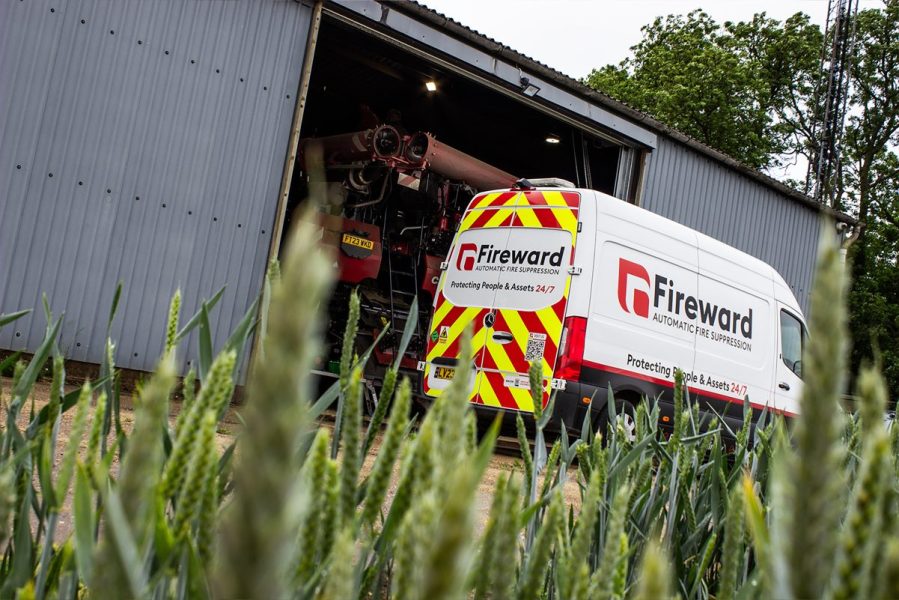
Yet even with those measures in place, Fred began looking at whether the farm could add another layer of protection. Having first heard about Fireward’s automatic fire suppression systems through the NFU, he later saw one fitted to a baler at a show and started investigating the technology more seriously.
But it was the experience of a neighbour which really brought home the potential wider cost of a machinery fire. “One of my neighbours lost a combine in harvest and he couldn’t get a replacement machine for about 10 days to two weeks,” says Fred. “Fortunately, the season was very good and he managed to get everything in eventually. But in a lot of years, that fortnight of missed work could have been absolutely crucial.”
With that in mind, Harrowden Farms opted to retrofit a Fireward automatic suppression system to its Case IH 9250 Axial-Flow combine rather than wait until the machine was replaced. In fact, Fred says there was little reason to wait given the business intends to retain the combine for at least another five years. “Looking at the actual cost of the Fireward compared with the cost of the combine, it was very favourable. For me, it was a bit of a no-brainer.
“Machinery is more complex, there are more areas for dust and combustible debris to accumulate and, due to emissions legislation, engines are running hotter. All in all, it seems to be a perfect storm for fires.”
On Fred’s 9250, many of those critical areas are concentrated towards the rear of the combine, where the engine, exhaust, hydraulics and drives are located. The Fireward system was retrofitted to the machine with automatic detection covering key risk areas around the combine and hydraulics. A monitor is located in the cab alongside a manual activation button, allowing the operator to trigger the system if a fire is spotted before automatic activation takes place.
Fred says the retrofit itself proved straightforward, while the system requires little additional input from the operator. “There are some very simple daily checks. We have the monitor in the cab and there’s a gauge or two on it. It doesn’t take you an extra hour in the morning to make sure it’s all up and ready – it’s there.”
But one feature Fred particularly values is that protection doesn’t stop when the combine is parked in the shed at the end of the day. “It’s extremely reassuring to know that the system is active 24/7. The combine stays hot for several hours after being parked up, so there’s still a risk,” he says. “A few years ago, we had bean dust smouldering on a combine after it was parked up and this highlighted that risk.”
Because the system doesn’t require electrical power to remain operational, Fred says there’s also reassurance that protection remains in place should batteries become drained.
Fortunately, the system hasn’t had cause to activate yet – and Fred would be quite content for things to remain that way. “The Fireward system is in addition to everything else that we’re doing, rather than a replacement. We’re still blowing the combine down and we’re still very vigilant for fire,” he says. “There’s no substitute for having everything else ready, having the staff aware and having good hygiene with the combine.
“But the system provides yet more peace of mind that we’re doing all we can to prevent fire.”
This article was taken from the latest issue of CPM. Read the article in full here.
For more articles like this, subscribe here.
Sign up for Crop Production Magazine’s FREE e-newsletter here.