
From drill filling and fertiliser handling to dryer loading and grain pushing, an arable farm telehandler typically plays a part at every stage of a cereal crop’s cycle. CPM finds out why one Warwickshire farmer has remained faithful to one machine despite changing his ownership strategy.
“The way it increases engine speed to increase hydraulic power on demand is really useful.” RUPERT INKPEN
By Martin Rickatson
Arguably, one of the main challenges for sales colleagues at a farm machinery dealership is making a telehandler ‘conquest sale’.
Convincing a potential customer that the make they sell has a better cab, lift performance or even fuel consumption than what the farmer already has, may be relatively simple. But, headstock design differences mean switching brands invariably involves factoring in the price of either a new headstock or a complete new set of attachments, and that’s often an insurmountable hurdle.
However, much more than this has kept Warwickshire farmer Rupert Inkpen loyal to Manitou. From significant features like the upgrade on his latest machine from powershift to a CVT transmission, to smaller details like recessed cab steps and a single-piece door with electric window, his commitment to the marque has multiple reasons behind it.
CONSTANT ACTIVITY
In addition to the demands of an arable operation, a suckler cow enterprise has traditionally provided plenty to do every day of the year on Rupert’s 300ha tenanted farm on the outskirts of Knowle near Solihull, from where he contract-farms a further 300ha. This year’s cropping primarily comprises winter wheat and spring oats, with maize grown under contract for a neighbouring dairy farm, and other land entered into SFI.
“The cattle usually make use of the 60ha of permanent pasture here, from which we also make haylage,” explains Rupert, who farms with the help of his self-employed son, who also works for a contractor.
“We recently sold the cows though as they were getting old and the cull cow price was good, plus the remaining best breeding cows made good money. We’re likely to re-enter the cattle sector as we have the buildings and the grassland, but currently assessing the figures to determine the best system for us.”
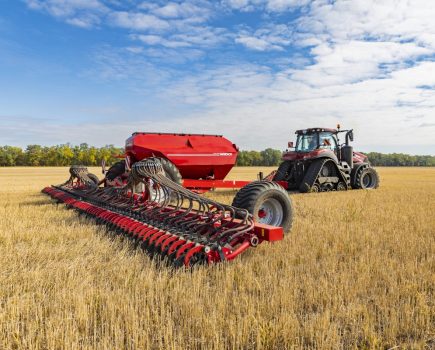
There remains plenty of arable activity to keep a telehandler occupied, though. Farm practices from on-floor grain storage with a mobile dryer to solid fertiliser application mean there’s always something for lift and shift. At the beginning of the season, there’s a Horsch Avatar drill to fill, the farm having moved some time ago to a direct drilling system across the mix of red marl, loam and gravel.
REGULAR USE
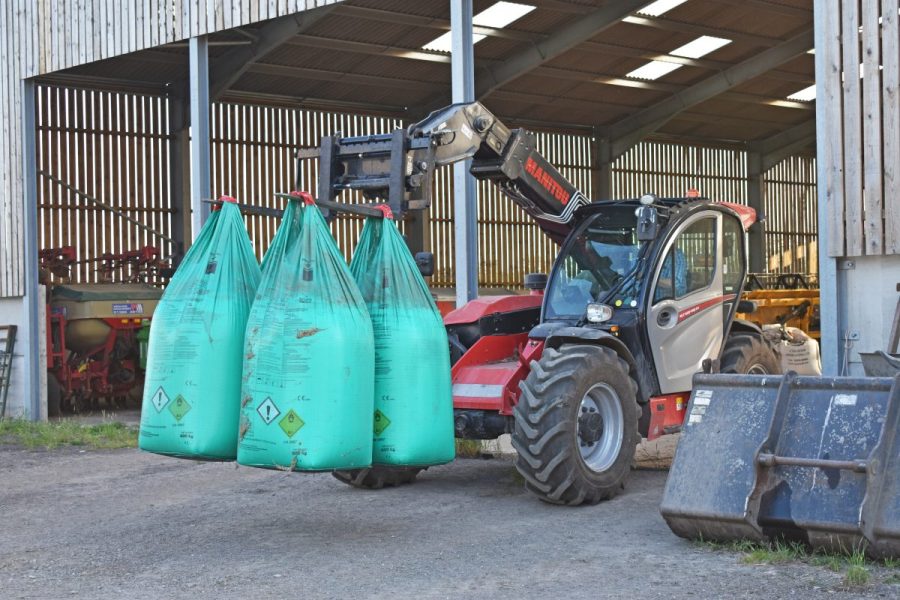
Then when spring comes around there’s fertiliser bulk bags to load, haul and empty into the spreader. “And at harvest our handler is on the go all of the time, particularly if grain is coming in above 15%,” says Rupert. “It rarely stops between our ‘wet grain’ shed, our Mecmar dryer and then pushing up dry grain in our 1000t long-term store.”
That handler has traditionally been a Manitou, and despite a change in the way it’s financed, that’s something which hasn’t changed with the arrival of the farm’s latest machine. “I have used other handlers, and like some of them, but I particularly rate the Manitou headstock, which I think is of a simple, strong design that gives the machine a more powerful action.
“And, of course, having been a long-term Manitou user there’s the fact that I have a set of compatible attachments – from our grain bucket and pusher to the Spreadbale straw distributor we use in our cattle buildings.”
Going back 12 years, Rupert purchased a nearly-new powershift 7m Manitou. “We put nearly 5500 hours on it, but during that time we had a few transmission issues and it required some repair work so wasn’t the cheapest handler we’ve run.
“But I liked a lot of its design features and performance, and when we sold it we decided to stay with Manitou but switch to hiring a machine, so that any issues of this nature would be covered by the company that owned it. The decision was also influenced by new prices which had jumped a lot by that point.
“As a result, we agreed a contract hire deal for five years firstly with a second-hand unit, and then after two years, upgrading to a new 6.0m MLT 635 model with Manitou’s M-Vario Plus CVT transmission. It was a system that worked well, particularly as it gave me known running costs including servicing. I really liked the CVT – in three years we put 1700 hours on that machine without laying a spanner on it.
“When this agreement was coming to a close and I was looking at my next option, the costs had risen considerably. The sums suggested a purchase was a better deal, and having made that decision, I then sought out a replacement machine.”
Rupert has a strong relationship with the Warwick branch of TH White, the local dealer for both New Holland – his preferred tractor and combine supplier – and Manitou, meaning service and spares are on his doorstep. However, he also makes use of other dealers and independent service engineers depending on what he’s buying and whether any machine requiring attention is out of warranty.
“I looked around at various sources when seeking the sort of Manitou model I wanted,” he explains. “The best value machine I could find for the specification I wanted was an ex-demo MLT 635-140V model with 136hp Deutz engine and M-Vario Plus transmission from Robert Davies Machinery in Shropshire, a dealer I’d used previously.
“If I could have found a simple four-speed powershift model I may have bought one, but experience with this transmission on the previous machine had convinced me of its benefits. Although it represented a 1.0m reduction in lift height, I hadn’t often needed to work beyond 6.0m, so I was happy to take it.
“Manitou was offering 0% finance, and the costings to purchase didn’t work out much more than for contract hire, so we agreed the purchase.”
Since its arrival early this year, the new machine, which was supplied fully serviced and with the balance of the three-year warranty, has bedded in well, notes Rupert. Small but significant upgrades over the model it succeeded have been especially welcomed.
“Its engine produces another 10hp and there’s a bigger hydraulic pump, producing an additional 20 l/min of oil flow, both of which speed things up when on jobs like loading lorries. While it’s a vital machine, I don’t think I use it hard enough to make direct comparisons on fuel consumption. At 120 litres, the diesel tank isn’t the largest, but we don’t use the machine for hours on end.
“In fact, it probably concerns me more that our work is quite stop-start, which doesn’t help the diesel particulate filter. We’d had an issue with this on a previous machine, but I think the newer models are better designed to handle it.”
The feature which impresses Rupert most when operating the new handler is the latest iteration of Manitou’s M-Vario Plus CVT transmission, available as a powershift alternative on all its NewAg XL models. It features a pair of radial hydraulic motors driven by a single hydraulic pump. At lower speeds, both motors are active, generating high torque for pushing tasks, while during acceleration on the road one motor is automatically disengaged, a single unit being sufficient for acceleration up to a top speed of 40 km/h.
Operators can set engine speed independently of travel rate to maximise hydraulic performance without increasing forward speed. Engine speed can be controlled directly via Manitou’s JSM joystick, eliminating constantly using the foot or hand throttle.
FUEL ECONOMY
An eco mode reduces engine rpm at top speed on the road, claimed to improve overall fuel economy by up to 8-10%. Two driving modes can be selected, with ‘Comfort’ for smooth response during precision load placement, and ‘Dynamic’ for greater responsiveness during for fast-paced loading.
“The way in which it increases engine speed to increase hydraulic power on demand is really useful,” says Rupert. “In comparison, I find a powershift never seems to be in the right gear, whereas the M-Vario Plus always seems to sort itself and I’ve been very impressed.”
While his previous machine had more lift height, Rupert has happily traded it for the greater hydraulic performance of the new model. “There’s nothing I especially require that extra metre for – I have a grain pusher and don’t stack bales especially high. What’s worth much more to me is the ability to quickly extend the boom when approaching a lorry to load with grain, for example. The extra hydraulic flow makes quite a difference to loading times.”
Simpler features that gain praise include the visibility offered by the curved windscreen, and the single-piece door with its electric window for ventilation. “It makes the cab noticeably quieter than the on older models with a split door,” says Rupert.
“The integrated cut-out step is also a good design, making entry and exit much easier and safer than a separate step below the cab.”
Rupert comments that it seems to be exactly the right size of handler for his size of operation, being compact enough to be nimble, yet powerful enough to undertake jobs like loading lorries and the dryer. “Even on the road its slightly smaller build seem to help prevent little things that used to occur on the last machine, like mud being thrown up onto the windscreen when travelling at speed.
“Like most handlers on a predominantly arable farm, it’ll do lots of relatively short burst of action when doing jobs like loading the dryer or our fertiliser spreader. On the latter, it can be sat waiting a lot, but it’s impossible to do the job without it. I also load and pull an AS Marston 10t tandem-axle flatbed trailer with it when loading the drill or spreader, and it happily pulls this,” he says.
The machine has an annual workload that totals around 600 hours, and Rupert hopes to achieve another 10 years from it. “As machinery costs have increased in recent years, we’ve adopted a policy of working machines beyond warranty and using independent servicing, working mainly with John Smith, a local specialist.
“Our main tractors – a 2014 New Holland T7.270 and a 2016 T7.200 – each have around 9000hrs on them without problems. We’re over-capacity on our much of our machinery, but this helps us to get jobs done on time. Also, running machinery over a longer lifetime like this keeps our depreciation down. This Manitou handler will be run the same way.”
This article was taken from the latest issue of CPM. Read the article in full here.
For more articles like this, subscribe here.
Sign up for Crop Production Magazine’s FREE e-newsletter here.