
Big baler manufacturers are developing designs that put more into each package for faster workrates and fewer bales from each field, while also harnessing technology to improve quality and efficiency. CPM speaks to the sector’s key players.
“This could prevent up to 80% of typical downtime, and help inexperienced operators to drive the Cubix to its full potential.” DANIEL MOERSCH
By Martin Rickatson
From higher workrates and greater knotter/knot reliability, to greater densities that cut bale numbers, big baler evolution centres on rapidly turning residues into valuable resources that contribute to overall crop return.
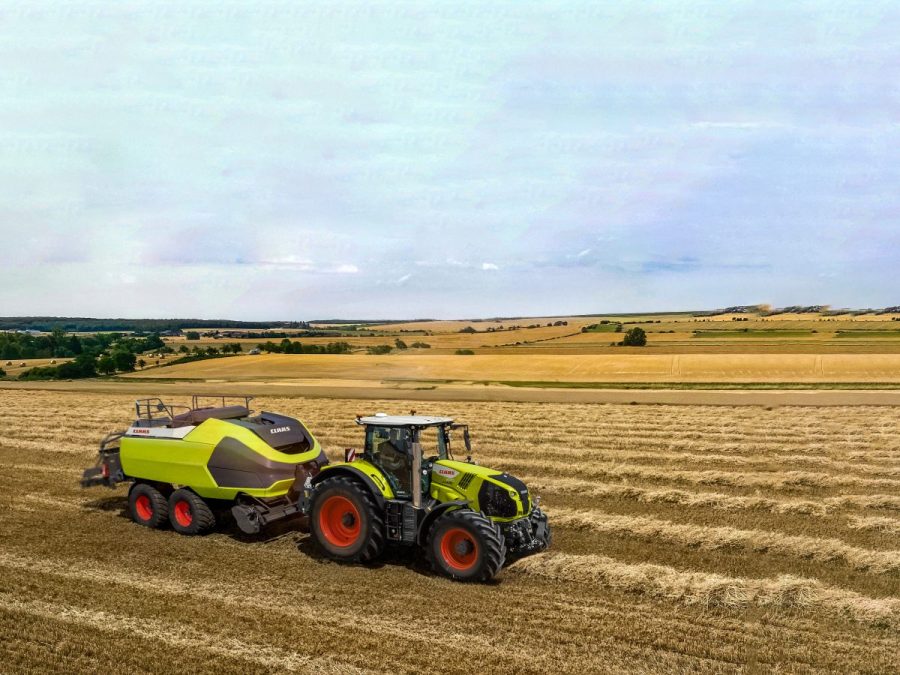
Among the most significant developments is the Claas Cubix, an all-new 120x90cm big baler previewed at Agritechnica 2025, and set for 2027-28 sales following final testing. With features including AI-supported bale density control, all-new drive concept and a novel double-loop knotter design, the Cubix is claimed capable of processing up to 70t/hr of straw, or up to 50t/hr with the Claas Finecut chopper option.
“The Cubix consistently produces 210kg/m3 densities, peaking at up to 235kg/m3,” says Daniel Moersch, square baler product specialist at Claas.
“Key to this is the straight power flow from a main gearbox integrated into the baler frame, and two longitudinally-arranged 202kg flywheels, which store sufficient drive energy to maintain smooth, consistently high compression. With the main gearbox integrated centrally in the drawbar, there’s then a power belt for each flywheel.
“An intelligent switch starts the two flywheels sequentially to minimise the required start-up energy. Once they’ve attained 1650rpm, the packer ram and then the rotor are engaged.”
Should an overload occur, drive to both flywheels is immediately disconnected by electro-hydraulic multi-plate clutches, and the packer ram is actively braked. “This eliminates any need for cam clutches and shear bolts, while foreign object damage is prevented and the baler can be rapidly restarted,” explains Daniel.
The packer ram, rotor and rake drives are switched individually via integrated clutches. When the baler drive is disconnected, the ram is stopped at 35o from rear dead centre, and when restarted, the baler then first makes an idle stroke before the next compression stroke, providing further powertrain protection.
A new pre-chamber features a pre-tensioned oil-bathed claw coupling that mechanically-operates the pre-chamber rake with alternate filling and raking strokes. “When the filling stroke is engaged, the claw coupling is preloaded, ensuring uniform feeding to the upper area when filling the press chamber,” says Daniel.
“Because the claw coupling drive is connected to a stepper gear, the gear shift occurs only when the claw coupling is still.
“Interconnected torque sensors in the rotor and rake gearbox measure the gearbox loads, using AI to continuously regulate automatic systems governing control of bale density and length. If an impending overload is detected in the torque curve, the rotor and pick-up are automatically disengaged before a blockage can occur.
“We believe this could prevent up to 80% of typical downtime, and will help inexperienced operators drive the Cubix to its full potential.”
Tractor Implement Management (TIM) matches forward speed to baler load, with ‘maximum density’ and ‘high throughput’ modes. AI-supported software based on torque sensor values then automatically regulates forward speed to optimise performance to those mode targets. “In addition to AI-supported density and bale length control, in testing we’ve seen no more than 2% deviation in bale weights,” adds Daniel.
“This helps to maximise legal trailer weights without risking overloading, for full transport efficiency.”
To match the higher density capability, collaboration with Schumacher Group has created a new knotter that produces two loop knots in each operation, said to combine the advantages and address the respective weaknesses of McCormick and Deering knotters. The double loop maintains twine tensile strength at around 70%, significantly higher than that of Deering knotters.
“We can either pack in more material, or use more economical twine with the same strength. Because twine loads are comparable to a Deering knotter, only six knotters are required meaning significant twine savings and cutting twine refill times. The double loop knotter also produces no twine waste, further cutting twine costs and protecting the environment,” explains Daniel.
Kuhn
Kuhn’s SB square balers now include pick-up enhancements to improve intake and a bale channel expansion to boost bale density consistency.
At the pick-up, a power feed roller actively follows swath height, while increased overall tine-to-tine width improves crop flow consistency to the rotor, removing power demand peaks and reducing blockage risk. Bale channel length is now 3.75m, incorporating nine cylinders and resulting in consistent bale density, particularly in very dry material, suggests Kuhn UK’s John Hulland.
“SB balers retain our Twinpact double plunger design, which produces uniform high density bales without higher strain on machine or operator, with 25% higher bale densities in dry crops compared with competitors,” he says.
“Twinpact’s split upper and lower plunger elements are connected via a triangle rod, compacting the bale in series during a complete plunger cycle, with greater force applied per surface area, while avoiding peak loads.
“This reduces power requirement and the ‘nodding’ impact associated with weighty plungers. Despite the heavier bales, the load on the machine is comparable with a conventional 120x90cm baler, which eliminates the need for an oversized driveline, flywheel and main frame, or a higher horsepower tractor.”
New Holland
Recent New Holland BigBaler Plus and BigBaler High Density updates include availability of IntelliSense baler automation across the range, a new operating terminal, full telematics integration via New Holland FieldOps, and improved maintenance features.
“IntelliSense uses LiDAR technology to continuously adjust the tractor steering to follow the swath, optimise chamber filling and maintain ideal speed,” explains New Holland’s Sion Whittingham.
“This means more consistent bale density and shape, reduced blockage risk, and improved fuel efficiency, plus easier operation for less experienced operators.
“Enhanced New Holland FieldOps telematics now enables recording of individual bale locations, plus associated characteristics such as moisture content. Boundary AI creation means users can create field boundaries before starting work.”
Compatible with both open and closed-centre tractor systems, load-sensing hydraulics are now available for all New Holland big balers, allowing control of key functions either from the cab or via baler-mounted buttons.
“With fewer hydraulic couplings required, setup is simpler and routine operations such as bale ejection, chute control and automatic axle locking are easier,” suggests Sion.
“For 2027, further updates include a new CropCutter chopping system with smart driveline, a lighter knife drawer and faster knife exchange, plus optional UltraCutter system, extending maximum knife number from 29 (40mm theoretical chop length) to 57 knives (19.5mm) for greater bale density.
“A new rotor driveline in development has an automatically-controlled hydraulic slip clutch with torque measurement. Automatically adjusted, it provides real-time load status feedback, helping confident full-capacity operation. Should a blockage occur, the driveline safely re-engages with a torque boost of up to 20%.”
Fendt and MF
Tandem-axle Fendt and Massey Ferguson big balers now feature improved suspension and passive steering, plus larger standard tyres. With five rather than four tine bars means swifter swath gathering, while new plastic pick-up bands improve crop flow, cut noise and prevent contaminant ingress, says Fendt’s Ed Dennett.
“Packer crankshaft bearings are now factory lubricated for life, while spring tension pre-compression of the sensor flap in the chamber is now lever-adjustable according to conditions. The bale chute, now retained by straps rather than chains, can be folded from the in-cab terminal.
“As for bale length, this is now monitored electronically to ensure preset limits aren’t exceeded. An optional twine monitor – standard on XD models – records twine used and provides a ‘low’ warning,” he lists.
This article was taken from the latest issue of CPM. Read the article in full here.
For more articles like this, subscribe here.
Sign up for Crop Production Magazine’s FREE e-newsletter here.