
As many growers are starting to question whether size really matters so much anymore, one Yorkshire farmer has found better efficiency from scaling back his cultivator. CPM reveals more…
“It’s simple, flexible and it suits the farm.” ALAN COPLEY
By Charlotte Cunningham
As establishment systems continue to evolve, growers are increasingly looking beyond outright working width when investing in machinery. Factors such as fuel use, labour availability, tractor requirements and versatility are increasingly influencing purchasing decisions, and in that respect, bigger isn’t always better…
While some businesses may look to increase working widths to cover more ground, others are finding that matching machinery more closely to their farming system can deliver just as many benefits. For Yorkshire grower Alan Copley, that meant taking the somewhat unusual decision to replace a larger cultivator with a smaller one.
Farming just over 400ha at Hawthorne Farm near Wakefield, Alan grows a rotation of combinable crops, maize and SFI rotational options – with establishment centred primarily around min-till practices and occasional ploughing where conditions dictate.
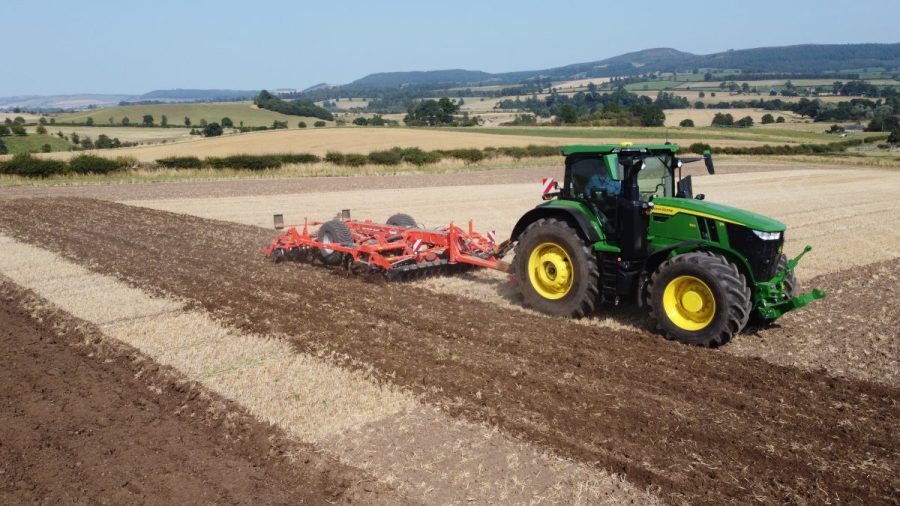
When the time came to replace a 4m cultivator already on the farm, the assumption might have been that a machine of similar size would take its place. Instead, following a demonstration of Kuhn’s Performer Select 3000, Alan opted to move down a metre in working width – a decision he says has delivered greater flexibility without sacrificing output.
“There was nothing wrong with the old machine,” he explains. “It was a good cultivator, but it was simply too big for what we wanted.
“We demo-ed the 3m Performer and found that because we were working at the forward speeds Kuhn recommended, we were actually covering nearly as much ground while still doing just as good a job.”
Instead, Alan found that improvements in manoeuvrability and efficiency more than compensated for the reduction in working width. “Ultimately, we liked what we saw and decided to keep it,” he says. “The biggest advantage is that it’s smaller and more manageable. It’s better on the headlands than what we were previously running and we can turn quicker, which means we’re spending more time working and less time manoeuvring.”
That flexibility extends beyond field performance alone and with a lower draft requirement than the machine it replaced, the Performer Select has also widened the choice of tractors capable of operating it. “We can pull it with a smaller tractor, which gives us more flexibility,” he explains. “We don’t have to rely on one particular tractor, so we can use other machines if required.”
So how exactly does the Performer stack up from a technical perspective? Originally launched as a straightforward alternative to the flagship Performer 1000 series, the Select range now includes 3m, 4m and 5m models, offering growers a more accessible route into one-pass cultivation while retaining the core features of the wider Performer platform.
According to Kuhn area sales manager Marcus Ainley, the Performer was designed as a true one-pass cultivator capable of creating either a seedbed or false seedbed immediately after harvest. “The Performer is Kuhn’s version of a disc-and-tine combination cultivator,” he explains. “Its primary role is to create either a seedbed or a false seedbed in a single pass following harvest. However, it’s also a very versatile machine and can be used in a range of different situations throughout the year.”
While designed as a deep-loosening cultivator, Marcus says the machine’s adaptability allows it to perform a variety of roles depending on seasonal requirements. “You can use it as a traditional stubble cultivator, but equally you can run shallower cultivations if required.
“If conditions dictate, the roller can be removed and the machine used almost like a tine drag to open soils up in the spring without creating excessive consolidation.”
The machine’s layout follows a straightforward sequence designed to maximise soil movement while maintaining residue flow. At the front, twin gangs of cultivation discs chop residues and break up root structures before material reaches the loosening legs. “The discs are there to process the surface material and start the cultivation process,” explains Marcus. “One of the major design features of the Performer is the overall length of the machine, which creates excellent trash flow.”
This becomes particularly important in high-residue situations, he points out. “If you’re cultivating maize stubbles or other high-residue crops, material requires space to move through the machine. The Performer is very difficult to block because of the spacing and overall layout, meaning residues continue to flow through the machine rather than building up around the cultivation elements.”
Behind the discs sit the deep-loosening tines, which are designed to alleviate compaction and create soil movement through the profile.
Something unique to the machine is that Kuhn manufactures all of the wearing metal themselves. “In practical terms, this means the leg itself is drop forged, while the mounting system uses high-tensile steel to provide additional flexibility.”
That flexibility forms an important part of the machine’s protection system, he continues. Although the legs feature auto-reset protection, the mounting arrangement also allows the leg to flex laterally when encountering an obstacle. “The leg can move up to 15cm either side, meaning it doesn’t always have to trip over a stone or obstacle. It can often flex around it, reducing stress on the reset system and helping to protect the machine.”
A range of point options allows operators to tailor the machine to different cultivation objectives. For example, growers seeking minimal disturbance can opt for a narrow loosening point, while wider points and wings create greater surface movement. “Some growers want maximum loosening with minimal soil movement, while others want more mixing and cultivation closer to the surface,” says Marcus. “There’s flexibility depending on what you’re trying to achieve.”
Following the tines, a row of levelling discs redistributes soil before it reaches the rear packer. “The levelling discs aren’t carrying out cultivation in their own right,” he explains. “Their purpose is to level the surface after the tines have passed through, filling in any ridges and creating a more uniform finish.”
Consolidation is then completed by the rear packer, with two options available depending on soil type and the desired finish. The HD roller provides deeper consolidation and leaves a weatherproof finish, while the Double U roller is designed to provide more surface tamping and improved performance on lighter soils. “The choice largely depends on soil type and what the customer is trying to achieve,” comments Marcus.
Back in Yorkshire, the Performer Select completed its first full season on the farm last year. “We’ve been really happy with it,” says Alan. “It did the job we wanted it to do and performed well in different conditions.”
Something he notes as particularly impressive is the durability of the wearing metal. “The wearing parts seem very tough,” he notes. “After a full season’s work we’re seeing very little wear on the points. They’re not cheap, but if they last as long as they look like they will, then they’ll be worth it.”
If there was one feature Alan would add, it would be the ability to lift the legs independently from the rest of the machine, something available on his previous cultivator. But overall, he believes the machine strikes a strong balance between simplicity, performance and practicality. “At the end of the day, it does exactly what we bought it for. It’s simple, flexible and it suits the farm.”
This article was taken from the latest issue of CPM. Read the article in full here.
For more articles like this, subscribe here.
Sign up for Crop Production Magazine’s FREE e-newsletter here.