
With ‘leave alone and minimally cultivate’ in vogue, many subsoilers may be rusting in the nettles. However, while the era of recreational shake, rattle and roll in those lazy, hazy days of summer 1975 is long gone, CPM finds out whether there’s still a case for deep loosening.
“Do what’s necessary, where necessary, and no more.” PROFESSOR DICK GODWIN
By Mike Saull
It’s likely that Dick Godwin will be a name familiar to many farmers across the UK and cultivation experts worldwide. Now a visiting Professor at Harper Adams University, he and colleagues including the late Gordon Spoor nurtured a host of students at what was the National College of Agricultural Engineering and then Silsoe College, many whom are among today’s top machinery manufacturers.
Critically, his view is that the deep loosening fundamentals developed back then haven’t changed. And while today’s arable farmer may wish to leave the topsoil relatively unscathed and stable, soil compaction at any depth will cut production and compromise long-term soil health.
“A compact soil restricts root development, impedes air and water movement, and increases the risk of anoxic conditions,” he points out. “Unless action is taken to counteract compaction, then long-term soil health will deteriorate and consequently yields suffer.”
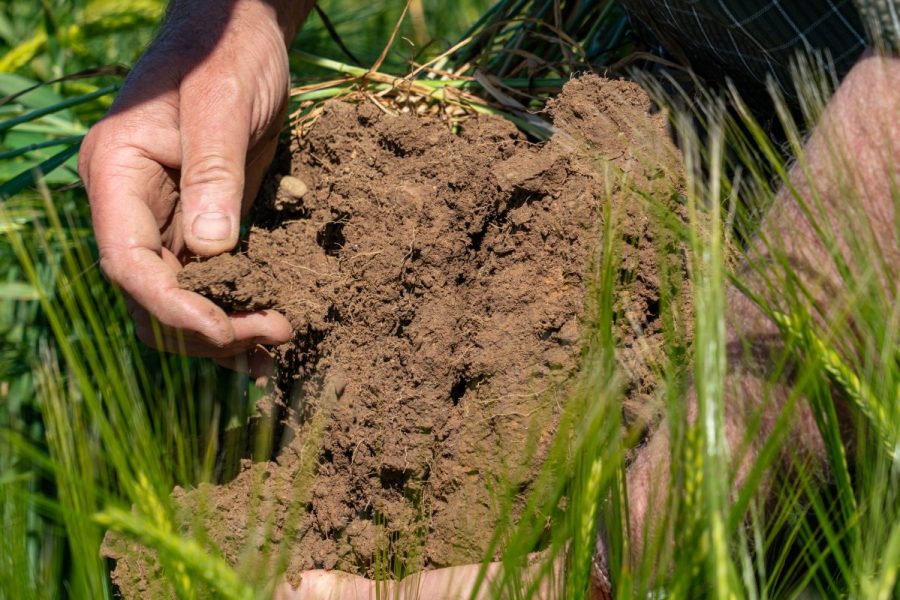
He urges that identification is key and while there may be ways of detecting compaction using remote sensing or penetrometer techniques, Dick believes nothing beats a visual assessment when the crop is actively growing. “We’ve yet to master the digital spade.
“It isn’t difficult to identify areas of poor crop growth in the spring and summer, so check these out looking at restricted rooting, the occurrence of large, difficult to prize apart ‘slabs’ in the soil, and impeded water movement through the profile.
“Sending up a drone can help to map out the extent of these areas, then it’s a case of focusing on putting things right after harvest and before the next crop.”
He suggests that growers should ‘box clever’ when it comes to correcting compaction if they’re practicing minimal cultivation. “Getting it wrong, using inadequate or poorly adjusted equipment, could add to your problems by re-compacting the looser, weakened soil during subsequent field operations.
“Equally, it’s important to have a plan before hitching up the subsoiler and starting to burn diesel. Tillage where it isn’t required causes more damage than good, disrupting natural root and water movement pathways.
“You can also increase surface soil cloddiness, put at risk any well-structured surface soil to depth, and increase waterlogging in situations where subsurface drainage is inadequate.”
To maximize success rates, Dick stresses it’s important to identify the type of soil disturbance required to alleviate the problem at hand. Then, check whether it’s been a success by digging deep again and taking care with subsequent field operations to prevent re-compaction.
He adds that compaction problems occur at different depths, take different forms and require different treatments. Causes may be natural, or, the result of field traffic from machines or animals. Regardless, it’s important to identify their depth and extent throughout the field.
Surface layer problems usually arise through surface trafficking and on weakly structured soils, through soil slumping. Here, more general soil loosening and breakup of the soil units, or a gentle easing of the compacted soil, will allow the natural soil structural units to separate and reopen structural pores.
In other situations, compaction may be relatively localised in the form of a pan because of implement or tyre action at that depth. Here the aim should be to disrupt the pan or create fissures through the compacted zone to allow root, air and water penetration, notes Dick.
Deeper problems usually take the form of more ‘massive’ structural conditions with zones of soils containing minimal or zero macro-porosity. These are commonly caused by very high surface loadings, excessive, untimely soil working, or through natural consolidation over time. In these scenarios, remediation is more difficult, involving reopening of any natural structural pores where they’re present, or securing a more thorough break-up of the large structures into smaller soil units.
While ploughing can remove compaction, successful loosening that creates more minimal disturbance involves kit with narrow tines and a leading foot, plus/minus wings. By using tined loosening at shallower depths, the soil is moved forwards and upwards along a succession of failure planes which develop from the foot tip as the tine passes through the soil.
As the tine works deeper, the resistance to this upward soil movement increases to the point where it becomes easier for the soil at depth to flow laterally around the foot rather than move upwards, which can leave the compacted zone relatively undisturbed and offer a channel through the soil.
The transition depth between these two types of disturbance is termed the critical depth and represents the maximum useful working depth of that tine for soil loosening.
By bolting on wings to the subsoiler leg, more soil can be disturbed and greater depths can be operated at. Wing lift height has a significant influence on soil movement, with the degree of disturbance increasing with increasing lift angles.
Wings also tend to boost the reorientation of the soil units at working depth – the greater their lift, the greater the possibility of tension cracks developing in the disturbed zone above.
In trials, the addition of wings commonly loosens approximately twice the volume of soil, with a corresponding increase in draught of just 20-30%. This means that more compaction is taken out with each pass, and less passes are required across the whole field.
Soil loosening efficiency can be further improved by operating with shallow leading tines which virtually doubles the volume of soil disturbed for little or no increase in draught force. However, Dick bemoans an apparent lack of kit that takes advantage of this effect. “Growers can get around this by carrying out a pre-subsoiling shallow cultivation, but it’s a shame most manufacturers don’t include forward leading tines to the subsoiler frame.”
The degree of soil disturbance and clod size at the surface is affected by the lift height of the wings and the tip width of the subsoiler leg, and this is important for those looking to minimally cultivate and then drill, he adds.
A further convenient way to vary disturbance would be to adjust the existing wing lift height and use shallower wing angles, but again there appears to be little if no commercial equipment available that allows these simple adjustments.
“In order to ensure a good, level soil surface, it’s a case of adjusting tine spacing, using low-lift winged tines and attention to working depth. Choosing kit with narrower tines will also help to minimise surface clod problems,” says Dick.
More seasoned readers of CPM may remember ICI’s/Howard Rotovator’s introduction of the Paraplow – a soil loosener which gently restructured using slanted tines at 45o over which the soil flowed. “This caused a virtually uniform lifting of the soil leaving a near level surface disturbance. We could really do with a machine of that nature available today,” suggests Dick.
In similar fashion, the Flat lift – developed in the 1980s with shallow-lift wings – also reduced soil surface disturbance, posing a major advantage for minimum cultivation. Leading discs operating ahead of the tines of both the Paraplow and Flat lift type subsoilers should help to minimise soil disturbance in addition to cutting surface residues.
Once loosened, soil is prone to re-compaction and in certain instances, one sequence of field operation including mouldboard ploughing with a tractor wheel in the plough furrow, could restore the soil to the same if not greater density than it was prior to loosening, adds Dick.
As a result, growers should consider one-pass systems that incorporate deep loosening, surface cultivation and drilling, using controlled wheelings in a bed management/controlled traffic system, plus lightly-loaded tractors equipped with low ground pressure systems particularly on deep loosened surfaces.
Where set tramlines are in place, utilise these same passageways when loosening, advises Dick. “If you have a map of where tractors and combines have travelled, focus on removing these wheel marks if that’s where compaction is an identified issue. Do what’s necessary, where necessary, and no more,” he concludes.
This article was taken from the latest issue of CPM. Read the article in full here.
For more articles like this, subscribe here.
Sign up for Crop Production Magazine’s FREE e-newsletter here.