
There’s no one-size-fits-all approach to direct drilling, with every farm adapting its establishment strategy to suit its own soils and system. CPM finds out how two arable businesses have taken different routes to achieving consistent crop establishment.
“We wanted a drill that suited our soils and the way we farm and so far, it’s delivered exactly what we were looking for.” STUART TABERNOR
By Charlotte Cunningham
Moving towards direct drilling is rarely straightforward, particularly on heavy clay soils where maintaining consistent establishment can prove challenging in less-than-ideal conditions.
At FRW Farrington & Son near Wellingborough, Northamptonshire, the transition has involved a gradual shift towards regenerative farming, with lower-disturbance establishment, cover crops and soil health forming the backbone of the system. But, as farm manager Stuart Tabernor explains, reducing cultivations is only part of the equation – success also depends on having machinery capable of working reliably within that system.
Farming 295ha of predominantly Hanslope clay, the business grows winter wheat, oilseed rape, winter beans and spring oats, alongside cover crops where opportunities allow. “We generally combine, stubble harrow and drill,” says Stuart. “The business has been moving towards a no-till approach and that’s something we’re continuing to build on.”
Reducing soil disturbance has also become an important tool in managing grassweeds. “We still have blackgrass and we have a bit of a brome problem as well, although that’s something we’re getting on top of,” he explains. “The move towards direct drilling is definitely helping.”
Although the farm had already adopted direct drilling, Stuart felt there was room to improve establishment consistency. “The Hanslope clay didn’t particularly suit a disc drill,” he says. “The discs could create smearing rather than producing a clean slot, so we started looking at alternatives.”
The aim wasn’t simply to replace one direct drill with another, but to find a machine capable of drilling directly into cover crops and surface residues while maintaining accurate seed placement across a range of crops and conditions. “We wanted something that could go straight into cover crops, straight into our stubbles and do a good job,” says Stuart. “Ultimately, you can have the best system in the world, but if you don’t establish the crop properly, you’re on the back foot from the start.”
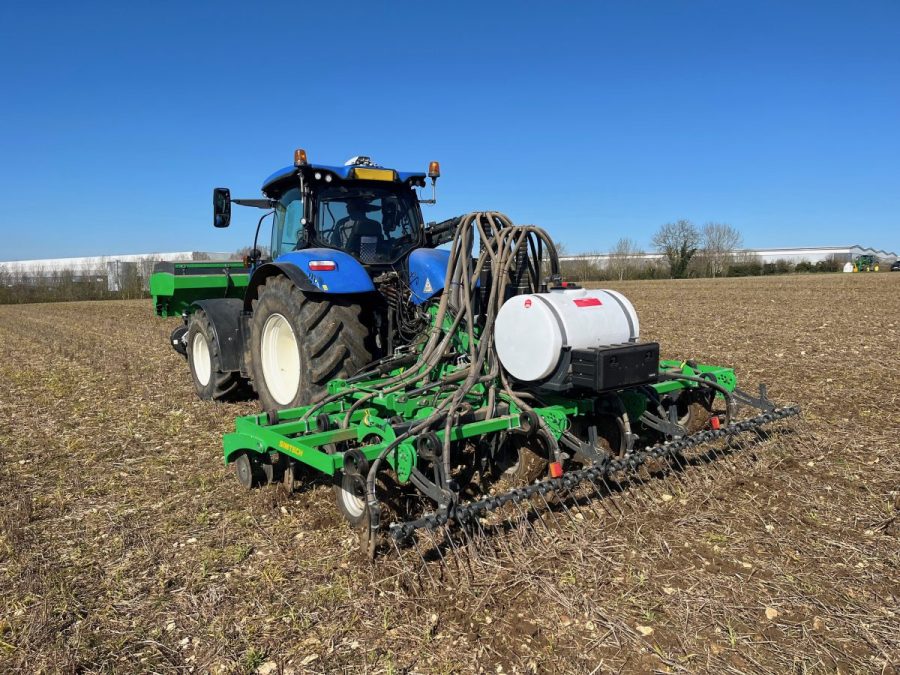
The search led the business to the Simtech TS480, a 4.8m drill combining leading cutting discs with four rows of staggered tine coulters. While Simtech was already familiar to Stuart, it wasn’t initially a brand he’d associated with large-scale arable drilling. “I’d mainly thought of them as a grassland drill manufacturer,” he admits. “It wasn’t until we started researching direct drills more seriously that we looked at what they offered.”
He adds that the coulter design immediately stood out. Rather than relying solely on a disc opener, the TS480 uses leading discs mounted within the frame to slice through residues ahead of the tine coulters, helping create a clean seed slot while maintaining low soil disturbance, explains Stuart. “It was the front discs built into the frame that really appealed. At the time, it was the only drill we looked at that offered that combination.”
A demonstration during autumn 2024 confirmed the coulter concept suited the farm, although exceptionally wet conditions exposed an issue with the original rear-mounted hopper configuration. “It was one of the wettest drilling seasons I can remember,” recalls Stuart. “With the hopper on the back, if the tank was full the drill would sink in wetter patches and we were putting wheat in at around 100mm depth, which obviously isn’t ideal.”
Rather than dismissing the machine, Stuart worked with Simtech to develop a specification better suited to the farm’s conditions.
The rear-mounted hopper was replaced with a front-mounted split hopper to improve weight distribution between tractor and drill, while the rear roller was replaced with four depth-control wheels to improve depth consistency and reduce the risk of the machine sinking in softer ground. The chain on the rear was also swapped for a harrow bar to reduce residue dragging behind the drill. “We ended up with a much better-balanced machine,” he says. “With the hopper on the front and the toolbar on the back, the weight is spread much more evenly, which suits our soils far better.”
The resulting machine arrived in time for the 2025 drilling season and has since established the farm’s entire rotation. “We’ve drilled everything from OSR right through to beans with it,” says Stuart. “Depending on the crop, we’re drilling anywhere between 10mm and 100mm deep.”
The split hopper and twin distribution system also provide flexibility for companion cropping and establishing multiple crops at different seed rates, supporting the farm’s continuing move towards more regenerative practices.
Meanwhile, the four rows of staggered tine coulters provide generous trash clearance, allowing the drill to cope with heavy crop residues and high-biomass cover crops. “Residue flow has been very good,” says Stuart. “That’s important because we’re increasingly drilling into situations where there’s plenty of material left on the surface.”
Power requirement has proved lower than expected, too. The 4.8m drill is operated behind a 185hp tractor, with engine load typically sitting at just 35-40% while drilling. Running at around 1400rpm and travelling at approximately 8kph, the outfit comfortably achieves around 4ha/hour while using roughly 6 l/ha of fuel.
But the main benefit has been establishment. “It was a good drilling season, but the crop establishment was fantastic,” says Stuart. “Everything came through evenly and looked good throughout the year.”
Those establishment benefits are now being reflected in crop performance. At the time of writing (end of July), wheat, OSR and winter beans had all been harvested, averaging around 8t/ha, 3.5t/ha and 3.5t/ha, respectively. “Considering the seasons we’ve had during the past few years, they’re probably the best results we’ve achieved during that period,” he says. “The spring oats, drilled into cover crop, are also achieving around 5t/ha on the AWH10 low input cereals.”
While Stuart is careful not to credit those figures to the drill alone, he believes consistent establishment underpins every subsequent management decision. “If you don’t get the crop established properly, it makes everything harder afterwards,” he says. “Getting that crop away well is one of the most important jobs you’ll do all season.”
He also highlights the aftersales support received from distributors Opico since taking delivery. “It’s been absolutely fantastic,” he says. “Every machine has little snags and questions when it’s new, but anything we’ve needed has been sorted quickly and efficiently. They’re also just good people to deal with.”
As the farm continues refining its regenerative system, Stuart expects the drill to remain central to the establishment strategy. “We wanted a drill that suited our soils and the way we farm,” he concludes. “So far, it’s delivered exactly what we were looking for.”
This article was taken from the latest issue of CPM. Read the article in full here.
For more articles like this, subscribe here.
Sign up for Crop Production Magazine’s FREE e-newsletter here.