

The loss of mancozeb is impacting potato growers not just because of the active’s role in late blight programmes, but for the added benefit it offered in keeping alternaria at bay. CPM explores what lies ahead for this month’s Common Ground.
“Some growers could be missing that alternaria is becoming a significant reason for leaf loss in their crops.” JIM AITKEN
By Janine Adamson
In the main, discussions regarding the loss of multi-site fungicide mancozeb have mostly centred around how potato growers will effectively combat Phytophthora infestans, particularly in the wake of new resistant strains emerging from Europe.
However, while late blight has somewhat stolen the limelight, reports of alternaria have been quietly increasing too, meaning mancozeb’s loss may cause wider implications for overall potato disease management, particularly in terms of the investment now required.
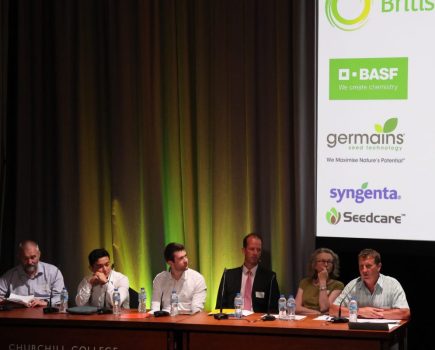
To discuss this topic further, CPM brings together Kings Lynn-based grower, Mark Means; senior agronomist at Branston, Jim Aitken; and BASF’s business development manager for potatoes, Paul Goddard.
Mark runs J S Means (Terrington) – a family business comprising both owned and contract-farmed land, with potatoes forming a significant part of the cropping rotation. Jim works for Branston, one of the UK’s largest buyers, packers and distributors of potatoes.
Double hit
To open the discussion, Paul reminded that mancozeb offered greater value than simply late blight control alone. “It was almost a ‘buy one, get one free product’, because while most people would use it in programmes for phytophthora control, it also had activity against alternaria.
“Furthermore, what it delivered at that price point has been really important, meaning now, farmers have to accept that growing potatoes successfully will likely cost more without mancozeb.”
In agreement, Mark said growers are feeling the pinch of the cost of production. “Previously it’d been quite simple to plan a blight programme that would cover alternaria at the same time. Now we have rather a lot of cost involved in achieving that same result.
“Plus with dual resistant blight and alternaria appearing in unexpected varieties, we require long-term longevity of green leaf area in potato plants to convert to yield to dilute these rising costs. It’s an interesting conundrum given the price pressures we now have.”
Reflecting on the issue of resistance in late blight, Paul suggested it appears to be developing at a quicker rate, especially compared with the quantity of new active ingredients being launched. “In the past13 years we’ve had two new phytophthora actives; if you go back 26 years, then we’ve had five. We’re not seeing new chemistry coming through.
“However in reality, we’d appear to have a luxury of actives for phytophthora – around 12 different modes of action. If we move to alternaria, there are now only three modes of action as one – a multi-site that was probably relied upon a lot – has been taken away.
“With just three non-multi-site actives the risk is going to go up, plus the additional pressure of weather conditions which can make both phytophthora and alternaria control more of a challenge.”
Realities of alternaria
Discussing alternaria specifically, Mark stressed that it can easily rob 5-10% of a crop’s yield potential. “If there’s a drought and we don’t have irrigation, then the crop is stressed and alternaria can come in and piggyback on that stress quite happily.
“We use two different products to control it and keep it back, otherwise you soon lose canopy quite easily. But I think with mancozeb no longer in the picture and limited options remaining, we have to learn more about varietal resistance.”
According to Jim, more of Branston’s growers in Scotland are seeing alternaria across a range of varieties. “In fact last season, it really brought it home that I was trying very hard to find late blight but I just wasn’t seeing it.
“That’s happened a couple of times during the past five years, but what was confusing for me was the symptoms of alternaria versus late blight. They manifest themselves in a way in some varieties, that makes it difficult to tell them apart.
“I think a number of growers could be missing the fact that alternaria is becoming a significant reason for leaf loss in their crops because they’re skewed towards controlling late blight.”
Jim said as a result, alternaria control is steadily rising up Branston’s agenda. “We advise all growers to keep on top of the disease. Yes it adds to the cost of production, but for some of these varieties they can lose 20% of their leaf area approaching maturity. That’s quite common towards the end of the season when the crop should be bulking rapidly.”
In response, Paul added that when talking to agronomists, the one disease attributed to stripping crops is alternaria, not late blight. “They say when you have it in the crop, it’ll run as quickly as anything yet it’s the disease that people have been perhaps over-looking.”
Fungicide solutions
Considering what’s available to successfully control alternaria in the absence of mancozeb, Paul highlighted Belanty (Revysol/mefentrifluconazole). “Belanty is a specialist fungicide and what makes it different compared with its sister product in cereals, is that it’s a SC (suspension concentrate) formulation specifically for potatoes, maize, legumes and vegetable crops.
“Also, it has a very useable label giving the grower full control to start from BBCH20, and has a short gap between applications with a very short harvest interval.”
For alternaria control, Paul stressed that Belanty is best positioned as the first spray. “Doing this gives the maximum flexibility according to FRAC guidance, which limits the number of QoIs and SDHIs to no more than 50% of the total programme.
“If you start with one of these then you’re committed to an even number of sprays, whereas starting with Belanty gives full control all of the way through.”
Paul added that having previously conducted potato leaf sampling in East Anglia, both QoI and SDHI resistance was observed in the alternaria populations. “So it’s a watch-out. We’ve shown we can manage resistance in the population with the modes of action we have available, the key factor is alternating chemistry.”
Mark explained he’d undertaken a recent trial on a crop of Markies, comparing Belanty with a competitor product by measuring green leaf retention and canopy persistency. “I’ve had experience of the active ingredient in cereal crops and know it’s a good DMI and works well. I’d say it’s a very useful string to the bow.”
Aside from controlling alternaria, Paul raised that Belanty also helps to reduce black dot. “Black dot management is very important for packing potatoes for good skin finish, and it can also be important in some processing varieties as a factor in potato early dieback disorder.
“If you can help to manage that through a programme you’re already using to control another challenge in the crop, then it’s efficient and helpful, and brings greater value.”
Integrated disease management
While discussing control techniques beyond chemistry, Mark commented that the goal is to simply avoid triggering alternaria in the first place. “Although there are environmental conditions such as humidity and day temperatures, you also have general plant health – is it well fertilised? Is it stressed? Is there good rooting?
“Aiming for a happy plant in the first place that it doesn’t increase the trigger of alternaria is one means of being preventative.
“No matter what, attention to detail is paramount without compromise; this involves planning the potato crop 5-6 years before it’s planted. If you’re not happy with the soil structure, drainage or fertility of that field, simply don’t put it into potatoes.”
Paul added that being aware of the limitations of specific varieties, such as Markies, is also important. “You’ll have alarm bell varieties which are where people mainly focus their attention. But equally you have to watch out; what variety comes next that you haven’t seen alternaria in before?”
Jim highlighted that in terms of integrated management, he believes generally speaking, the industry can be too hard on itself. “We have to remember where we came from in the 1960s and 70s – modern products are much more specific in their targets. We’ve come a long way and done well.
“Therefore, I think we require all of the knowledge and experience we can gain from natural systems, whether that’s biostimulants, fungi or bacteria, plus we still need the best chemistry available. This helps us to augment what we’re doing to get the best results in a holistic way. I don’t believe we can have one without the other in the short term.”
Future markets
Shifting to discuss current demand, Mark raised that because sales of 2025 potatoes have been struggling, there could be volumes dumped or stored for stock feed, meaning a potential increase in inoculum from outgrade piles – an additional concern regarding disease and virus control in the potato crop.
According to Jim this is unsurprising given demand for UK-grown potatoes appears to be heading in one direction. “A message I’m putting out to our growers now, is don’t consider expanding your area or tonnage because the long-term decline in fresh consumption continues.
“The key is to build your long-term programme around a slight reduction in tonnage, while focussing on getting more potatoes into the pack and fewer into the outgrade pile. That’ll inherently separate the professional and good growers from the rest – that’s my personal view.
“We don’t require more growers, rather we need all growers to get the best out of every hectare,” he concluded.
This article was taken from the latest issue of CPM. Read the article in full here.
For more articles like this, subscribe here.
Sign up for Crop Production Magazine’s FREE e-newsletter here.