
Shallower working that shifts less soil can bring significant benefits in terms of soil health, yet doesn’t necessarily have to compromise production. CPM talks to a leading potato consultant for the low down.
“The amount of fuel you burn on the tractor often correlates with the amount of soil damage you do.” Dr Mark Stalham
By Mike Saull
While the somewhat ‘smash and grab’ approach to potato production may be counterintuitive to efforts applied to improve soil health in other crops in the rotation, there’s plenty that can be done to minimise the impact without compromising yield, suggests potato consultant, Dr Mark Stalham.
Yes getting the crop into a well-formed ridge requires plenty of soil movement, but when it comes to cultivations, it’s a case of doing so in the least intensive manner, he adds. This should include operating to a minimal depth, leaving as much of the soil untouched as possible and working the ground under conditions and in a way that creates as much stability as possible.
Mark points out that trials using lower intensity destoning with shallower, faster, wider-pitch webs or stars, suggest it’s possible to cut cultivation costs and speed the planting operation without compromising yield.
“All it takes is closer attention to detail, a willingness to try, and a change in mindset,” he raises. “And don’t underestimate the role of the potato crop in the rotation where it’s possible to correct structural issues created by reduced-tillage cereals.”
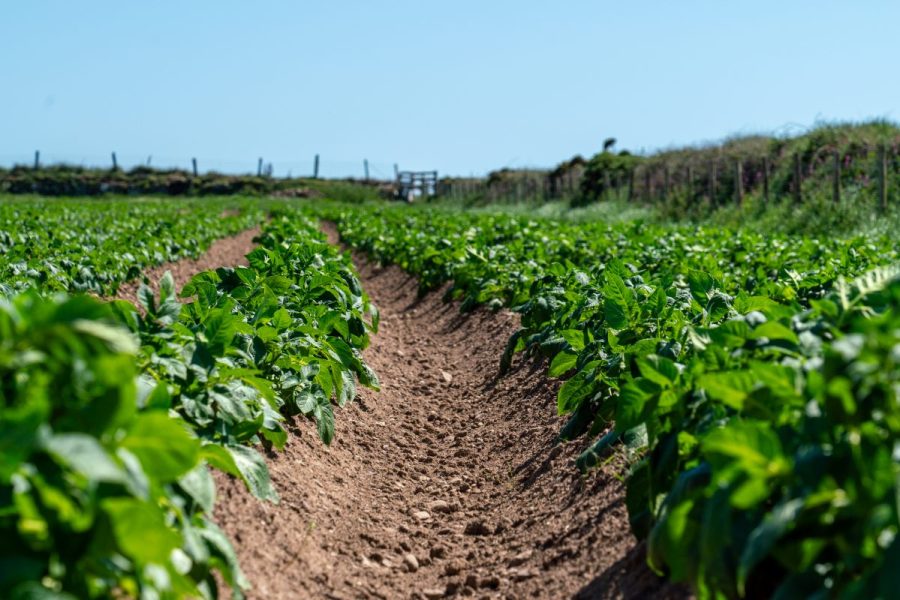
So, what’s the ideal ridge for potato production? Quite simply, it’s one with sufficient soil volume to grow and contain the crop tubers with minimal greening, says Mark.
“With only 3-4% of ridge volume occupied by the tubers for typical yields, growers should ask themselves why they’re shifting such large volumes of soil?”
Adequately sized ridges – with a 1100-1200cm2 cross-section – can be formed from as little as 25cm of soil, even in moderately stony scenarios. Equally, potato seedbeds should be compaction-free, especially 25-30cm below the ridge apex, and be porous and free-draining.
HARVESTER PERFORMANCE
Ideally, there should be 5-6cm of loose soil below the seed tuber, then a layer of firmer but not compacted soil, to allow the harvester to work to a consistent depth without slicing tubers. At the same time, the ridge should be stable and not prone to wind or water erosion, water-induced slumping or gravitational settling.
Mark argues that since World War II, when the UK recognised the demand for self- sufficiency, growers have been farming too hard and destroying the productivity in soils. “As a result, we’ve been growing too many crops such as potatoes, carrots and onions on productive, irrigated, sandy soils in a 7-8-year rotation, which all require intense seedbed cultivation. The damage has been done and soils and production are barely sustainable.
“Now we’re starting to reverse the decline using regenerative techniques, and there’s plenty more we can do to build improvement into our soils and potato crop production methods.
“This is particularly important on our lightest, sandy soils. Here, it’s very easy to put the pedal to the metal and move earth deeply just because we can, but this de-stabilises soil and reduces its resilience to recover from damage.
“We must recognise that it takes time to build organic matter in these sandy soils even to low levels of just 2.5-3%, and in some rotations, if it wasn’t for the combined approach of organic matter amendment and use of cover crops, they’d hardly be viable anymore,” he stresses.
Mark points out that cover crop roots aerate, allow water to drain over the winter and reduce nutrient leaching. However, the wrong choice before potatoes can be painful, he warns. “Growers will have to spend more time experimenting with and managing different cover crop regimes to ensure they work.
“Farmer attitudes have changed and if push came to shove, most would carry on with regenerative measures including a cover crop, even if commercial support and SFI payments weren’t available,” he believes.
Mark adds that that cover crops keep soils living for longer during the wet winter periodand by maintaining the cover crop root channels for as long as possible, soils are better drained to greater depth. “The contribution of roots to the below-ground active carbon pool is often underestimated compared with the above-ground biomass.
“Best practice is to establish cover crops early by drilling in August or early September, and the aim is to maximise below ground biomass using a mix that provides shallow rooting, well-branched roots and plenty of thicker, vertically-orientated roots, over the relatively short growing period.
“Mixes cut risk, but utilising complex multi-species blends can be over the top and difficult to manage; you’re never quite certain what’s going to grow and what will fail. It’s also important to avoid species such as stubble turnips or chicory that leave residues that cause soil flow issues on destoners. Bamboo-cane like kale stalks can also create issues for the destoner or bed-tiller,” says Mark.
Cover crops should be terminated well ahead of primary cultivation; ideally in January or early February to allow the dying roots to detach from soil aggregates and create voids in the soil, he advises. “The aim is to make the most of this added porosity and improved drainage that cover crops deliver to allow us to cultivate soil to the required depth when it’s in a state that minimises the risk of damage.”
Then, the ideal moisture content to form beds is when the soil state is just below field capacity and in the friable range. The more air added into soil, the lower the plastic limit – the minimum moisture content at which the soil becomes likely to smear or compact. Cover crops can effectively allow working to around 2-3cm deeper, without creating damage, he highlights. “They help tremendously: it’s difficult to dry soil to 25cm depth through natural evaporation alone from the soil surface.”
According to Mark, cultivation following cover crops is key and growers should start shallow – at 5-8 cm – then work deeper to create sufficient tilth to form ridges and allow flow through the destoner. Cover crops can also reduce bed-tilling ahead of destoning in heavier soils, he points out.
UTILISING SKILLS
Most contractors employ operators that are more than capable of adjusting cultivation, destoning and ridging kit to accurately work within a 2-4cm range of depth, and these skills should be used accordingly, advises Mark.
“In a cereal crop system, you’d look at every operation and try to find ways of getting rid of at least one-pass or more with the cultivator. If you reduce the destoning depth by 3-4cm in the potato crop, that’s the equivalent of removing an operation from the establishment process of many other crops.
“Remember that the amount of fuel you burn on the tractor often correlates with the amount of soil damage you do. Putting energy into moving soil is damaging and if you plough, rotovate and then bed-till very deeply using a 400hp tractor, you’ll significantly damage soil health in the long-term.
“The less we do and the coarser the seedbed, the more resistant the ridge to slumping when water comes along. While many think that creating smaller ridges will exacerbate greening, we’ve found the opposite because the ridges are more stable so collapse less.”
A RETHINK
Typical destoned ridges can contain 1200cm2 of soil, but there’s no reason why 80-90t/ha crops can’t be grown with minimal greening in just 900-1000cm2, suggests Mark. Often as much as 3000cm2 of soil is moved, frequently more than twice, to create such a ridge – that’s three times the amount of soil in the ridge itself.
“Our target should be to only till half the soil we currently move. By operating to 30cm depth – that’s a big profile – we almost produce so much soil we don’t know what to do with it,” he notes.
Based on research, Mark’s view is that soil shouldn’t be cultivated deeper than is necessary to produce destoned beds, and that producing a good ridge based on a 27-28cm depth of worked soil is achievable.
“We’ve found that destoning deeper than 35cm on sandy soils and deeper than 28cm on heavy soils will result in reduced yields. In addition, producing beds as shallow as 25cm won’t affect planting depth or time from planting to emergence; it also allows for soils to be cultivated closer to their optimum moisture content.”
Critically, most destoners lose 10-20% of the soil entering the front of the machine. Much of this falls out of the sides, either ahead of the intake share or out of the intake stars or shares. The key to avoiding this is matching bed profile and height to the required destoning depth, explains Mark.
Shallower destoning requires shallower, flatter-topped beds. Once destoned beds have been formed, further soil loss occurs on the planter. Equally, deep destoning results in very loose soil which requires high pressures on planter hoods to stabilise the soil in ridges. This extra pressure often results in soil capping, delayed emergence and soil cracking leading to increased greening.
Shallower destoning – with wider-pitch webs and/or wider star gaps and avoiding bed-tilling – leaves soil with larger aggregates which require less compression to stabilise ridges. This is turn leads to less erosion and slumping of ridges and fewer green tubers, says Mark.
“In our trials, shallower cultivation has no negative effect on yields, and in heavier soils, some very significant improvements in yield,” he highlights. “In addition, seedbeds can be made appreciably coarser and shallower than current practice before any significantly increased risk of common scab or greening.”
Destoning shallower is a faster operation and there’s a wider weather window to operate in; in addition, labour and fuel costs are lower. It reduces the wear on machinery and results in lower repair and depreciation costs and decreases the chance of breakdown during the planting season, notes Mark. “We’ve also found that cultivation depth has little effect on nitrogen mineralisation, crop uptake, fertiliser requirement or input costs.
“By gradually increasing the depth of destoning on heavier soils, operators should be able to observe the sudden change in soil being placed in the furrow, indicating where they’re close to the critical depth.”
When it comes to harvesting, providing the kit is adjusted to take into account the shallower ridge depth, bruising is generally unaffected, except on very stony soils where destoning deeper may have to be accepted.
SPOT TREATMENT
Highly stony areas of fields – for example, greater than 30% stones – are usually identifiable from stone content on the surface and can be ‘spot’ treated accordingly to reduce mechanical damage to both tubers and harvesters. There’s no reason not to destone at shallower depths in less stony areas though, suggests Mark.
Large savings in labour costs can be made through 20-40% faster work rates and there are also significant savings in fuel of around 20-30% by cultivating and destoning beds shallower than is currently being practiced.
“In trials we’ve also seen that there’s a value of 3-5t/ha from the majority of the cropped area being planted in a more ideal weather window which can result from destoning when soil conditions are optimal.
“Where there are concerns and more soil may be have to be moved, then growers should consider zonally tilling – equally if they can leave the soil alone, why not just loosen under the tuber?” concludes Mark.
This article was taken from the latest issue of CPM. Read the article in full here.
For more articles like this, subscribe here.
Sign up for Crop Production Magazine’s FREE e-newsletter here.