
Potato yields are down not just in the UK but across Europe, posing a significant threat to supply. CPM looks at what can be done to optimise the quality of what’s being lifted.
“Dormancy break can be expected to occur up to a month earlier this year than might be expected in a typical year.” ERIC ANDERSON
By Andrew Watts
It’s too late to influence potato yields this year, but there’s still plenty that growers can do to protect quality, believes industry expert, Eric Anderson.
Eric, principal advisor for Grounded Agronomy, says bruising and tuber turgor are his main concerns. “Experience in 2025 showed that crops under soil moisture stress at haulm destruction were more vulnerable to bruising at lifting than where moisture stress was limited prior to burn down,” he adds.
Bruising damage can be internal or external depending on impact severity and other tuber factors, namely temperature, dry matter skin set and tissue condition. Whereas superficial damage such as scuffing, splits, cuts and gouges can be removed at harvest, internal bruising may not show until later. It can also be made worse during store loading and unloading, he raises.
“Tuber turgor is central to managing this risk. High turgor, often caused by excess moisture after a dry period, can increase the risk of shatter bruising and cracking. Low turgor, caused by a prolonged lack of moisture, makes the tissue more compressible and increases the risk of blackspot,” explains Eric.
Some varieties are more susceptible, for example Maris Piper, but in all cases soil moisture levels should be managed carefully after haulm destruction. “Moderate soil moisture status helps tubers enter harvest and storage with more stable internal pressure and better resistance to vibration, drops and conveyor impacts,” he adds.
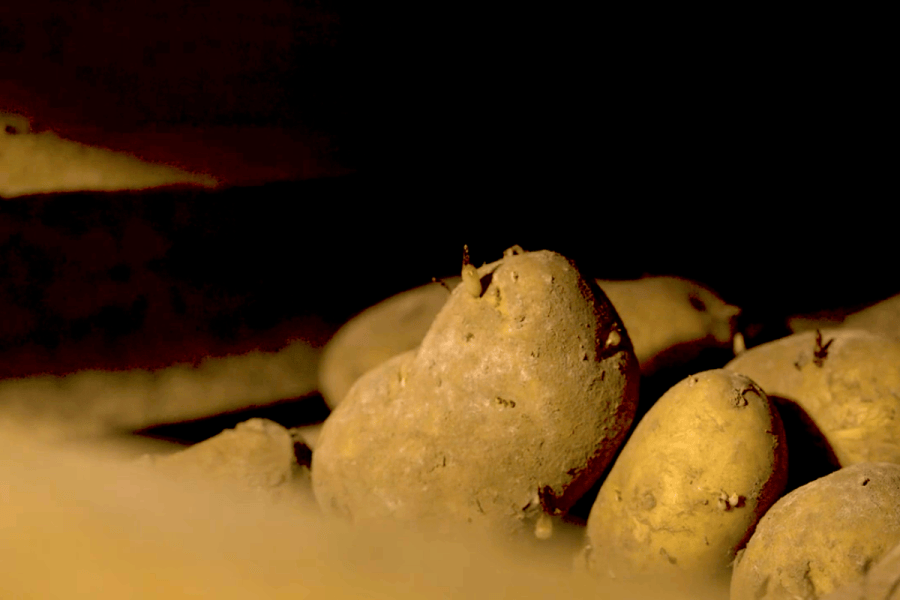
Another issue that’ll require monitoring closely because of the hot and dry summer will be dormancy break. Potatoes housed in older stores with less efficient fridges or processing crops – which are often stored at higher temperatures – are at greatest risk.
“Dormancy break can be expected to occur up to a month earlier this year than might be expected in a typical year; reducing temperatures to 3oC slows this process,” raises Eric.
MH TAKE-UP
Pre-pack and processing growers are likely to have applied a sprout suppressant such as maleic hydrazide, and just how well it was taken up will influence dormancy break, he says.
“Stores will require inspecting regularly so that any dormancy break is spotted early. This will allow re-application to be timed appropriately, which is when 20% of tubers are at first white spots visible. This approach will maximise the time between applications and reduce costs during the season,” notes Eric.
Exactly what treatments growers choose is likely to be dictated by the intended marketing strategy, as harvest intervals differ between products. “It’s worth discussing the options with your adviser or contractor. 1,4-dimethylanaphtalene (DMN) has a 30-day harvest interval, while that for spearmint or orange oil will me shorter,” he comments.
Discussing maleic hydrazide (MH) performance further, its likely to have been compromised this season, especially in droughted or non-irrigated crops, notes Jon Kemp of Mercian. “In many cases, MH wasn’t applied, and where it was, we don’t know whether it worked.
“Those crops also died off quickly, so in terms of life cycle, the potatoes have already physiologically aged 4-6 weeks more.”
Hitting processing specification on some of these crops is likely to be a challenge with smaller tubers, he adds. Therefore, Jon advises growers to think carefully about whether unirrigated crops will long-term store, even if they will hit specification and the financial incentive is strong.
“Some customers might have sympathy particularly if there’s a shortage, and be able to bend sufficiently if things go wrong, but in some smaller grower groups it could be difficult. Be realistic and prioritise crops for early movement.”
Short-term stored crops that will be moved by Christmas might not require any sprout suppressant treatment, he raises. “Take a ‘wait and see approach’ but if there are any signs of movement, apply orange oil (as in Argos).”
The advantage of Argos over DMN in that situation, is its speed of activity. “It works within a couple of hours so there’s no loss of efficacy once you start venting the shed to bring temperatures down, whereas with DMN, it will be blowing it out of the shed.”
Where crops will be stored until at least January, he advises bringing down temperatures as quickly as possible once the crop is dry and then treating with DMN immediately, and following up with another 20ml/t application four weeks later.
Experience from a not dissimilar season in 2025 highlighted the importance of getting protection on early. “It’s going to need it because from March we had significant issues with internal sprouting and trying to keep the crop dormant.”
Irrigated crops should have fewer problems, particularly where MH was applied, but Jon still recommends treating those destined for long-term storage as quickly as possible because the impact of the summer heat is unknown.
“MH applications will mean they should store better with no internal sprouting,” says Jon. “I think all sprout suppressants require MH to make them effective.”
Growers storing potatoes for the pre-pack market often rely on MH and low storage temperatures to control sprouting, at least for short- and medium-term storage, notes UPL’s Geoff Hailstone.
“But with lower MH levels in tubers, that might not be sufficient this year,” he suspects. “Where it’s a shorter dormancy variety or in longer-term storage, store managers are almost bound to require orange oil, possibly at the start if potatoes have already sprouted, or at the end.
“If rots appear and you have to unload quickly or there’s a marketing opportunity, you can do it after 48 hours following treatment with Argos, while it’s common practice to leave stores ventilated for 7-10 days with mint oil because of the risk of taint,” comments Geoff.
Steve Edgley of Nightlayers Farm in Chatteris, Cambridgeshire, applies orange oil during the latter stages of tubers that are stored long-term. The farm’s 200ha of potatoes are split approximately 50:50 between those that are lifted ‘green-top’ from June through to around October for immediate movement, and crops stored from November through to June.
Potatoes destined for storage are treated in-field with MH, including non-irrigated fields. “Everything we applied MH to was green, so I’m happy that it was taken in,” he comments. “We put a lot of detail into feeding crops with nutrients because even if they’re not getting water, they keep producing with feeding.”
Longer-term storage is in two 1500t ambient temperature box stores kept at 9oC, and a third 1000t refrigerated store at 8oC. All are treated initially with DMN once potatoes have been cured and dried down, with further treatment 4-5 weeks apart as required.
HOLDING PERIOD
Once unloading has started, a switch will be made to orange oil, or less often, mint oil, says Steve, because of the much shorter holding period.
“We’ve had good results with all three products, but Argos comes into its own when we come out of using DMN [because of its shorter 48 hour holding period].”
Considering the broader impact of the challenges experienced this season, Europe is on course for its smallest potato crop on record (including seed and starch crops), due to the lower yields incurred by the drought and successive heatwaves of summer 2026, combined with a smaller planted area.
Analysis by the Energy & Climate Intelligence Unit (ECIU), a non-profit organisation that supports informed debate on energy and climate change issues in the UK, suggests this summer’s weather will knock around 3.11M tonnes of the potato harvest in Germany, France, Belgium and the Netherlands. Collectively, these four countries – often described as the ‘North-western European Potato Growers’ (NEPG) – account for more than half of total EU production.
Separate analysis of Great Britain’s potato crop suggests a loss of roughly 0.44M tonnes, bringing the total for NEPG+GB to more than 3.5M tonnes in reduction.
These estimates of lost production are based on comparisons with the five-year average, with yields 13% lower in France, 21% in Belgium, 10% in Germany and 7% in the Netherlands. This is in addition to the estimated 3.6M tonnes already lost across the four countries due to the 2026 lower planted area. The NEPG puts the crop area for 2026 at 521,500ha (excluding seed and starch), a drop of 82,700ha compared with 2025. In a statement, the NEPG warns that buyers will have to revise specifications or accept a lack of supply.
“Export customers may also have to adapt their usual specifications and expectations, particularly regarding tuber size and length. Availability of the larger and longer potatoes they’re accustomed to sourcing will be more limited this season, requiring greater flexibility in terms of product specifications,” says the NEPG.
These assessments have been estimated using a combination of grower test digs, national statistics and trade estimates. Although similar data doesn’t currently exist for Great Britain, the ECIU references trade publication World Potato Markets, which estimates yield in line with the drought year of 2018 – 11% below the 2021-2025 five-year average.
The publication also highlights the demand for more investment in private water storage and overall water management, whether that’s conserving water when there’s too much, or irrigating during dry periods.
ECIU reports that the trade expects an EU potato crop of 19.5-20.5M tonnes, a decrease of around 27% compared with 2025’s record 27.3M tonne crop. In response, market prices have increased dramatically – Belgian free-market potatoes have moved from zero in April to €200/t or more; German processing potatoes are making €240/t against a season low of €15 in June; and British processors are paying more than £300/t to secure supply against what was £180 in February.
This article was taken from the latest issue of CPM. Read the article in full here.
For more articles like this, subscribe here.
Sign up for Crop Production Magazine’s FREE e-newsletter here.