
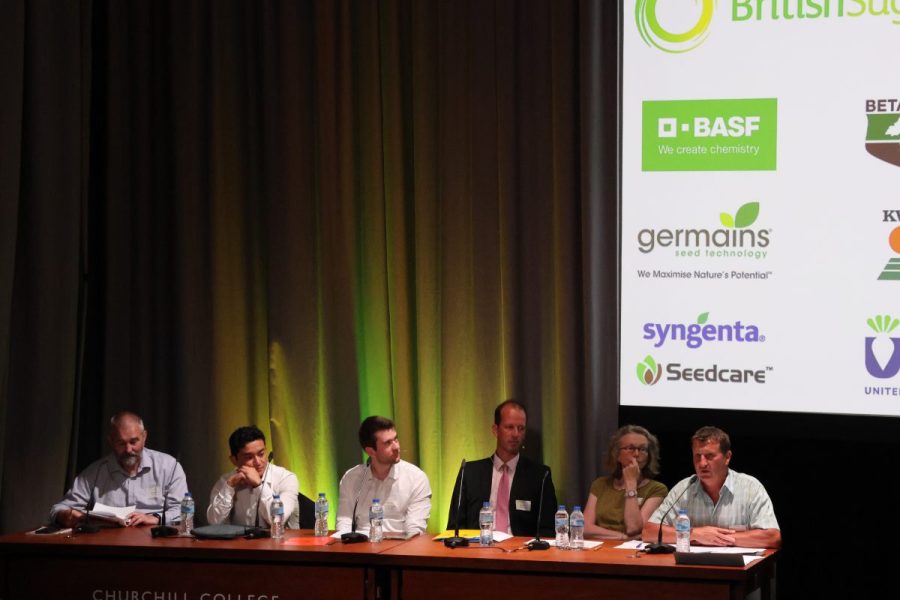
Research from around Europe was presented at the 80th IIRB sugar beet research congress held in Cambridge recently. CPM reports on some of the key lessons for UK growers.
“We have to start thinking about resistance management for variety traits as we do for fungicides or herbicides.” WIBKE IMGENBERG
By Mike Abram
Six sessions, more than 30 presentations and 110 posters at the 80th International Institute of Sugar Beet Research congress highlighted the breadth of ongoing work to ‘advance sugar beet in a dynamic environment’.
Much of the research presented at the congress, held in Cambridge, is being conducted on mainland Europe, giving the opportunity for the UK industry to learn from colleagues across the channel without necessarily having to repeat the same experiments, or perhaps even mistakes.
One example could be from the Austrian experience of using cercospora-resistant varieties. Wibke Imgenberg, a project manager at Agrana Research & Innovation Center provided a classic case study of how quickly varietal resistance could be overcome by the disease pathogen.
She explained that Austrian sugar beet growers faced high pressure from cercospora. Mostly grown in the northeastern part of the country, the western part of that region had higher rainfall leading to up to five applications of fungicide. In the drier east, up to four applications were sprayed, unless irrigation was used, when up to six sprays could be required.
“We’re mainly limited to azoles,” she said. “There are some products with other active ingredients combined with azoles, but we’re not able to do a real active ingredient rotation, which is the reason why copper is routinely added.”
VARIETAL RESISTANCE
Prior to 2021, when the first resistant variety was introduced commercially, all varieties were susceptible to the disease, she highlights. “In trials, the resistant variety showed virtually no symptoms, even under high disease pressure,” said Wibke.
Not surprisingly, the resistant varieties were quickly a commercial success, with 60% of growers choosing one in the high-pressure wetter west, and more than 30% market share in the irrigated region.
In the first two years, the resistant varieties demonstrated delayed cercospora symptom onset and 20-30% higher yields than standard varieties, but their effectiveness proved to be short-lived, explained Wibke.
By 2023, in a region close to the Danube River characterised by significant disease pressure because of high humidity and warm temperatures, the first severe cercospora symptoms were seen on resistant varieties. “That was the warning shot,” she said.
Then in 2024, varietal resistance broke down, when an extremely warm spring led to disease detection two weeks earlier than usual, with resistant varieties showing the same symptoms as standard varieties, and the yield advantage shrinking to just 6%.
SHIFTING THREAT
The following year confirmed the breakdown wasn’t just a temporary weather effect, with resistant varieties showing similar performance to standard ones. “We were surprised how fast cercospora adapts,” she said. “The most important lesson is there’s no single solution. We have to start thinking about resistance management for variety traits as we do for fungicides or herbicides.
“But we also wonder if we should somehow control cropping densities – could we slow down development by establishing a more moderate crop density of resistant varieties, especially in high pressure situations?” she asked.
Other key mitigations that in hindsight should have been used more were better use of tools, such as tillage and rotation to reduce disease inoculum and avoiding excessive reductions in fungicide use.
“In the beginning, farmers reduced fungicide use, but now we recommend they use the same programmes on both resistant and susceptible varieties.”
In the session on current weed control research, Christine Kenter from the Institute of Sugar Beet Research (IfZ) addressed whether variety trials accurately assessed the true yield gap between conventional and Conviso Smart herbicide-tolerant varieties.
In Germany, its Recommended List-equivalent trials series suggested Conviso Smart varieties carried a relative white sugar yield penalty of 3-9% when compared with the mean of all tested standard varieties.
But these trials are all treated with a standard herbicide programme, whereas one of the potential advantages of the Conviso Smart system is that there’s very little phytotoxic effect on the tolerant beet plants when treated with Conviso One (foramsulfuron+ thiencarbazone-methyl).
That led to IfZ comparing classic herbicide programmes against two 0.5 l/ha applications of Conviso One on seven Conviso Smart varieties and two standard varieties without herbicide tolerance, across 28 trials in three seasons, said Christine.
The results showed that on average, there was a 4.3% improvement in white sugar yield when treated with Conviso One rather than classic herbicides, which, at least partly, balanced the current genetic yield penalty from growing tolerant varieties.
Conviso One was used alone in these trials, she noted, but that’s not advised for resistance management reasons. “So we have to find out what the yield response is to using Conviso One in tank mixtures or in combination with additional active substances. This is work we started this year,” she concluded.
The resistance management message was pertinent, given a survey by the IIRB’s weed control subgroup suggesting that resistance to ALS herbicides was being demonstrated by at least 14 different weed species across Europe.
In the UK, ADAS weed scientist John Cussans warned that sulfonylurea herbicide resistance in broadleaf weeds is likely underreported, partly because of the lack of testing. ADAS tests roughly 100-300 grassweed samples a year for resistance, he said. “For broadleaf weeds it’s often less than 10.”
That’s despite the most common application to a cereal crop being a sulfonylurea herbicide applied alone, creating significant selection pressure around the rotation for that type of chemistry. “In sugar beet, you bring in a crop that’s tolerant to this type of chemistry, and suddenly the problem is manifested,” he said.
More testing is required to help growers understand the nature of their weed populations to help tailor management of such ALS-tolerant crops, he stressed.
MOLECULAR DIAGNOSTICS
Traditional pot tests have been available for some time, where test plants are grown from collected seed to a specific size and then sprayed to assess sensitivity levels. But collecting seed from broadleaf weeds, including poppy, chickweed and mayweeds is difficult, said John, while the test is slow, expensive and difficult to scale.
That makes using molecular diagnostic tests on DNA extracted from leaf tissue an ideal solution, he proposed. The test has a rapid turnaround and the advantage of being able to test for specific mutations that caused resistance to different ALS herbicides, said John.
Leaf tissue testing for resistance has then been trialled as part of a joint British Sugar / BBRO / ADAS project on 20 poppy populations collected from fields with sugar beet in the rotation, where resistance was suspected.
Eighteen of the 20 showed some level of resistance to one of the mutations, noted John. “It does reinforce the message around the prevalence of resistance being higher than previously found, and that we’re not doing enough testing.
“It also reinforces the need to understand the resistance situation on-farm before the adoption of ALS-tolerant crops.”
Südzucker’s Dr Peter Risser suggested proactive resistance management is essential as reactive measures after resistance has developed are often less effective and more costly.
That might include incorporating mechanical weeding when growing Conviso Smart varieties, alongside other integrated weed control measures, such as combining Conviso One with other treatments, considering when and how to use ALS herbicides in other crops in the rotation, and cultural controls, such as tillage before drilling.
“It all leads to higher costs,” he noted. “But I’m convinced that we’ll come back to mechanical weeding where possible because this is a real break of resistance.”
This article was taken from the latest issue of CPM. Read the article in full here.
For more articles like this, subscribe here.
Sign up for Crop Production Magazine’s FREE e-newsletter here.