
Technology will play a key role in helping Elveden Farms to use water and fertiliser sustainably in the future, as CPM finds on a tour organised by AgriTechE.
“Having data that shows you where roots are active is incredibly valuable in maximising profitability from the amount of water available.” PETER WHITE
By Mike Abram
A £4.5M investment in a new reservoir is just part of Elveden Farm’s approach to keeping its root crop production sustainable as the pressure on agricultural water and nutrient use continues to increase.
The government’s National Framework for Water Resources 2025 makes it clear that agriculture will be expected to improve efficiency, develop more resilient local supplies and, in some catchments, prepare for the possibility of reduced abstraction where current use is judged unsustainable.
Nutrients use is heading in the same direction. The Environment Agency’s latest assessment of agriculture’s impact on water emphasises the need for tighter nutrient management, better soil stewardship and more targeted use of technology to reduce losses while maintaining productive farming systems.
LESS WATER
Those policy drivers haven’t been lost on Elveden Farm’s senior farm manager Nick Scantlebury. “We know the Environment Agency is wanting to take water away from agriculture, and we feel they’ll be reducing our groundwater sources. Reductions could be anywhere from 5-20% by 2030,” he suggests. “So we have to do the same job, or probably a better job, with less water in future.”
That’s likely to see further shifts towards switching poorer performing land into environmental stewardship schemes or other sources of income, while getting the same tonnage of produce from a smaller area, using fewer inputs in terms of water, fertiliser and sprays, he adds.
However, it’s certainly not a new goal – Elveden has worked to improve its water management for the best part of 30 years, notes Nick, but the developments in collecting, analysing and using data for decision making is opening new opportunities for further improvements.
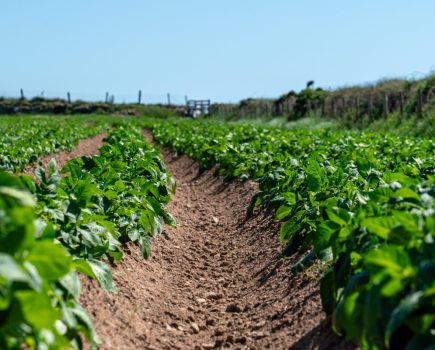
The farm currently uses around 42 litres of water to produce 1kg of potatoes across its 550ha of production, with each hectare typically receiving around 250mm of irrigation in a season depending on rainfall.
Quality, then yield, are the key drivers for irrigation use, highlights Nick. On the packing side, both salad and main crop potatoes are irrigated for scab control to achieve a clean skin finish, while on the processing side irrigation is used, but slightly less intensively, to ensure the product McCain receives is consistent in shape and size.
While checking with a fork remains crucial, Nick uses at least one probe per veg crop field installed by Soil Moisture Sense, together with a secondary check on designated fields using the irrigation scheduling decision support model developed by Mark Stalham Potato Consultancy, to drive decision making.
UNDISTURBED
Soil Moisture Sense’s probes have six sensors spaced at 10cm intervals on a 60cm moisture probe, starting at a 5cm depth. Unlike many other probes, installation doesn’t disturb soil, with a hole drilled with a tapered auger for the similarly tapered probe to be pushed into, explains Tim Blyth, director of Soil Moisture Sense.
“We’re then reading exactly the same soil structure as the rest of the field,” he comments. “So we can be confident that when water is coming in from the top, it’ll be behaving the same as elsewhere in the field.”
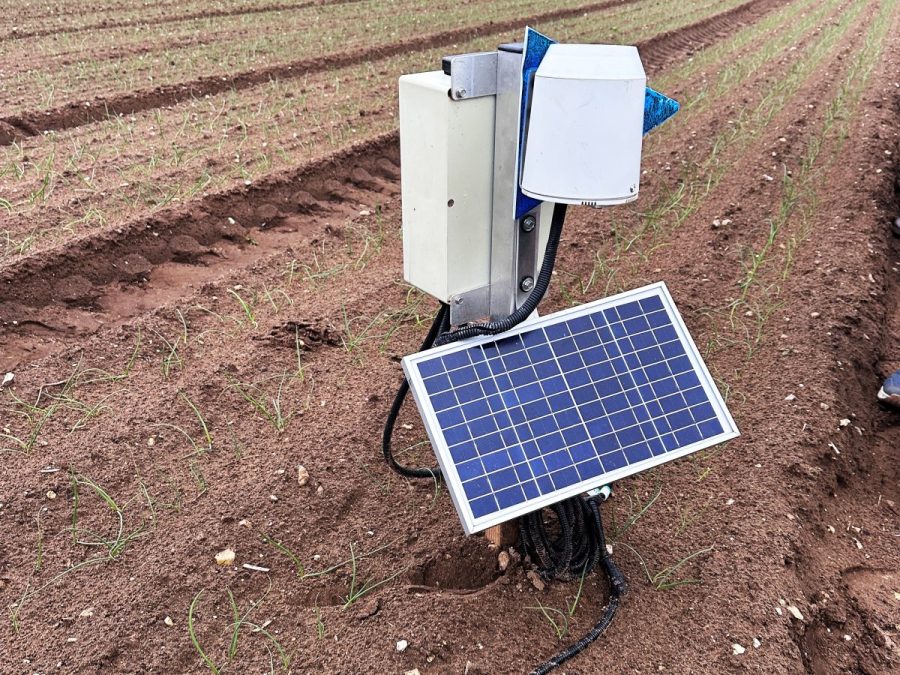
Connected to a solar-powered data transmission unit, alongside a rain gauge, data is sent to the cloud and relayed to growers via the firm’s IrriMAX Live app in a range of near real-time graphs.
The sensors assist growers in understanding water use in several ways, including helping to measure how much water the crop is using each day, explains Tim. “There’s a staircase effect in the data that’s day and nighttime water use by the plant. The flatter spot is during the night when there’s minimal water use, and then a drop during the day when the crop is photosynthesising.
“This allows growers to quantify daily water use and gauge how many days remain before irrigation is required.”
With sensors at multiple depths, the data also shows where roots are actively taking up water. By summing those layers together, growers can track total available water in the main rooting zone and aim to irrigate only to the depth where roots are extracting water, refilling the moisture deficit without over-watering deeper layers.
“If you’re pushing water deeper, which you can see by spikes in the data, you might be wasting water and possibly washing nutrients through the profile,” says Tim.
Maximising rooting depth through effective cultivations is critical to making best use of water, adds Soil Moisture Sense director, Peter White. “If poor cultivations restrict maximum rooting depth, plants could be missing out on an extra 40-50mm of water, which will make an enormous difference to yield,” he comments.
“Having data that shows you where roots are active is incredibly valuable in maximising profitability from the amount of water available.”
VALUABLE INSIGHTS
Other information the probes provide includes how much water was actually applied and whether it entered the soil profile, giving an early warning when water isn’t penetrating the soil as expected, as can happen in hydrophobic or very dry sands.
But while the probes are an integral part of how Elveden currently manages irrigation on the farm, Nick is testing whether more data can help to make smarter decisions and help save water through a Defra-funded ADOPT project.
Currently in most fields, a single probe is sited in the first irrigation run, explains Nick says. If it rains while the field is being irrigated, that probe will say the field is saturated, while in another part of the field there won’t be any accurate data for where irrigation was stopped prior to application after the rain.
“We’re not necessarily turning the irrigator back on very accurately,” he says. “But if we had probes in every run, you might be able to make better decisions.”
At a cost of around £1200-1400 to buy the probe, plus £200/yr/probe subscription fee, that probably won’t be feasible commercially, but Nick is keen to see what benefits there are from splitting fields into smaller management zones in the ADOPT trial, and whether variable irrigation across the field is practical and worthwhile.
To test that, the two-year project splits a potato field into eight runs or zones, with 14 soil moisture probes sited at strategic points. With at least one probe in each run, Nick is using a combination of the data from the probes and information from Mark Stalham’s irrigation scheduling model to determine when and how much to irrigate.
“If run one needs 20mm and run four needs 25mm, we can do that, rather than just use data from a single probe,” says Nick. “We’re trying to manage the crop evenly to get a more consistent product.”
In addition, Nick is experimenting with when to apply, with the northern half of the field receiving irrigation during the day, and the southern half at night.
A similar trial is also running in onions on the farm, he adds. “We don’t have quite as good a handle on the soil moisture deficit trigger point for when to irrigate in onions as in potatoes, so we’re looking at irrigating one run when it reaches 15mm deficit, another with 20mm, and third with 25mm deficit.
“Is it better to irrigate with less water but more often, or bigger volumes, less often? And will that limit stress in the onion crop?” he questions. Success will then be measured through yield and quality, with each area harvested separately.
But it’s not just water where Elveden is using technology to help improve efficiency – it’s also experimenting with sensors that track nitrates and help with decision making about when crops require applications, highlights Nick.
JUSTIFICATION
In onions, there’s often a period mid-season where visually crops look hungry, and experience suggests applying more nitrogen, notes Nick. “But with more variable seasons, I thought we required more data to back up applying nitrogen and how much.”
That led him to getting in touch with Paul-Tech, which has built a soil nitrate station that’s placed in a representative part of a field. Using two or three probes, it measures plant-available nitrate at typical depths of 8cm, 20-25cm and 40-50cm, according to the firm’s Rob Vanhoucke.
The system overlays weather modelling and satellite imagery with soil data to calculate how the crop is using nitrogen. “It helps you to understand at each layer where the probes are, what’s happening with applied nitrogen. When is it being released? When is the plant using it? Is it leaching through the profile?”
Having tested this in various crops, Nick says the sensors are able to detect nitrogen applications, as long as there’s moisture. As with crop nitrogen uptake, applied fertiliser requires soil moisture to dissolve and become available to plants, so changes in nitrate levels are slower to appear in very dry conditions.
“If the soil is really dry, it’s challenging for it to pick up nitrogen applications, but in moist situations, it reacts very quickly,” he adds.
That simple finding has focused Nick into trying to apply nitrogen ahead of irrigation to help make it available as quickly as possible. “It’s about planning our operations to make that happen, because if it’s dry and the irrigator isn’t coming for seven days after we spin fertiliser on, we’ve lost seven days.”
The sensors are also helping Nick to compare a little and often approach to nitrogen applications in onions compared with the standard regime. “Onions are lazy rooters and want everything given to them as close to the surface as possible.”
Standard practice is to apply 120kgN/ha in four doses through the season, but a trial last year suggested a more extreme little and often approach could potentially save nitrogen at the end of the season.
That’s led to a trial this year where standard practice will be compared with 90 or 120kgN/ha split into eight applications to investigate more closely whether that finding can be repeated.
“I’m not sure my fertiliser spreader driver will like me if I double the number of applications across 550ha, but we have to test the theory with nitrogen at £500/t. Obviously fuel costs have to be taken into account, but if we can save money on nitrogen it will add up pretty quickly,” he concludes.
Information for this article was gathered at AgriTechE’s Soils and Water Management day heled at Elveden Farms.
This article was taken from the latest issue of CPM. Read the article in full here.
For more articles like this, subscribe here.
Sign up for Crop Production Magazine’s FREE e-newsletter here.