
While it’s been a challenging year for maize with many crops maturing far earlier than usual due to drought conditions, R&D work has to continue. CPM attended Hutchinsons’ maize open days to learn the latest.
“We’ve had so many heat units it’s been very hard to objectively assess performance – a lot of our later maturing material has been ready very quickly.” CHRIS PASHBY
By Janine Adamson
Those who love maize will likely always champion the crop. In a good year, it offers a host of rotational benefits – from providing an opportunity to control grassweeds to disrupting pest cycles – plus a usually high demand across various end market sectors.
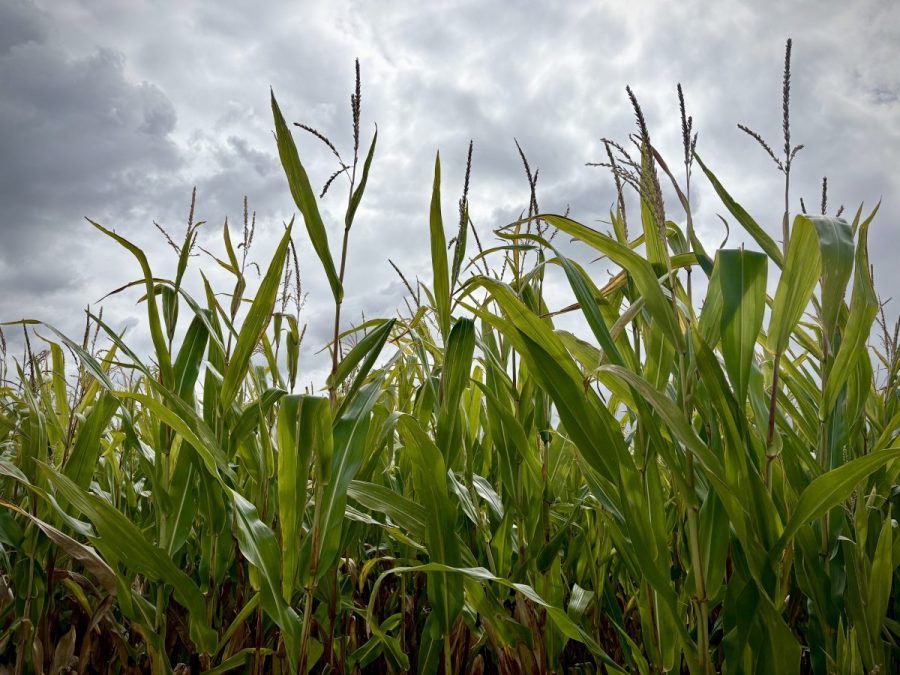
This year, however, has proven challenging including for those hosting maize trials, as experienced at Hutchinsons’ autumn open days. In fact at Sutton Lodge Farm in Broughton Ashley in Leicestershire, just the variety trial plots were left standing on 9 September following an extremely dry spring and summer and early harvest.
Despite this, the mood was buoyant among attendees, who presented a mix of those growing maize for livestock and AD feedstock. Hutchinsons agronomist Greg Hopkinson shared that he believes there’s increasing potential for maize in the region, driven by demand.
To delve into this further, Greg introduced Pioneer’s promoter for the North West, Chris Pashby, who discussed his priorities for selecting a hybrid maize variety. “It’s key to consider what the yield of the variety is, its end market, and of course what the following crop will be,” he said.
LIVESTOCK VERSUS AD
If growing maize to feed livestock, he added that requirements should also include high starch content, high digestibility, and an earlier harvest maturity so the crop can be off the ground in a timely fashion.
“For AD, we’re then looking at the later maturing hybrids, still focusing on what the following crop is because that dictates how late it can be pushed. However, this is determined by site selection and potential heat units,” he said.
While usually the advice would be to attend a regional trials open day, or test a small area of a variety on a grower’s own farm, Chris noted that this year had thrown a spanner in the works. “We’ve had so many heat units it’s been very hard to objectively assess performance – a lot of our later maturing material has been ready very quickly.”
He also offered further thoughts on what to consider in the future, based on breeding pipelines. “There are two primary types of maize – Flint and Dent. Flint genetics are cold tolerant, hardy but lower yielding. Conversely, Dent genetics are higher yielding, offer more available starch and better plant health, but are later maturing with no cold tolerance. The main aim for breeders is to produce a hybrid between the two,” he explained.
Currently, Pioneer’s push is towards Dent genetics due to the uplift in yield and starch quality, noted Chris. “But the main thing for us is for livestock farmers, Dent genetics have high rumen degradable starch at harvest time – an aspect that we’re now proactively focusing on and should be showcasing during the next few years.”
With maize growth having accelerated during this this past season’s drought conditions, Chris reminded attendees about what to look for with cob maturity. “Snap a cob in half and look at the pointy end; you’re looking for the milk line in the grain which generally starts developing from the top of the kernel and travels down.
“When the cob is fully mature, this appears at the very bottom of the kernel and a black layer at the base forms, which means the maize has stopped accumulating starch and it’s then about dry down.”
He added that in early August this year, with dry weather meaning crops were receiving a lot of heat units, some varieties were drying down at around 8% every week. “Generally at this time of year, it’s only 2-3% a week if we’re lucky.”
OLD TRUSTY
Considering specific varieties, Chris highlighted that P7326 has been in the market for around 10 years and has remained a faithful and consistent performer. “On trickier ground it can favour heavier conditions, but being FAO 180 it’s dried down very quickly this year while generally speaking, would be harvested from mid-September onwards. It’s not at the top of the list anymore, but has long been a popular top seller.
“However, P7381 (FAO 185) has proven a significant step forward in genetics; there’s an 8% yield difference for virtually the same maturity. As with all of our varieties, we’ve seen this 4-5 years before national listing, so can understand how it performs early on. It’s definitely a dual-purpose, early maturing variety with good yields and high starch quality.”
Chris pointed out that new for last year was P72847 (FAO 180), which appears to favour hotter conditions. “With Dent genetics in the mix it’ll require adequate heat units at flowering to make sure it comes through to maturity.
“Equally, I’d be cautious about recommending a move towards later-maturing varieties. Recent seasons have demonstrated just how unpredictable growing conditions can be, making final outcomes difficult to forecast. A more reliable approach may be to focus on establishing crops earlier by bringing drilling dates forward where conditions allow.
“The advice for anyone who is considering later maturing hybrids, trial them on your own land and see how those varieties react to your individual circumstances,” he urged.
Over at Hutchinsons’ Carlisle site, hosted by Smalmstown Farm, compared with much of the country maize seemed to have fared well. So much so, Hutchinsons’ Jim Clark was confident that crops should produce good dry matter and starch, with reasonable yields.
NOT BOMB-PROOF
“While maize likes the heat, it’s not infallible to running out of moisture, especially on lighter land. We’ve seen where growers pushed drilling slightly later into May, perhaps to get a cut of grass in first, crops put a lot of energy into growing, but cob sizes generally don’t seem as big as in crops that were sown earlier (typically mid- April) and had more time to get their roots down,” he explained.
More than 20 varieties were trialled at site this year. “Apart from perhaps one variety, you wouldn’t be disappointed with any of them given the season. A few appear to have withstood the conditions better than others – P7034 was the stand out variety at Carlisle and yields so far have been 40-50t/ha at 33-35 dry matter. P7326, P68106, LG Highlight also did well,” he concluded.
For part two of this event coverage, which includes using drones in maize, visit page 42.
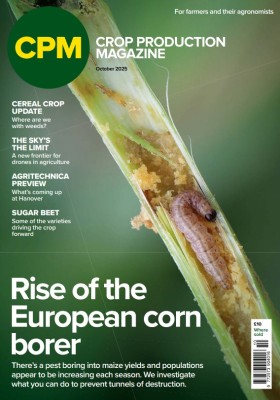
This article was taken from the latest issue of CPM. Read the article in full here.
For more articles like this, subscribe here.
Sign up for Crop Production Magazine’s FREE e-newsletter here.