

Coping with the current difficult economic environment requires clarity of thinking within the business, as discussed at the recent BASE-UK conference. CPM joined delegates to share the findings.
“Farms that will thrive in the future are those that are clear on what they’re trying to achieve, and disciplined to align everything around that in a landscape.” RYAN MCCORMACK
By Mike Abram
Navigating the collapse in government support when commodity prices are low requires change, as outlined at the recent BASE-UK conference. In particular, Ryan McCormack shared that his strategy involves building diversified income streams from four pillars – food and farming, the environment, energy and development.
As farm manager at Dennington Hall Farms near Framlingham in East Suffolk, Ryan oversees 1500ha which is split into 310 fields with an average area of just 6ha.
“Farming has never felt more uncertain,” he told the audience. “But the biggest risk isn’t volatility, it’s assuming that tomorrow will look like yesterday. The rules are changing with the safety nets we relied on, removed. Markets are more volatile than ever and the climate is getting harder to farm.”
The future of UK agriculture will be shaped by businesses that adapt fast, diversify smartly, and take control of their own resilience, he suggested. “The future is no longer predictable; policies are shifting faster than businesses can plan.
“Support schemes are changing from area-based to outcome-based. Global shocks affect local prices overnight, input costs continue to rise sharply, and climate extremes [mean] increasingly wetter winters, drier springs and unpredictable harvests,” he said.
“Relying purely on commodity production in this environment is like trying to stand on one leg in a storm. You might stay upright, but you might not.”
The business has made a deliberate decision to hedge its bets, shared Ryan. “Food and farming is our foundation – arable and livestock production will always be at the heart of what we do, but it’s no longer enough on its own.”
On the arable side, a relatively recently implemented 12-year rotation is the backbone of the entire system, pointed out Ryan. “It spreads risk and workloads, and most importantly, reduces reliance on inputs.”
Within the rotation, cover and catch crops play an important role in making the farm more resilient to climate extremes, by building soil organic matter, improving soil structure and increasing water infiltration, he added.
“We graze the cover crops with around 1500 lambs every year which manages the biomass naturally, feeds the soil biology, and adds another income stream. It’s a brilliant example of stacking enterprises.”
He’s also changed the machinery profile on the farm to introduce more direct drilling and equipment that supports soil structure rather than fights it. Hutchinson’s Omnia records every operation, helping to analyse performance and build variable rate maps for seeding and nutrition using data from satellite imagery, plus sap and soil test results. He’s also trialling OptiGene’s DNA plant disease reader this season to help inform fungicide use.
According to Ryan, acting as Limagrain’s demonstration farm is paying off by identifying genetics that cope with disease pressure and improve nitrogen use efficiency.
Then, wherever possible, he strives to add value within the farming enterprise. Milling wheat is grown for Wildfarmed, which, particularly when combined with SFI payments, becomes ‘genuinely profitable’, he said.
“We’re now exploring how to make sustainable arable production profitable through private funding,” commented Ryan.
Beef from the farm’s low input Red Poll suckler herd and wild venison are sold direct to the consumer to capture more value and strengthen connections with consumers and the local community.
He also suggested that nutrient dense food should become a sought-after commodity by consumers (see box). While recognising there’s no current market, he believes it’ll be central to future food systems and the future of the NHS.
“With new diet suppression drugs coming into society, people will increasingly demand whole foods that are nutrient rich, sustainably grown and traceable. Farming isn’t about calories any longer, it’s about nutrition and our farm wants to be part of that shift.”
Using the farmed environment as another means of providing an income is the farm’s second pillar. “We’re fortunate to farm in an area with huge natural potential and have made a conscious effort to enhance that across the farm. We have 115 ponds, more than 100 miles of hedgerows, 40ha of wild bird food and pollen and nectar mixes, and grass margins around every field, plus areas of bare fallow that aren’t productive.
“That level of habitat diversity creates structure, shelter and year-round food sources and corridors for wildlife movement,” he explained, with recent surveys finding 1162 invertebrate species and 12 red-listed birds.
To support one of those species, the turtle dove, Dennington Hall Farms had taken 5ha of productive land out of farming to create the perfect habitat for the birds, managing it with pigs to create the open, seed-rich habitat required. Pork is then sold to the local community to provide a ‘perfect example’ of conservation and food production working together, added Ryan.
The farm uses goats to manage permanent grassland or difficult habitat that can’t be reached by machinery, with the subsequent meat valued by the local communities and providing additional income.
“We’ve also created a new wetland area in partnership with Essex and Suffolk River Trust to slow water and improve quality, while increasing breeding wader numbers on the farm. It’s a long-term project, but one that’ll be a real asset for biodiversity.”
Another longer-term opportunity is from biodiversity net gain markets, with the farm entering into an option agreement with developers to supply BNG units from larger landscape scale habitat areas.
Baselining the farm’s natural capital and carbon auditing is crucial in taking control of future opportunities, stressed Ryan, with the farm fortunate to be part of the AHDB environment baselining project.
“The reality is, Countryside Stewardship and SFI may not look the same in five years, with payments changing and requirements shifting, and natural capital and private markets playing a bigger role. This means the environment is part of the farm’s resilience and identity, and increasingly it’s part of its income.”
The third pillar, energy, sits at the centre of many farm activities, from drying grain to running machinery. “Rather than being passive consumers of energy, we want to be active producers and keep as much value on the farm as possible.”
That means managing the farm’s 100ha of woodland as a practical energy source – supplying fuel for two biomass boilers that provide heat and hot water for the farm buildings and hospitality and events business.
Around 200kVA of ground-mounted and roof top solar panels generate electricity, reducing operating costs and carbon footprints, while Ryan is now exploring the use of drones for seeding and surveying, smaller lighter machinery that uses less diesel, alternative fuels, and technology that reduces horsepower requirements across the farm.
In the future, other large-scale renewable energy projects – especially where energy generation can complement habitat creation or input systems – will be considered, as well as an anaerobic digestion (AD) plant, said Ryan. “Done correctly, AD can tie farming and energy together using crop residue, manure or dedicated energy crops to create biomass, biogas, electricity and digestate, while keeping the nutrient loop on the farm.”
He stressed that energy projects aren’t just a diversification, but a hedge against rising costs while being an opportunity to generate stable, long-term revenue.
The final income stream is through development and diversifications. For Dennington Hall Farms, this has centred around developing a wedding and events business – Bruisyard Country Estate. This uses traditional farm buildings as well as repurposing a redundant cattle shed into a multi-purpose meeting and training space for local businesses and the community.
Many of the 28 residential and 11 commercial lets also started as redundant agricultural buildings, pointed out Ryan. “It provides stable and predictable income for the farm, strengthening the local economy as well as our own.”
Using these four pillars helped smooth the volatility of the farming cycle, believes Ryan. “Each pillar behaves differently under pressure – when farm margins fall, environmental payments or energy revenue can stabilise the business. When policy shifts, development or farming might be stronger than environmental funding. If weather ruins a harvest, environmental income or renewable energy isn’t affected.”
Clarity of thinking from inside a business is much more important than having clarity of government policy in a world of far lower support payments, more volatility and fewer second chances, concluded Ryan.
“The farms that’ll thrive in the future will be the ones that are clear on what they’re trying to achieve, and disciplined enough to align everything around that in a landscape. Every hectare, enterprise and hour of labour must earn its place.
“Sometimes that means uncomfortable change and letting go of things we’ve always done to make the family farm robust, profitable and resilient. The real risk isn’t adapting enough, hoping the old model will somehow hold on together. But the future of the family farm will be built by those who choose direction over habit, decision over delay and strategy over sentiment.”
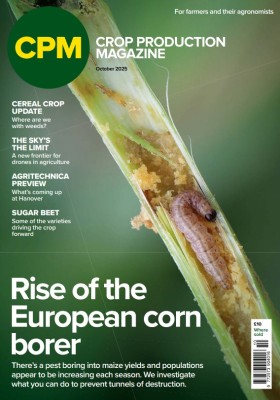
This article was taken from the latest issue of CPM. Read the article in full here.
For more articles like this, subscribe here.
Sign up for Crop Production Magazine’s FREE e-newsletter here.