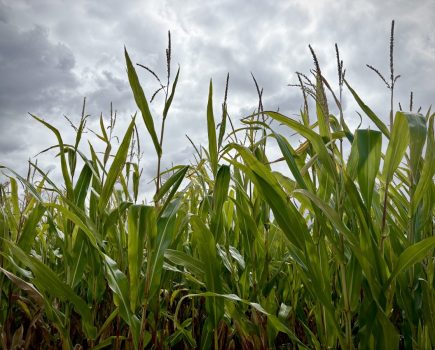


With maize area rising and grower confidence building, attention is turning to how to deliver consistent performance from a crop that doesn’t always suit UK conditions. CPM explores the fundamentals shaping maize strategy for 2026.
“If you create the right conditions for the seed, the crop will do the rest.” MALCOLM BARRETT
By Charlotte Cunningham
Across much of the UK, maize is moving from a marginal option to a more deliberate part of the rotation – not because it’s necessarily simple to grow, but because its role is becoming clearer.
That shift was evident earlier this year when almost 190 growers, agronomists and industry specialists gathered in Leicestershire for the annual conference hosted by the Maize Growers Association (MGA) – the highest attendance in recent years.
UK maize area reached around 240,000ha in 2025, reflecting a crop that’s increasingly being integrated into rotations on its own merits. Silage maize continues to dominate, but grain maize is also expanding as arable businesses look to broaden their cropping mix.
That interest is being shaped by a combination of factors – from market opportunity and system flexibility through to the crop’s ability to deliver biomass and spread workload – but it comes with a clear understanding of its limitations.
Because while maize is becoming more established, the fundamentals haven’t changed. It remains a crop defined by climate – and success still depends on how well that risk is managed.
HEAT IS ON
For MGA’s Jon Myhill, maize strategy starts with temperature. Speaking at a recent webinar, hosted by BASF, he says: “On average, we require around 2200 heat units to reach maturity – roughly 30-32% dry matter.”
Calculated using the Ontario system, heat units combine daily maximum and minimum temperatures to measure the energy available to the crop. It’s a more useful guide than calendar dates, particularly in seasons that no longer follow predictable patterns.
Data from the Met Office shows a clear geographical divide. Southern and eastern regions consistently accumulate sufficient heat units, while higher altitude, western and northern areas often fall short. “With warmer summers and autumns, that suitability is shifting,” he says. “But the principle doesn’t change – you have to match the crop to the conditions.”
Where heat units are marginal, growers are increasingly using film-assisted establishment systems to increase soil temperature and accelerate early growth. Combined with careful variety selection, this can bring crops to maturity within a tighter window, improving both yield potential and harvest reliability.
But while temperature sets the potential, establishment determines how much of that potential is realised. That’s because despite its reputation, maize isn’t a forgiving crop early on. “For the first six weeks, it’s not competitive at all,” says Jon. “That’s where you either set it up properly or limit it.”
Soil structure is central to that with compaction, particularly in the upper profile, restricting root development and limiting the crop’s ability to access both moisture and nutrients – issues that can’t easily be corrected later. “Go out with a spade and understand what’s happening,” he advises. “If there’s compaction, deal with it before drilling.”
Alongside soil condition, early nutrition is equally important, particularly phosphate. In cold spring soils, phosphate availability is limited due to both reduced biological activity and its low mobility within the soil.
This has prompted renewed interest in starter fertiliser strategies. Microgranular products which use significantly smaller particles than conventional fertilisers, can increase the number of nutrient contact points around the seed. “The advantage is placement,” explains Spunhill agronomist Bryn Thomas. “You can position fertiliser very precisely close to the rooting zone.”
With hundreds of times more granules per hectare, these formulations create a more uniform nutrient environment for the developing root system, improving early vigour and crop uniformity. In some cases, improved efficiency also allows application rates to be reduced without compromising performance.
COB SET
Maize development is effectively determined early in the season too. “At the six-leaf stage – V6 – the size of the cob is set,” says Jon. “Anything that stresses the crop before that point will influence final yield.”
That stress may come from poor establishment, nutrient limitation, weed competition or soil constraint, but the outcome is the same – reduced yield potential that can’t be recovered later. For that reason, early weed control remains fundamental, he warns.
This is particularly important given the crop’s slow early growth. In cool conditions, weeds can outcompete maize, reducing access to light, water and nutrients at a critical stage, adds Jon.
Pre-emergence herbicides form the foundation of most programmes, helping to reduce early competition and protect yield potential. But achieving consistent control is increasingly dependent on how products are matched to conditions and weed spectrum, explains BASF’s Andrew Clune.
“Different actives bring different strengths. Some are stronger on broadleaf weeds such as chickweed and cleavers, while others offer better grassweed activity or improved performance in drier seedbeds,” he says.
That latter point is becoming more relevant, particularly where drilling takes place into drying soils. Under these conditions, herbicide efficacy can be compromised, making active choice and timing even more critical.
“You’re often dealing with multiple flushes,” he says. “So it’s not just about what you apply first, but how you follow it up.”
As a result, a two-pass approach is increasingly common – an early pre-emergence or very early post-emergence application to protect establishment, followed by a later treatment to maintain control as new weeds emerge.
This approach also reduces the need for more aggressive ‘firefighting’ treatments later in the season, which can place additional stress on the crop.
GROWTH ASSESSMENT
Accurate growth stage assessment is therefore essential. The leaf collar method – identifying true leaves by the presence of a visible collar – provides a more reliable guide than simply counting emerging leaves, helping to ensure applications are timed correctly and remain within label recommendations.
Once the crop is established, attention turns to how nutrients are supplied through the season, including nitrogen timing. Research suggests that around 60% of nitrogen uptake occurs from the ninth leaf stage onwards, meaning early applications may not align with crop demand, points out Jon. “Historically, we’ve applied nitrogen early and expected it to be there later, but that’s not how the crop uses it.”
This mismatch creates a risk of nitrogen loss, particularly in wet spring conditions, and reduces overall nitrogen use efficiency. To address this, growers are increasingly looking at delayed or split applications, ensuring nitrogen is available when the crop requires it most.
Foliar nitrogen products are also gaining attention, particularly those designed for maize that offer low scorch risk and can be applied during warmer conditions. These allow nitrogen to be delivered directly to the crop at key growth stages, improving uptake efficiency.
Trial work from the MGA suggests that total nitrogen rates can be reduced without compromising yield where timing and placement are optimised. In some cases, crops receiving around 105-110kgN/ha total nitrogen have performed comparably to those receiving significantly higher rates.
“There’s an opportunity to improve efficiency – both financially and from a carbon point of view,” says Jon.
As the crop moves beyond establishment, the focus shifts to protecting yield. While maize has traditionally been considered relatively low risk from a disease perspective, that assumption is becoming less reliable. Diseases such as eyespot are now widespread, with conditions in many UK seasons favouring infection.
Eyespot thrives in cool, wet conditions and requires prolonged leaf wetness to establish. Northern corn leaf blight presents a similar challenge, developing under moderate temperatures and high humidity – conditions often created within the crop canopy itself. “Once that yield potential is set, it’s about protecting the canopy,” explains Andrew.
As maize area continues to expand, the focus is shifting from adoption to optimisation. In practice, this means understanding its limitations – particularly its reliance on heat and sensitivity during establishment – while refining management to improve consistency.
Done well, it offers a viable and increasingly relevant option within the rotation, concludes Jon. “As conditions change, maize has a bigger role to play. But it still comes back to management – that’s what makes the difference.”
This article was taken from the latest issue of CPM. Read the article in full here.
For more articles like this, subscribe here.
Sign up for Crop Production Magazine’s FREE e-newsletter here.