
Managers of a 2400ha mixed farm have developed an approach that’s boosting soil resilience and stabilising crop yields to help maintain a closed-loop circular production system. CPM learns how improving soil health has kept them on track.
“This year, we anticipate that around 90% of the farm won’t require deeper loosening, bringing clear savings in diesel and wearing metal.” CALEB COUSINS
By Mike Saull
With an impressive 2650 cows housed all year-round, the goal for Grosvenor Farms is an efficient circular production model whereby waste streams are exploited to help maximise the crops grown to feed its livestock.
Based on the North Wales/Cheshire border with 2400ha of cropped land, the farm uses a six-year rotation, comprising grass, maize, winter wheat, winter rye and winter barley. Organic manures are used to help offset artificial fertiliser, while a new gas-to-grid AD plant is being constructed to add another revenue stream to the business.
In total, the aim is to produce around 9000t of grain and 50,000t of forage annually, the latter made up of around 50/50% split of grass silage and forage maize.
Assistant arable manager, Caleb Cousins, has been at Grosvenor Farms for three years and says while the circular economy system is efficient and builds in strong business resilience, the farm has struggled with its soils which has had a knock-on impact. This is because aside from 300ha of sandy land, the rest of the farm is on clay loams that are inherently unstable.
“In current volatile climatic seasons, this has become a major issue, limiting yield and increasing input costs,” says Caleb. “In the recent, wetter autumns it was almost impossible to get winter cereals established well and compaction was becoming an increasing challenge with all crops struggling to reach the farms rolling average yield.
“We were increasingly being pushed into spring cropping to recover from poor winter establishment waterlogged crop failure, with significant yield and cost penalties. That in turn meant importing more grain and straw for feed and bedding, moving the business further away from its circular economy and more closed-loop approach,” he explains.
The farm has been operating a min-till cultivation system for more than 20 years, but on its ‘two-day soils’, drilling timeliness is critical, adds Caleb. “In a kind season they drilled well, but where we were increasingly utilising delayed drilling to help manage blackgrass, wet weather could quickly cause the soils to slump and lose structure.
“As a result, min-till wasn’t always enough to keep us on track and, increasingly, we were forced back to the plough and combi-drill to salvage crop establishment.”
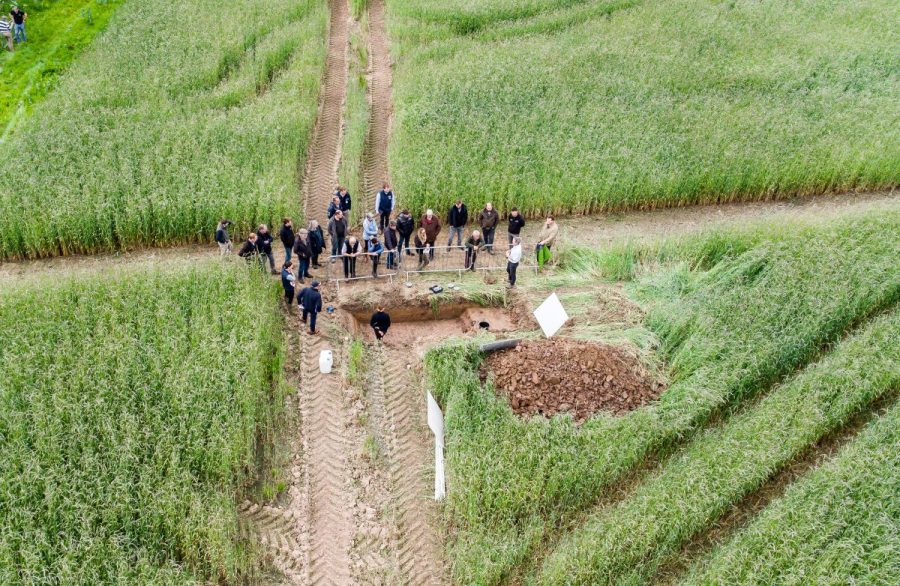
During an open day at the farm, the team was introduced to Hutchinsons’ soils specialist Ian Robertson. As part of the event, a ‘healthy soils gold standard’ investigation was undertaken alongside a soil pit, which provided an in-depth analysis on the chemical constituents of the soil.
Consequently, Ian identified a chemical imbalance as a major factor behind the farm’s physical soil challenges. He then demonstrated a number of practical remedial measures that could be adopted, marking the start of a new close working relationship.
“We’ve all largely been brought up to use horsepower and soil physics to solve our structural problems,” suggests Ian. “However at Grosvenor, excessive cultivations followed by wet winters and dry summers were exacerbating the problem.
“The soil tests highlighted a number of issues and by working with the farm managers, we’ve helped to lead the farm down a completely different approach helping to breathe vibrancy and life back into their soils.”
Ian adds that first and foremost, there was a significant nutrient imbalance in the farm’s clays with magnesium the dominant cation; some had quite high potassium content as well. In essence, this magnifies the effect of sodium in the sodic soils which disperses and disturbs soil aggregates, explains Ian.
“In addition, there were varying levels of organic matter ranging from just 2% on the sandier soils and fields further away from the dairy which didn’t get regular applications of manure, to a farm average of 4%, and up to 9% on good grassland.”
While soil health can be measured by the ratio of soil organic carbon to clay content, Ian’s view is that this wasn’t relevant in this situation. “The suggestion is that by adding manure and improving the ratio of organic matter to clay, this will improve soil workability and structural strength. In the case of Grosvenor Farms the ratio was good at 1:8, but this alone wasn’t solving the structural stability problem.
“Although most advice is to build organic matter as it’s your soil’s battery, raise levels too high – as was the case at Grosvenor Farm – and it’ll bind potassium and other cationic elements too strongly, with consequent problems of low soil bulk density and low available water content.
“So the first remedial step was to use gypsum to introduce calcium at a colloidal level – this helped to replace magnesium on clay particles, reducing slumping and increasing pore space. It’s a little like creating a soil with the structure akin to a chocolate sponge cake, compared to that previously, which resembled a tight, chocolate brownie texture,” explains Ian.
The gypsum also helped to bind fibres from the manure, and at the same time, provide some calcium and sulphur to promote a healthier growing crop. However, according to Caleb, this wasn’t an complete instant fix.
Following an exceptionally dry year which encouraged cracking and fissuring in the clay soils helping the restructuring process, the farm has adopted targeted mechanical intervention encouraging strong crop establishment and enabling better root development.
“It’s clear that weather still has a major influence,” says Caleb. “But as soil resilience has improved, so too has the farm’s ability to reduce cultivations. In many situations, a light stubble cultivation will now be enough to incorporate manures and create a workable seedbed.”
Deeper loosening is reserved for where it’s genuinely required; usually tramlines, occasional headlands and fields struggling from ageing drainage systems, he adds. “This year, we anticipate that around 90% of the farm won’t require deeper loosening, bringing clear savings in diesel and wearing metal.
“It took a leap of faith to reduce cultivations so quickly and break from the way we knew after doing it for so long, but even some of the farm’s arable operators who were cynics initially are slowly becoming converts after observing results and increased worm activity,” notes Caleb.
Ian recalls summoning the farm’s 15 operatives into a room for an hour’s basics on soils and then out into the field to dig holes. “Three years on and they’re seeing the changes – this is a massive win for how the farm is managed; all of the staff are buying into the new approach,” he says.
According to Caleb, the farm is still at the mercy of the season but the soils are more forgiving than they were. “However, there are still pressures in the system, for example, heavy application kit is required to handle manures, our five-cut grass silage traffic can compromise soil structure in a wet season if timing isn’t kind, and a difficult maize harvest doesn’t help either.”
A further important part of a wider soil management approach is to establish forage maize following first cut grass in its third year, using strip tillage. By disturbing only the planted strip and leaving the soil between the rows intact, the system helps preserve structure and reduce the risk of slump; a major advantage in wetter harvests when machinery compaction damage is at its greatest.
That resilience is strengthened further by the root mass from the previous grass crop, which helps to hold the profile together and leaves a better platform for the following crop. “It fits well with what we’re trying to do,” says Caleb. “It’s not just about the maize crop — it’s about improving and protecting the soil for the next crop as well and when conditions allow, wheat can then be direct drilled after maize.”
As such, the results are measurable – physical VESS assessments show that the farm’s soils are around 1.5 points better than they were before Ian came on board. “Visually, there’s less coarse aggregation and fewer large cracks of the size that you could lose pheasant chicks down,” raises Ian.
Equally, plant counts are now more consistent with fewer bare patches across headlands, and yields are being achieved more evenly across whole fields. More importantly, Caleb believes the greater stability now means the drilling window is less impacted by weather than it used to be with more consistent crop establishment pushing yields upwards again.
Critically, as the soil began to respond to the changes, Grosvenor Farms found it could start trimming back nitrogen without sacrificing crop performance. “On soil with such a tight poorly aerated structure, a lot of the nitrogen the farm was using to promote crop growth was being stolen by microbes to stay alive, and these microbes were doing little to improve agricultural stability,” explains Ian. “In essence, the bacteria that dominated the microbiome respire quickly using nitrogen and releasing cardon dioxide from the carbon supplies in the soil.”
However, this reduction in nitrogen applications came from a lot of work behind the scenes, notes Caleb, with Ian and his team analysing data from on-farm nitrogen rate trials, tissue tests, plant, tiller and ear counts, together with crop establishment and yield data. Where deficiencies showed up in the tissue analysis, these were addressed with targeted micronutrient applications.
“That’s allowed us to build a model that refines nitrogen recommendations through the season using tissue results and other measured components,” adds Caleb. “The result has been a 25% reduction in applied nitrogen, with improved nitrogen use efficiency and higher yields.”
For the future, Ian sees no reason why the farm shouldn’t eventually look at sources of high protein crops with the right amino acid profiles to replace brough-in livestock feed and close the circular economy loop further still. “While yield is still king, the aim would be to cut the amount of cake or protein the farm has to source,” he suggests.
As for Caleb, he says the land is starting to offer improved resilience to volatile climate changes with less fluctuation in yields year-on-year. “This enables more accurate budgeting and planning,” concludes Caleb.
This article was taken from the latest issue of CPM. Read the article in full here.
For more articles like this, subscribe here.
Sign up for Crop Production Magazine’s FREE e-newsletter here.