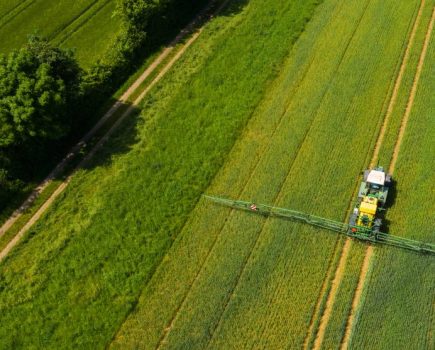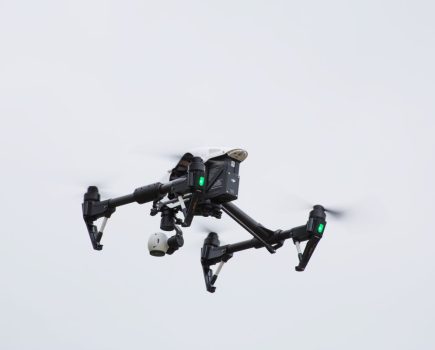


A high-resolution drone-powered weed mapping solution is about to wing its way to the UK, to help ensure in-field herbicide use is truly on-target. CPM speaks to the developers behind SAM-CAM AI.
“Independent trials have shown that by using our system and targeted spot spraying, growers can reduce herbicide applications by up to 70%.” SEBASTIAN STEIMER
By Janine Adamson
While in the past there’s been a trade-off between the speed and resolution of aerial weed mapping solutions, that’s all about to change, thanks to the commitment of an innovative, German company.
Having spent the past six or so years developing a bespoke solution, including gaining momentum across Europe, the team behind SAM-DIMENSION is now preparing to revolutionise precision weed control in the UK… and it starts in just a few months.
All will be officially revealed at the Cereals Event in June, but the journey to Diddly Squat Farm first began in 2019, when founders Dr Robin Mink and Dr Alexander Linn met at the University of Hohenheim in Stuttgart, Germany.
With combined skills spanning agricultural science, remote sensing and herbicide resistance, the duo identified a specific gap in the market: weed mapping large areas of agricultural land at single plant level to enable precision herbicide applications, or spot spraying.
SEEKING SOLUTIONS
Although some applicable technologies existed at the time – centred around camera drones – none were feasible for what they wanted to achieve, explains the firm’s Sebastian Steimer. “The key was finding a solution that could balance both speed and resolution without compromise, which had previously been the main barrier in the economically feasable deployment of aerial weed mapping.”
In the early days, efforts focused on data collection to assess the merits of various camera systems and to train the associated AI required for robust mapping. Sebastian says this even involved mounting a DSLR camera to a wheelbarrow and travelling through fields on-foot to capture the first images.
Having conducted a raft of development work and data capture, it became apparent that the solution lay in combining an unmanned aerial system with a multi-camera rig. The result: SAM-CAM AI – ultra-high resolution, georeferenced drone imagery for precise weed detection.
According to Sebastian, the system can perform up to 1ha/minute, mapping fields at a 1.6mm ground sampling distance (resolution) to detect a variety of weeds as small as a thumbnail. “AI-based analytics then identify and localise individual weeds from the cotyledon stage onward, with the resulting spatial distribution data translated into precise spot-spray maps.
“These maps can then be directly integrated into the ISOBUS-sprayer terminal and applied without disturbing existing workflows. For the grower, this means maximum precision, potential reduced input use, and efficient crop protection tailored to real-field needs,” he says.
EUROPEAN DEMAND
In Europe, adoption has been swift since SAM-CAM AI was first launched in 2024, with contractors and service providers such as sprayer specialists purchasing the system to add to their capabilities. In particular, the technology has proven highly successful for example in targeted dock control in grassland, points out Sebastian.
With work underway to enable the identification of blackgrass in wheat, he believes now is the ideal time to bring the technology to the UK, as the weed remains one of the most challenging herbicide resistance issues for growers.
“Our blackgrass mapping is currently under development and will be the next addition to our portfolio. Of course, achieving this has been very challenging so far because wheat and blackgrass appear very similar at early emergence.”
He adds that while the overall technological concept is undoubtedly exciting, the team has a greater goal. “We want to provide growers with actionable insights so they can use mapping data more effectively and make informed decisions regarding their plant protection strategies.
“Independent trials have shown that by using our system and targeted spot spraying, growers can reduce herbicide applications by up to 70% on average, and in some cases up to 90%, while maintaining operational efficacy and crop safety. That means saving money and using resources only where they are truly required while still enabling working weed control.”
Having conducted initial customer research, Sebastian says he’s been impressed by the level of enthusiasm from growers when it comes to achieving environmental gains. “You might assume that farmers are more focused on the financial benefits associated with reduced herbicide use, but actually, respecting the environment is important to them too.
“As long as an innovation doesn’t cost more than a conventional solution, it seems in some cases, environmental benefits can override perceived cost gains,” he concludes.
This article was taken from the latest issue of CPM. Read the article in full here.
For more articles like this, subscribe here.
Sign up for Crop Production Magazine’s FREE e-newsletter here.