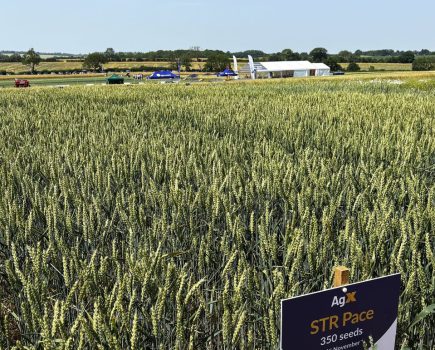


Competitive yields, a strong agronomic package plus the bonus of warding off BYDV. CPM takes a look at Guardsman – the specialist feed wheat variety that provides protection without compromise.
“It’s the first time we’ve seen high yield, BYDV resistance and strong disease scores all in one variety.” TED WILLIAMS
By Janine Adamson
With the right trait package behind it, a niche variety has every potential to become mainstream, believes RAGT’s senior wheat breeder, David Schafer.
And while certain wheat varieties carry specialist recommendations on the AHDB Recommended List, he believes to stand the test of time, they must hold their own among the competition. “In gaining wider appeal, that once specialist trait then becomes simply an added bonus,” says David.
To illustrate further, he highlights the development of RAGT’s varieties with barley yellow dwarf virus (BYDV) resistance, a breeding programme that was first introduced on UK farms around six years ago through the launch of RGT Wolverine. “We acknowledge that the first wave of varieties with this trait had its issues, but we wanted to get the BYDV trait and its benefits into the hands of growers as quickly as possible,” he explains.
“In delivering successful new varieties, as soon as you stop to pick a trait up, particularly something innovative, you have to inevitably slow breeding progression for other traits while you adjust and find your feet. The goal is to then speed back up again, which is where we are with the second wave of our BYDV varieties that are filtering through now.”
According to David, this acceleration has involved creating robust, all-round options that address not only the challenge of BYDV, but that come with few compromises for the grower. “As breeders, there’s always a difficulty in ensuring all desirable traits are offered in combination. For example, delivering BYDV and OWBM in the same variety, to get as close to insecticide-free as possible.
“Equally, we have to ensure the rest of the plant is doing what it’s supposed to do. So offering the expected traits and performance, such as reliably high yields, solid disease resistance scores and good grain quality.
“In time, the aim is to have BYDV resistance as ubiquitous as other traits, if it remains useful enough. Just like the much more widespread OWBM, BYDV resistance could become the same success story,” states David.
One variety that he believes could achieve wider grower appeal is RGT Guardsman, the first BYDV-resistant wheat to yield more than 100% of controls on the latest RL.
While historically, wheat varieties with BYDV resistance have come with a level of compromise, namely yield, Guardsman represents a significant landmark in the development of the critical trait, says RAGT’s Andrew Creasy.
Furthermore, he suggests that growers are becoming increasingly interested in such genetics, especially given that recent mild autumns have increased the risk of aphids – the vector of BYDV – in many parts of the country.
Andrew hopes that this season will prove the ideal scenario to fully test drive Guardsman. “Due to the constraints of official RL trial protocols, it’s difficult to reliably see the effect of the BYDV-resistance trait in the lead up to a variety being launched.
“However in RAGT trials, we’ve often seen our BYDV material perform in ways the RL may not suggest, particularly yield in the absence of insecticides. I’m looking forward to seeing how Guardsman performs this year given many crops were drilled early and conditions were conducive to aphid activity and thus the transmission of BYDV,” he says.
For growers in BYDV hot-spots, and even those in marginal areas, Guardsman should come into its own. “While you had to accept the yield penalty with Wolverine, that’s no longer the case. And critically, for those aiming for an insecticide-free rotation, Guardsman is providing confidence and greater flexibility. It’s achieving a lot of objectives,” he states.
For one, it comes with an improved agronomic package, highlights Andrew. “I don’t believe it can really be faulted, neither can its respectable 103% treated yield. Other pertinent points are that its yellow rust resistance isn’t based on Yr15, and it’s one of the only varieties across all wheat groups to have young plant resistance to yellow rust.”
Agrovista’s Ted Williams agrees that Guardsman is the first variety from RAGT’s BYDV suite to deliver the full package. “It’s the first time we’ve seen high yield, BYDV resistance and strong disease scores all in one variety.
“It’s a considerable step-up on Wolverine which had limited disease resistance, Grouse which didn’t make the RL, and then Goldfinch which is a Group 2,” he comments.
Ted adds that his views are based on Agrovista independently trialling Guardsman for around two years. “It’s performed well across the country – even last year which was an especially challenging season. It’s a really interesting variety and easily sits alongside the stalwart Group 4s.”
Looking at Guardsman’s RL scores in more detail, the variety is rated 7 for yellow rust, 6 for brown rust and 6 for septoria.
According to Ted, the main watch-out for Guardsman is its potential PGR requirements, as it scores a 3 for resistance to lodging without PGR. “It requires careful management, particularly if it’s drilled early. But, we recognise it as an initially slow-developing variety with a prostrate growth habit that’s perfectly suited to the early drilling slot, which is exactly what you’re looking for in a BYDV-resistant variety.
“This means it can be the first variety planted in autumn – a significant benefit given the unpredictable weather conditions growers have been experiencing recently. This can then be balanced with varieties that feature alternative genetics to help manage risk on farm,” he explains.
Andrew concurs that lodging is a risk, but should be manageable. “It has a very particular spring growth habit that accelerates after the winter. But, with a proactive PGR approach that’s tailored to the intricacies of Guardsman, there shouldn’t be a problem.”
Now that BYDV resistance has crossed the 100% yield Rubicon, Andrew is hopeful that the trait will gain market share through Guardsman. “We see it as a turning point in how farmers can manage the disease and reduce their reliance on insecticides,” he concludes.
This article was taken from the latest issue of CPM. Read the article in full here.
For more articles like this, subscribe here.
Sign up for Crop Production Magazine’s FREE e-newsletter here.