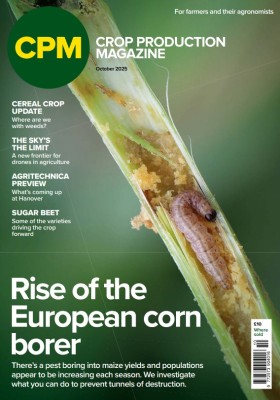

Neither a true winter or spring variety, STR Pace is a high-yielding Group 1 option that delivers the best of both worlds. CPM uncovers what makes this Sprinter wheat stand out, and why it’s causing growers to question what they know about vernalisation.
“It’s a nice fit and a useful tool for if the malting barley market remains depressed.” MICHAEL WILTON
By Janine Adamson
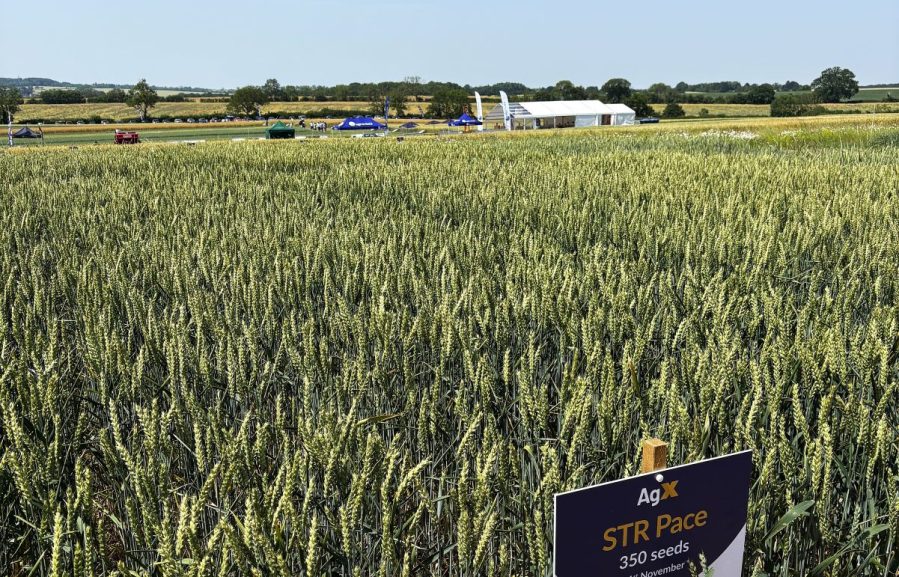
Agrovista’s Lamport AgX site has long been a haven for agronomic R&D – whether that’s related to the topics of grassweed control, soil health, or alternative approaches to crop nutrition. However this year, eyes were focussed on one corner of the site – the firm’s variety trials.
While comparative variety plots always pique grower interest to a degree, in this case, there was something truly different to behold – STR Pace – the first ‘Sprinter’ wheat to be launched to the UK market.
Although it’s officially featured on the AHDB Recommended List as a Group 1 spring wheat, it can in fact be drilled as early as mid-October, explains Agrovista’s Ted Williams. He adds that in crossing different wheat types and blending genetics, Pace boasts the benefits of early vigour and winter hardiness, plus a wide drilling window.
“Choosing a Sprinter wheat like Pace provides security in knowing that if a drilling window is missed, the variety can still perform as expected when drilled later, even in late spring, unlike winter wheat varieties where there’s a vernalisation requirement.
“This is important because in scenarios where later drilling is the preference – to help combat blackgrass or other pest/disease threats – weather becomes more unpredictable and days become shorter. Pace is an agronomic tool that helps to overcome those pressures.”
And because Pace is quick to emerge, establish and develop, it’s ideal to follow late-lifted break crops such as sugar beet, maize or potatoes, suggests Ted. “But critically, it has been bred from a milling quality-focused breeding programme, therefore delivers enhanced protein content (13%), grain quality and robust specific weight (80.6kg/hl). These factors make Pace the earliest maturing Group 1 milling spring wheat on the RL, and one of the earliest maturing overall.”
MINIMAL DISRUPTION
Unlike more conventional-type spring wheat varieties which can be late to harvest, because of its early maturity, subsequent cropping options can be established in a timely manner, minimising rotational disruption, he points out.
Equally, the reason why Pace sits in the spring category and not winter, is because its earliest drilling date is mid-October. This would mean the variety would have been too forward if tested within the AHDB RL protocol for winter wheat.
Taking a look at disease resistance scores, Ted believes Pace offers a respectable overall package, scoring [8] for mildew, 5 for yellow rust, 7 for brown rust, and [6] for septoria. “It’s only weakness if you had to pinpoint something, would be it doesn’t have orange wheat blossom midge resistance.
“However, in every situation, Pace presents a brilliant management tool that can overcome challenges such as heavy blackgrass, having a late-drilled slot and weather unreliability; but it also yields well and has excellent spec weight.”
At two contrasting sites – Lamport and Haddenham in Cambridgeshire – Agrovista has been comparing Pace with a popular late-drilling variety. Last year on the heavy soils at Lamport, Pace yielded nearly 1t/ha more from a November drilling, while on the high-yielding silt soils at Haddenham in Cambridgeshire, uplift was almost 0.6t/ha.
With this year’s trial yet to go through the combine at the time of writing (mid-July), so far, Pace appears to be well ahead of its competition at various drilling dates and seed rates, notes Ted.
Over in Norfolk, Michael Wilton has been growing a 36ha seed crop of Pace at the Stody Estate. He says he decided to give the variety a try because he was looking for an alternative to spring barley to follow sugar beet.
“I was initially intrigued because of Pace’s wide sowing window and the flexibility to choose when it’s planted. Equally, we’re growing hybrid winter barley for seed and that has a wider isolation requirement, so planting a spring wheat fits better than a spring barley in some scenarios,” he explains.
According to Michael, the farm has also struggled with volunteer barley in its winter wheat seed crops, making the drive to find an alternative even more important.
Having committed to Pace, he says the weather turned against him when it came to drilling the crop in mid-autumn, resulting in it being planted around the beginning of March into light, sandy soils. “Ultimately, this means it’s presenting as a spring wheat crop,” he notes.
SPEEDY ESTABLISHMENT
Despite this, Michael says Pace has shown good vigour considering the challenging dry conditions this spring. “All of our crops have been irrigated, including Pace, with the aim of moving nutrition into the plant at the right time.
“I imagine that will have helped, but even prior to this, the crop established quickly with good ground cover and plenty of biomass by early April,” he highlights.
As for disease pressure, the season has proven relatively clean, although Pace did exhibit some yellow rust symptoms, says Michael. “It’s a strong variety though, with a good overall disease resistance package and deep green colour. It hasn’t retained tillers quite how I’d expect it to, but this could be down to the drilling date and seasonal conditions and would be overcome by increasing the seed-rate.
“I’ll reserve full judgement until the combine has rolled, and then it’ll be a case of comparing its gross margin with other crops that fit in that place in the rotation. But for us, it’s a nice fit at this moment in time and is a useful tool for if the malting barley market remains depressed.”
Having grown other spring wheat varieties in the past, he believes Pace has performed better, and that it should be an exciting opportunity for many growers, particularly those with sugar beet in the rotation. As such, he’s planning to stick with the variety for this coming autumn.
“If the yields are good then I’ll likely increase the area up to 80ha, but crucially, aim for an earlier drilling date, ideally in October. However, knowing there’s the flexibility there, it’s not a problem to go after late-lifted beet in December, should conditions allow,” he concludes.
Pace will be commercially available from this autumn onwards, with further Sprinter varieties coming through the pipeline for future launch.
This article was taken from the latest issue of CPM. Read the article in full here.
For more articles like this, subscribe here.
Sign up for Crop Production Magazine’s FREE e-newsletter here.