
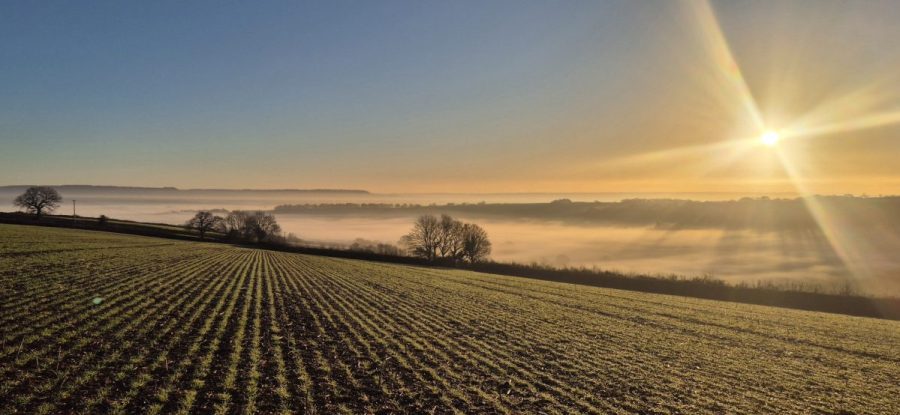
Having recently gained national recognition for his approach to soil management, Devon mixed farmer Paul Baker is proving that strengthening an arable system doesn’t have to mean spending more. From variety blends and heritage genetics to companion crops and reduced inputs, CPM finds out how questioning convention is helping to spread risk and build resilience.
“Ultimately for me, the future is all about being curious and just trying to find another way of doing things.” PAUL BAKER
By Charlotte Cunningham
Devon may be renowned for its mixed farming landscape, but at Paul Baker’s 142ha business, the term ‘mixed’ extends far beyond simply having crops and livestock.
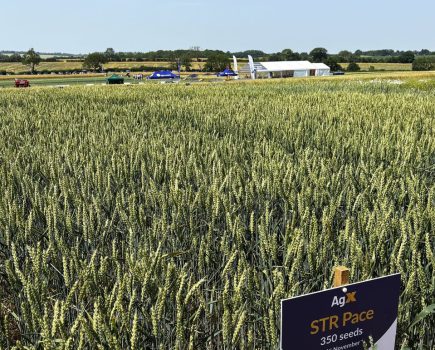
Here, organic and conventional systems sit side-by-side – wheat grows among beans and oilseed rape with vetch, livestock are increasingly being brought into the arable rotation, and even a single wheat crop can comprise five different varieties. Meanwhile, cover and catch crops, reduced cultivations and a growing interest in what’s happening biologically beneath the soil surface are all becoming part of an increasingly diverse picture.
There’s experimentation at almost every turn, but importantly, it isn’t experimentation for experimentation’s sake. Underpinning it all is a relatively straightforward objective – to create a farming system which costs less to run, carries less risk and is consequently better equipped to cope when conditions turn against it.
HIGH FLYER
It’s an approach that’s recently gained national recognition through the Soil Farmer of the Year competition, although Paul admits the journey didn’t begin with grand ambitions around soil biology or regenerative agriculture – it all started with economics. “It probably is a little bit embarrassing to say it wasn’t because I thought that nature was the answer. I was just going down the road of, ‘okay, this is much cheaper, I’m trying to save money and still be here in 10 years.’
“But actually, it turns out leaving it to nature probably is the answer because it does it for free.”
That pragmatism perhaps explains why the system which has emerged is difficult to place neatly into any one farming camp. Paul runs organic and conventional land side-by-side, takes ideas from both and is continually experimenting with ways to make each more resilient, rather than working towards a fixed blueprint.
Alongside the arable enterprise, he rears 60 organic replacement dairy heifers for a neighbour and around 7000 ducks at a time, while he’s also considering how other livestock could have a greater role. He says the aim is to bring livestock back into the cropping wherever they can perform a useful job.
The arable rotation is similarly fluid. On the conventional land, wheat, barley, OSR and beans form the core of the operation, but Paul deliberately avoids setting the rotation in stone. “Markets, conditions and what the soil requires can all change the plan,” he notes. “Everything’s evolving all the time. If I talk to you now about the rotation, it’ll change next week.
“Nothing’s set in stone anymore like it used to be, which keeps us guessing, the agronomists guessing, and any sort of pest guessing as well.”
DIVERSITY DELIVERS
Increasingly, the common denominator is diversity and Paul says that might mean another crop in the rotation, livestock grazing cereals, a companion species growing beneath the main crop or several varieties occupying the same field. “Generally, I’m trying to introduce more diversity, whether that’s livestock, or even microbes,” explains Paul. “No plant is sown as a monocrop. It’s always either as a companion to start with and then we’ll take it out, or it could be a variety blend.”
That philosophy is a considerable departure from the farming system Paul returned home to in 2013. At the time, establishment centred on a plough and combination drill and, initially, his attention was less on changing the system than making the existing one work more efficiently. “I thought, okay, we’ll just be more efficient with things and get the timing better, and it just sort of – nothing changed from year to year. We couldn’t feel that anything was improving.”
The first step away from that approach came with a £4000 set of second-hand discs, initially bought with the organic ground in mind but soon put to work in the conventional system. The first season wasn’t an instant success, with a noticeable yield penalty from discing followed by combination drilling, but it was enough to keep Paul experimenting.
An equally inexpensive 4m KRM tine drill followed, but at which point he’d also started monitoring the time and diesel required for individual field operations – and the figures were beginning to provide a compelling reason to keep changing. “The amount of fuel saving was ridiculous,” he says. “I knew how much fuel and how long it took to do an operation on each field, so it was apparent that the combination drilling was really burning some diesel.”
Today, the conventional system has moved another step further. Paul has converted a 3m Simba Freeflow from 12cm to 25cm row spacings and fitted narrow JJ Metcalfe legs to create a strip-till drill. “So we’ve gone from two really high diesel usage passes in the plough and combination drill, to two faster, lower fuel usage passes in the tine drill and discs. Now we have one pass.”
Across the wider system, diesel use has fallen by around 75%, while crop performance has been maintained. And although reducing cultivation was the starting point, perhaps its greatest impact was prompting Paul to ask the same question of almost everything else he was doing – does this operation, or input, genuinely earn its place?
Nitrogen on conventional wheat has progressively fallen from around 180-190kgN/ha, with Paul aiming to remove roughly another 10kgN/ha each year. He’s now down to around 150kgN/ha.
At 160kgN/ha last season, wheat yielded around 9.9t/ha against a budget of 7.4t/ha, helped by rain arriving when it was needed and fungicide spend was minimal, with only one application late in the season. This year, in starkly different conditions, wheat yielded closer to 6.2t/ha. Yet Paul argues that looking at yield alone misses the point. “Some people are losing money, whereas we’re just making less.”
It’s this lower-cost base which increasingly shapes decisions about everything from chemistry to crop choice – and importantly, the genetics expected to perform within the system. Paul is openly sceptical about accepting variety claims at face value. Instead, he’s increasingly interested in seeing what individual genetics actually do on his farm, under fewer inputs and alongside other varieties or species.
For the past two or three seasons, that has included growing winter wheat as a five-way blend. The current mixture comprises Extase, Beowulf, Champion, Mayflower and Graham, and the extreme conditions this season offered an unexpected insight into how differently those genetics could respond. “There was one variety that wasn’t killed off by the heat in early May, and we believe that was Mayflower.”
The difference really became apparent at harvest, where hand-threshed samples were testing at around 10-11% moisture, suggesting the crop was ready to cut. Yet once the combine entered the field, moisture readings climbed to around 16%. Closer inspection revealed a small proportion of the blend was still green and doughy, explains Paul. “It was a bolder grain. So I think from that you can see, okay, well on my farm, in this season, Mayflower probably works quite well.”
Rather than providing a definitive answer about which variety is ‘best’, Paul says that’s exactly why mixtures interest him. Performance is specific to the farm, soil and season – and the experience has prompted him to consider increasing Mayflower’s proportion in the blend.
That same desire to spread risk is increasingly visible between species too. Winter wheat has traditionally been drilled with beans, which remain through the winter before being grazed by sheep in spring. Paul says grazing has achieved around a 99% kill of the companion, while the approach also brings diversity and potential disease suppression.
NITROGEN FIXATION
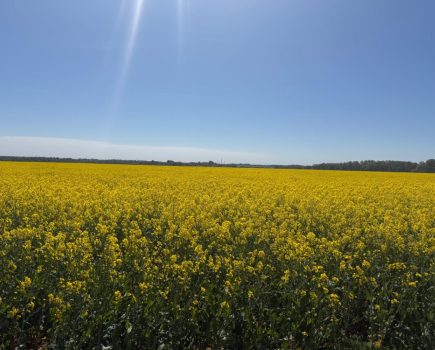
OSR is grown with vetch, which Paul separates after harvest. Alongside a typical farm OSR yield of around 4.9t/ha, he says the system can produce a further 0.6-1.2t/ha of vetch seed. “You get the extra nitrogen fixation from the vetch, which is great, and you get the seed and the diversity in the field.”
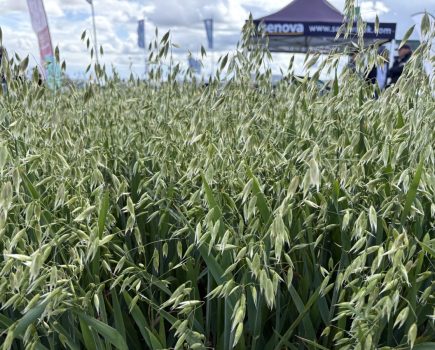
Even two crops which struggle to excite him economically – beans and oats – have become an opportunity to ask whether putting them together can make both work harder. “The oats are weed suppressants. So I wanted to grow beans without having to actually spray them because we end up with an open canopy and it’s all weedy and messy. It could eventually offer a route into growing beans within the organic system too.”
Perhaps the fullest expression of that thinking is Paul’s seven-way polycrop of wheat, barley, oats, triticale, peas, vetch and rye. “It began as wholecrop for the neighbouring dairy business whose replacement heifers we rear. Straight spring barley had previously performed well, but increasingly dry springs made its performance less reliable,” he explains. “Adding peas produced an uplift, encouraging us to widen the mixture further.”
And after one of the driest growing seasons in recent memory, the performance of those more diverse crops has given Paul plenty to consider. His conventional wheat suffered along with much of the country’s crop, but the spring-sown einkorn actually yielded better than the previous season. “Those heritage wheats, they grow to about six foot tall and they root six foot deep. So that builds resilience.”
Cereal rye also performed strongly, while the organic polycrop looked remarkably similar to the previous season when Paul and his customer walked it ahead of wholecropping. “I think that diversity in the sward made it hold on a bit longer,” explains Paul. “It’s not as bad as it could have been had we grown monocrops.”
FUTURE PLANS
It’s already influencing plans for next season. Paul is considering growing peas alongside barley and wants to bring more legumes into the conventional rotation, while continuing to assess which crops and varieties appear capable of coping with a system where purchased inputs are deliberately being reduced.
Yet he’s conscious that genetics can only exploit what’s available beneath them, so for Paul, much of the next stage is therefore about creating a soil in which crops have the best possible opportunity to root, find water and access nutrients. “The main thing is trying to build organic matter in some fashion in the soil, because the more organic matter and humus there is, the more moisture your soil can hold,” he says. “I think your whole system has to be based around that.”
He’s also experimenting with soil biology, using a microscope to monitor applied microbes – a process which has reinforced the importance of feeding what’s already there. “I’ve seen that those microbes are live in the soil for days, but not weeks or months. So it’s about trying to feed them; I think organic matter is where it starts.”
That willingness to challenge convention has also brought Paul’s thinking on varieties almost full circle. He explains that a friend recently gave him around 50 old jam jars containing ears of wheat and barley collected between the 1930s and 1950s. “We’re now attempting to revive them, vernalising seed in the fridge before germinating and, if successful, multiplying it in the field. I’m really interested in what these genetics might offer having originated from farming systems without today’s crop protection programmes.
“It was all very much in rotation, mixed farms back then. So I think that’s what we need to go back to.”
For Paul, that doesn’t mean recreating farming as it was 80 years ago, but rather understanding what can be taken from those systems and made relevant today. Whether that’s greater genetic diversity, companion cropping, fewer inputs or simply allowing biology to do more of the work, the aim is to keep building resilience without adding unnecessary cost. And with a system that remains very much a work in progress, he says there’ll always be another idea to test.
“Ultimately for me, the future is all about being curious and just trying to find another way of doing things.”
This article was taken from the latest issue of CPM. Read the article in full here.
For more articles like this, subscribe here.
Sign up for Crop Production Magazine’s FREE e-newsletter here.