
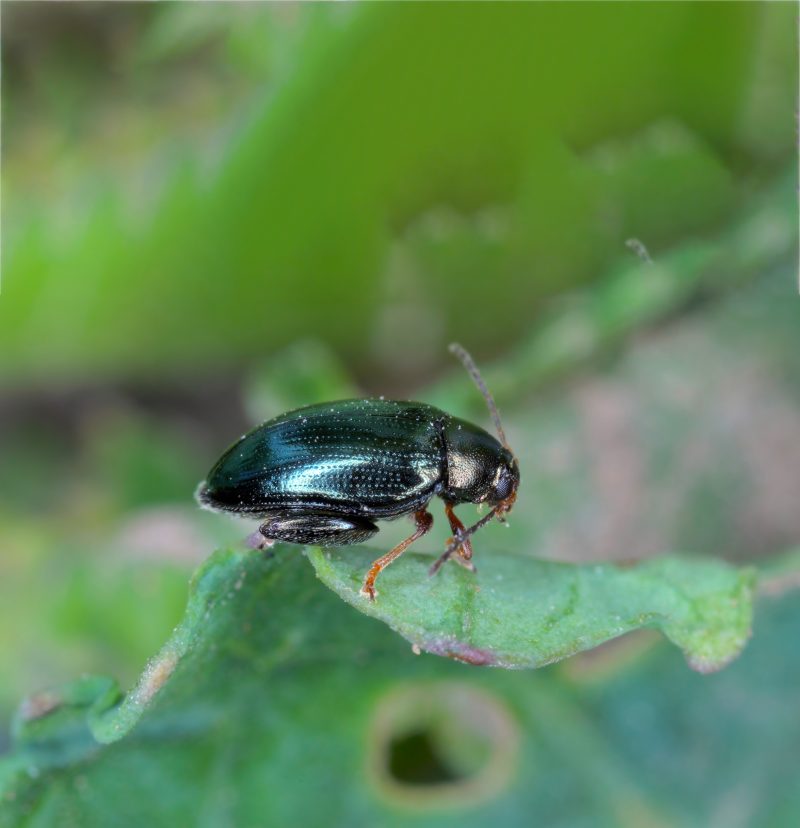
A research project that aims to identify genetic variation in oilseed rape lines that are resistant or tolerant to cabbage stem flea beetle is in its final stages. CPM takes a look at how the findings will make a difference for growers.
“Just like disease resistance is a key focus for the Recommended Lists, palatability could eventually become a similarly important trait.” SIOBHAN HILLMAN
By Janine Adamson
Five years ago, a collaborative research project launched with the aim of answering whether it’s possible to breed oilseed rape varieties with greater resilience to cabbage stem flea beetle. The work, led by the John Innes Centre with support from Rothamsted Research and AHDB, is now preparing to conclude, and perhaps critically, the results appear promising.
The initial concept began several years prior in response to the EU-wide neonicotinoid ban, as well as increasing concerns regarding pyrethroid resistance. Consequently, studies, also led by JIC and AHDB, explored the basis of varietal CSFB resistance.
These identified potentially useful variation in adult feeding damage in laboratory-based ‘choice experiments’ that were later replicated in the field. Furthermore, preliminary laboratory screens for resistance against CSFB larvae found potential differences in the frequency of adult emergence between the 40 lines tested.
As such, the results suggested some OSR varieties carry genes that may deter adult CSFB feeding and confer resistance against larval infestation, paving the way for further work to investigate the concept.
PROJECT LAUNCH
This commenced in 2021, funded mostly by the BBSRC Industrial Partnership Award (IPA) scheme, and supported by a consortium of stakeholders including DSV, KWS, Limagrain, Bayer, Elsoms Seeds, RAGT, NPZ (was LSPB) and BASF. Together, the goal was to investigate how breeding could best harness the genetics identified during the initial studies.
The project was divided into three main work streams exploring around 100 lines of Brassica napus: characterising the genes associated with adult CSFB feeding and the mechanisms of plant resistance; understanding the basis of variation underlying reduced adult CSFB palatability and exploitation for breeding; and understanding the variation in larval resistance to CSFB.
If successful, this would mean the potential introduction of OSR varieties with resistance to CSFB within the next decade, thus offering a long-term, insecticide-free solution for combatting the pest. It could also help to identify and promote changes in research and breeding strategies for resistance to other insect pests.
With the project preparing to conclude, JIC senior scientist, Dr Rachel Wells, says the work has not only addressed its original objectives, but delivered results which should have a positive impact at a much wider level.
“The project and its funding have allowed us to develop a comprehensive rearing strategy for CSFB in laboratory conditions. This is significant, because in the field, there’s only one generation of the pest present each year.
“Being able to rear CSFB effectively in the lab means we can produce our own generations – enabling continuous testing. This has dramatically opened up the capabilities of research to address not only genetic solutions, but novel biocontrols too,” she explains.
This is particularly useful for when field pressure is low, as has been the case this season and the last, adds Rachel. “We had potential resistant lines to trial but couldn’t test that new genetic material in a truly robust way because there simply weren’t enough beetles.
“But now, we have a really useful research tool at our fingertips – one that’ll be helpful long-term. It’s a big win.”
AHDB technical lead for the project, Dr Siobhan Hillman, believes this is an incredible achievement from the scientists at JIC. “It sounds like a relatively simple thing, but relying on field samples significantly restricts the pace at which research can take place.
“In devising a new rearing strategy, we’ve entered a new frontier in CSFB research. Plus, in sharing this with other laboratories, partners and breeders, there’s been no gatekeeping – it’s revolutionary,” she states.
FEEDING PREFERANCES
Similarly, the project has also generated robust protocols to assess feeding damage in laboratory tests. In utilising this, the research has identified significant differences in adult feeding in commercial OSR lines.
This demonstrates the significance of variety choice in integrated pest management approaches, proposes Siobhan. “Just like disease resistance is a key focus for the Recommended List, palatability could eventually become a similar trait to highlight. Variety choice is evidently fundamental and will play an even more important role in the future.”
According to Rachel, another key outcome from the project has been greater understanding of CSFB’s interaction with the host plant – whether feeding is stimulated by the plant’s chemical properties, or if the relationship is based on the plant’s response to feeding.
The science behind this hypothesis comes from beetle behaviour. Beetles use their mouthparts, antennal tips and leg segments furthest from their bodies (tarsi) to scan leaves for metabolites. Some of these metabolites can attract pests and beneficials, whereas others may deter them.
A metabolite analysis of brassica cotyledons conducted by project partners Rothamsted Research revealed a wide range of surface and internal compounds. Initial results indicated no correlation between waxes and sugars and beetle feeding, and no difference in the time taken to start feeding on leaf material between resistant and susceptible genotypes (which occurs within the first few hours of beetle introduction). However, there were significant differences in feeding after 24 hours, with less damage on resistant lines.
Rachel says while there are some aspects that require further work, what the research has concluded, is that the plant specifically responds to feeding by the beetle. “We observe an activation of defence responses, and growth appears to shut down; there’s essentially a trade-off.”
She adds that of the candidate genes associated with beetle feeding, some are associated with susceptibility, while some are only expressed in resistant plants in response to feeding. All of this could comprise a resistance mechanism, consequently, further research is taking place at JIC as part of the institute’s core OSR research programme.
Compared with adult CSFB behaviour, Rachel points out that knowledge remains limited regarding larval-plant interactions. In a bid to address this, part of the project at both Rothamsted Research and JIC involved field trials to assess larval numbers across different Brassica napus lines.
Rachel says this was relatively inconclusive. “We found the larval numbers across the varieties was highly variable, which makes looking for larval resistance in the field difficult. It’s a negative result in one instance, but also positive from a research perspective as it hones future focus.”
TEMPERATURE EFFECTS
Rothamsted Research also looked at larval development and population numbers throughout the winter months, with work led by Dr Sam Cook and Dr Patricia Ortega Ramos. “We observed first instar larvae (the youngest larval stage) even in February plant samples, which indicates the adult females continue to lay eggs during the winter,” explains Rachel.
“This suggests there are temperature effects; we simply don’t have harsh enough winters in the UK to knock the adults back,” she adds.
The project also developed protocols to perform controlled larval trialling, with the aim of finding antibiosis resistance – where larval survival and development is reduced. This formed the basis of an experiment looking at various Brassica napus lines (including popular variety Campus), plus white mustard as control.
Rachel says knowing that larvae are far less successful at survival in white mustard plants, they’d hoped to find similar in Brassica napus, but were unsuccessful. “This again shifts our focus – we can assume that larval populations may be more related to the adult female’s behaviour and where she chooses to lay her eggs, rather than antibiosis.
“We could also potentially look at isolating the effective trait in white mustard, to see if this can be introduced into Brassica napus through targeted breeding methods. This is certainly worth investigating in the future.”
With so much to unpack from the project, one outstanding take-home is the power of collaboration across the sector, suggests Siobhan. “At a time when the OSR area had significantly declined, the level of information sharing and enthusiasm for the crop has been impressive.
“It demonstrates how important OSR continues to be for the UK, whether for academics, breeders or wider industry partners. The whole project has been a huge success, delivering more outcomes than originally laid out.”
And all the while, OSR has been continually boosted by individual research programmes and development work from the breeders, adds Rachel. “For the adult beetles especially, we’ve tested some of the new material versus existing lines and have already noted a step up in resistance.
“This would suggest that the new varieties preparing for launch may also be more resistant to CSFB than what was available previously. There are some great crops out there; perhaps we’re learning to live with the beetle,” she concludes.
This article was taken from the latest issue of CPM. Read the article in full here.
For more articles like this, subscribe here.
Sign up for Crop Production Magazine’s FREE e-newsletter here.