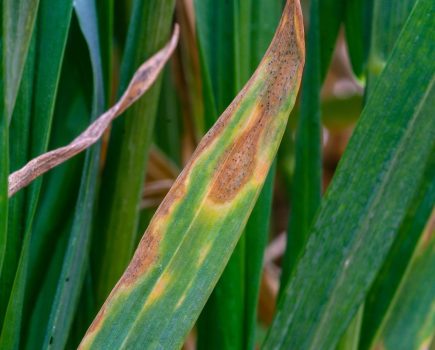


With early drilling and prolonged wet conditions meaning the risk of septoria is high this season, can growers successfully combat the disease while managing increasing resistance concerns and their business balance sheets? CPM weighs up the conundrum…
“Evidence suggests we’re seeing more changes in the efficacy of SDHIs than other fungicide groups.” JONATHAN BLAKE
By Janine Adamson
While the breakdown of the Yr15 resistance gene has meant yellow rust has somewhat stolen the limelight in recent months, growers are urged to not neglect the threat of septoria. In fact, early indications suggest a significant impact on yield from the disease if left unchecked, highlights ADAS’ Jonathan Blake.
“Broadly speaking, the pressure coming out of winter is high and septoria is rife, even in varieties with decent resistant scores. This means the rainfall throughout April and May will be key in determining just how significant that pressure continues to be,” he warns.
Once yellow rust concerns have been addressed with early, appropriate applications, he hopes growers will now turn their attention to finessing T1 and T2 product choices. “Robust chemistry at these timings is critical in keeping the top three leaves clean from GS39 onwards.
“Ultimately, fungicides prevent septoria’s threat to yield, and will help to maximise the excellent crop potential that’s present this season,” comments Jonathan.
However, as with many aspects of farming, the road to a solution is ever-winding. Not only will early drilling this autumn have knocked variety disease resistance scores, but concerns remain regarding the performance of key fungicide groups, namely triazoles and SDHIs.
These concerns are based on resistance – whereby a fungal pathogen’s sensitivity to a fungicide is reduced, thus resulting in a failure to completely control the disease.
Jonathan highlights that the only way to truly avoid selection for sensitivity is to not apply fungicides at all, which in the presence of high disease pressure, is impractical. He also raises that while resistance is a broad term, the speed of decline varies across the different modes of action.
“Azoles took around 20 years to decline, equally, we’ve observed a change in SDHIs for some time; this isn’t a new occurrence.
“But what does appear to be happening, is we’re still selecting for greater SDHI insensitivity, which we’re not seeing in the likes of azoles such as mefentrifluconazole, or QiIs (fenpicoxamid). So evidence would suggest we’re seeing more changes in the efficacy of SDHIs than other fungicide groups,” he says.
He stresses that while this appears to be the case, independent monitoring and research regarding the degradation of fungicides to resistance remains limited in relation to the scale of the problem at hand.
In a bid to address this gap, work has taken place to track resistance development in septoria using a validated computer modelling system. Undertaken by ADAS and Corteva, the aim was to explore ways to protect SDHIs, with one concept being to introduce Univoq (Inatreq (fenpicoxamid)+ prothioconazole).
Belonging to the Qil group means Inatreq is a different mode of action for septoria control, highlights Corteva’s Mike Ashworth. He adds that this is critical, given the domination of SDHIs and azoles in conventional T1 and T2 sprays. “Additionally, two new SDHI fungicides have recently been launched (Adepidyn (pydiflumetofen) and Iblon (isoflucypram)), both recognised as strong at combatting septoria. However, because SDHI resistance already exists, this means those products have entered a high-risk environment.
“If both are then used in the same programme, this will inevitably place further selection pressure on septoria, and greater resistance risk. Instead, if we replace an SDHI at T2 with Univoq, our modelling work suggests this can double the effective life of the SDHIs.
“With just three sites of action for effective septoria control, using the Inatreq component of Univoq in this way means growers can achieve the same level of disease control while extending the life of another critical fungicide group,” he explains.
This methodology is based on the fact that a primary contributor to fungicide resistance is the repeated use of certain modes of action, hence the industry’s drive to mix and alternate between the fungicide groups.
By introducing an alternative mode of action, in this case from the Qil group, this reduces the overall pressure. However, this can’t be at the detriment to Inatreq, stresses Mike. “The Univoq label permits only one application per crop and this was a conscious choice made during the product’s registration. This must be adhered to.”
Corteva’s Sally Harris points out that despite a rocky start for Univoq’s reputation, last year there was a significant decrease in reported sprayer incidents. “Compared with 2022 when the product was launched, we’ve seen a 99% reduction. Hopefully this reassures growers that with some minor amendments to how the product is used, it can be applied without concern,” she says.
“Around 1.5M hectares have been sprayed with Univoq and it remains solid and working effectively. This is confirmed by sensitivity testing which indicates it’s maintaining its position with no significant shifts in control, partly due to the restrictions on its application per crop.”
Jonathan agrees with this sentiment: “Qils are also at risk of resistance development, so it’s vital to avoid over-relying on that group too. Luckily, with only one application per crop per season, this goes some way to safeguard their effective life,” he says.
The modelling work also explored the introduction of multi-site folpet at T1 and T2 in addition to Univoq at T2, which according to the data, should protect SDHIs even further. In fact, taking this approach can add another 50% to the effective life, equating to tripling the lifespan of SDHIs.
While this is a message relating to the use of Univoq from Corteva, the overall strategy seems relatively consistent across all ag-chem manufacturers – utilise different modes of action in order to protect all available fungicides.
BASF’s Steve Dennis says the goal should be to simply avoid using products that rely on an SDHI component to control septoria at both T1 and T2 timings. “New data suggests this is increasing the selection pressure.
“Instead, using Revysol (mefentrifluconazole), as the only azole which now gives sufficient control of septoria, and Qils as in fenpicoxamid, should prove a robust strategy. Equally, multi-sites are a useful tool to help reduce the pressure on higher-risk active ingredients,” he comments.
Moving from SDHIs to consider the performance of azoles, while resistance shifts seem to be moving relatively slowly for this group, AHDB recommends alternating throughout the season to avoid over-exposure.
Due to its unique chemical make-up, this makes mefentrifluconazole a useful tool to reduce the reliance on prothioconazole, which is recognised as the most widely used azole, suggests ProCam’s Paul Gruber.
Classed an as isopropanol-azole, mefentrifluconazole can assume different conformations, binding to the target site more easily even when mutations have developed.
“So unlike other azoles, Revysol doesn’t appear to have slipped since its launch; used at an appropriate rate early in the programme its doing an adequate job,” states Paul. “In high septoria pressure scenarios the message is clear: rotate azoles, minimise SDHIs and introduce multi-site chemistry.”
This compelling message is what led ProCam to work with BASF to instigate RevyTur (mefentrifluconazole+ sulphur) – a product that ticks the boxes for both Revysol and a multi-site.
Steve adds that having a non-SDHI product with a built-in multi-site poses a robust technical argument given current resistance concerns. “Revytur tank-mixed with fenpicoxamid delivers an exceptional treatment; it’s certainly possible to have an SDHI-free ‘T’ timing.”
Although sulphur has been used as a fungicide for some time, bringing it under BASF’s R&D umbrella should deliver greater results for growers, believes Steve. “For one, the handling characteristics have been much improved.
“RevyTur is a prime example of why putting effort in to elevate existing chemistry [sulphur] to match our wider R&D portfolio matters.”
ProCam’s Nigel Scott points out that when used in trials, multi-sites always deliver a return on investment, but arguably, the greater value currently lies in resistance management. “We have to protect all modes of action, and using a multi-site is one way to achieve that goal.
“It may appear simple to devise the perfect fungicide programme that balances both efficacy and resistance management, but messaging can be mixed and knowledge varies dramatically. That’s why it’s critical that we work together to have the same consistent message for now and the future.”
However, beyond effective disease control and addressing resistance concerns, there remains one primary driver this season – getting a handle of input costs. Not only are grain markets perpetually depressed, but current geopolitical unrest has hiked the price of key inputs from fuel to fertiliser.
Even so, Paul stresses that cutting corners with fungicides could lead to significant losses at harvest, this year especially. “The yield potential is there and it’s in everyone’s best interests to preserve that. Equally, septoria levels in some crops this year are as high as I can remember, which will in part be due to early drilling.
“Depending on geography and other farm-specific variables, it’s about balancing the threat and acting accordingly,” he says.
This could mean deploying a firebreak to stop disease in its tracks, adds Paul. “Not doing so was evident in 2024; the more that can be done early doors, the better. Conventionally, T2 was always the most important timing, but increasingly we’re seeing greater emphasis on T1 as a robust foundation.”
Nigel believes that with the shifts in SDHI efficacy, the pressure is on agronomists to keep on-top of industry guidance. “Seeing the reported changes is concerning, and without on-label rules for SDHIs this means we have to go above and beyond to preserve the chemistry. It’s up to agronomists to get a grip of that and find a solution, which will also involve looking beyond the can.
“Every element of a disease management programme must be scrutinised and therefore maximised,” he concludes.
This article was taken from the latest issue of CPM. Read the article in full here.
For more articles like this, subscribe here.
Sign up for Crop Production Magazine’s FREE e-newsletter here.