

Tackling light leaf spot in oilseed rape could soon be a problem of the past thanks to the application of precision breeding techniques. CPM investigates LLS-Erased, the project behind innovative work driving to find a solution.
“Around 15 years ago we might have seen 90% control of light leaf spot using fungicides, but we now routinely see around 50%.” DR FAYE RITCHIE
By Janine Adamson
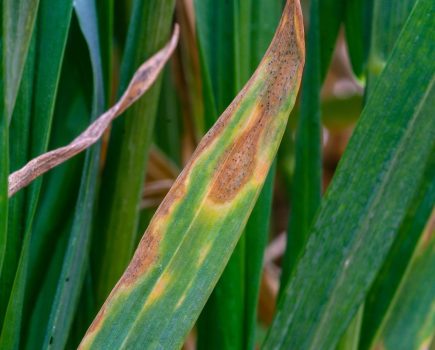
Widely recognised as the most economically damaging disease in UK oilseed rape, light leaf spot continues to challenge growers, particularly in the North. And while OSR has experienced a welcomed renaissance lately – last year saw a bumper harvest for many – researchers suggest the threat of light leaf spot simply hasn’t gone away.
Acknowledging this background risk has led to the launch of a new Defra-funded project called LLS-Erased. The aim is to investigate whether the work of breeders to improve varietal disease ratings, specifically for light leaf spot, can be improved further by applying precision techniques.
Oxfordshire farmer Tom Allen-Stevens is managing director of the British On-Farm Innovation Network (BOFIN), the group leading the work. He points out that yield losses from light leaf spot continue to increase.
“Crop losses from the disease peaked at the equivalent of more than £300M in 2022. The problem with the pathogen responsible is that it cycles several times in a season, unseen, until it’s already taken hold,” explains Tom.
He adds that because of this, fungicides can be less effective, and with no existing forecasting system, it can be difficult to time applications correctly to get ahead of the disease.
According to Tom, while breeders have improved varietal resistance through genetics, due to pathogen shifts, new virulent strains are emerging that can overcome this protection. “However, precision breeding through gene editing presents new opportunities.
“As such, scientists working on LLS-Erased have recently identified a novel susceptibility gene that could prove to be game-changing. Unlike traditional gene-for-gene interactions whereby a pathogen can break down resistance, they’ve introduced a specific change in the plant’s genome that has conferred considerably reduced susceptibility.
“The pathogen simply finds no place in the novel plant where it can take hold and cause devastation.”
Perhaps critically, by utilising precision-breeding in this way, its possible to accelerate the introduction of beneficial traits without introducing foreign DNA (as in genetic modification).
To support this genetic advancement, the project is working on developing a new risk forecasting tool based on molecular markers to enable real-time decision-making. Both the breeding and forecasting work will then be taken to the field through farmer-led trials, meaning UK growers will be the first in Europe to trial such innovations.
At the heart of the entire project is collaboration, stresses Tom. Key stakeholders include John Innes Centre, the University of Hertfordshire, ADAS, Scottish Agronomy, UK Agri-Tech Centre, Elsom Seeds, KWS, Limagrain, DSV and NPZ. The work also involves US-based Cibus, whose rapid trait development system enables precise genetic edits to be introduced directly into elite breeding lines.
University of Hertfordshire’s Professor Yongju Huang says two factors are involved in understanding how to control light leaf spot better. “The first is understanding the host resistance.
“We currently have two types of resistance to control this disease: major gene resistance that stops secondary infection, and quantitative resistance that reduces sporulation and therefore only reduces secondary infection. To have really effective resistance, we require no sporulation or secondary infection,” she explains.
Then to effectively use such cultivar resistance, it’s important to understand the pathogen population races and their regional differences, comments Yongju. “But currently we don’t have this information.
“So by detecting pathogen races from leaf samples (see box) as part of this project, we should be able to deploy cultivars with effective resistance on a per-region basis. We’ll also use spore samplers at trial sites in different georgraphies to detect the timing and abundance of spores to inform the forecasting tool.”
ADAS’ Dr Faye Ritchie highlights that underpinning the LLS-Erased project is a drive towards greater use of integrated disease management strategies. “Around 15 years ago we might have seen 90% control of light leaf spot using fungicides, but we now routinely see around 50%. That doesn’t mean fungicides aren’t doing anything, but that there are opportunities to improve substantially.
“Yield losses exceed other diseases, and we’re observing azole-insensitive strains. Although that isn’t yet impacting field performance, it is something we should always bear in mind when considering control measures.”
According to Faye, conventional breeding has already made substantial improvements, with many Recommended List varieties now offering light leaf spot resistance scores of 7. “We require an integrated approach because pathogens will continue to overcome control measures, no matter what’s thrown at them. Equally, we have limited trials data that suggests fungicide inputs could be better targeted.
“The trials show that just by using a variety with good light leaf spot resistance, we can achieve a yield response. Those trials weren’t conducted in a particularly high pressure year either, suggesting the benefits of using a variety could be even higher.”
Similar work has been undertaken exploring fungicides, looking at the role of application timing, further cementing the necessity for a decision support tool, adds Faye.
“Having the opportunity to develop a real-time forecast with local weather data will enhance how we predict disease risk. By reviewing all historic guidance and metrics around disease pressure, we can develop a dual epidemiological and weather-based model to predict probability.”
She believes a key aspect of the project is testing. “We have to make sure the outcomes are fit for purpose so having growers involved from the off will be critical,” concludes Faye.
The Genetic Technology (Precision Breeding) Act 2023 has allowed for the release and marketing of certain gene-edited plants. This makes England currently the only country in Europe where this novel material can be grown in farmers’ fields.
This article was taken from the latest issue of CPM. Read the article in full here.
For more articles like this, subscribe here.
Sign up for Crop Production Magazine’s FREE e-newsletter here.