

With disease pressure building in winter wheat, exacerbated by continued damp conditions, growers are being urged to maximise the current crop’s burgeoning potential by finessing all aspects of production. CPM reports…
“In all the years I’ve been doing PGR trials, a split treatment has always been the approach that’s kept crops standing.” RON GRANGER
By Janine Adamson and Rob Jones
This season there’s a consistent message emerging from all aspects of the crop production industry – take proactive steps to preserve yield potential. While at the time of writing it might not feel too spring-like, crops have exited winter carrying much promise, which is a stark contrast to last year’s struggles.
Although much will depend on weather conditions later in the spring, as well as how disease risk and nutrition are managed, Limagrain’s Ron Granger stresses that equal care has to be taken to manage crops with large biomass, to retain strong tillers through to harvest.
“Many farms drilled crops several weeks earlier than usual in autumn. With a relatively kind establishment period and winter, this season is looking very different to previous years with huge biomass and yield potential in a lot of crops,” he says.
With this comes the inevitable risk of lodging, meaning manipulating growth to strengthen stems and retain tillers will be essential to avoid being caught out, adds Ron. This means shortening the distance between internodes; keeping the first node tight to the basal node and the second node close to the first, which increases straw stiffness, he explains.
Ron adds that generally speaking, a split PGR programme of two carefully-timed applications is advised – one just before the start of stem extension around GS29-30; followed by a second at the first node detectable stage, just prior to the second node moving (GS31-32).
“In all the years I’ve been doing PGR trials, across thousands of variety plots, a split treatment has always been the approach that’s kept crops standing. On-farm, you can be more targeted to just a single variety so growers can sometimes get away with a well-timed single application, but I still question whether many are getting the timing right.”
A useful, reliable way to ensure accurate timing is to observe the primordia ear development. However, Ron suggests using careful plant dissection to determine when individual nodes are moving, both off the base of the plant, and between differing nodes of interest.
“Crops have been drilled earlier and will move quickly, especially once nitrogen is applied, so be vigilant and proactive, don’t rely on calendar dates.”
Should conditions remain wet, growers may have to apply a full-rate single PGR programme targeted around the first node detectable stage (GS31). Conversely, if conditions turn very dry into April, care should be taken to avoid applying PGR products to stressed crops, raises Ron.
“We’ve seen from previous seasons of drought that when plants are compromised, you can reduce yield by applying a PGR. It’s better to apply PGRs early while crops are healthy and there’s plenty of water available so they’re growing strongly.”
Shifting to fungicides, and the Crop Doctor team has been on tour to analyse current field trial conditions. At Callow near Hereford, this involved inspecting 35 AHDB Recommended List winter wheat varieties.
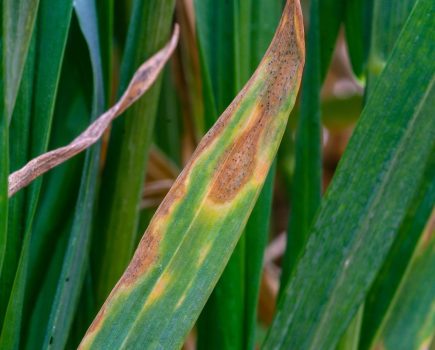
At the end of March, arguably to be expected, septoria was the main culprit, present at varying levels across most plots. But equally, the team discovered active yellow rust in several varieties including Bamford, Champion and LG Typhoon.
ADAS arable plant pathologist, Chloe Francis, highlights that it’s unusual to see yellow rust that early in the West. “But with the breakdown of the Yr15 resistance gene, we’re seeing the pathogen more widespread than usual; Champion in particular had clear foci at the site.”
Traditionally, Callow isn’t a high yellow rust site, raises Bayer’s Gareth Bubb. “I’ve never seen yellow rust pre-T0 at Callow, but it’s here this year.”
Pustules of mildew were also found, as were the distinctive stem base lesions of eyespot found in KWS Extase. Chloe shares that after a spell of methodical searching, she found an isolated spot of sporulating brown rust on Champion.
With a tebuconazole-based T0 planned for the first week of April at the site, followed by a T1 spray three weeks later, there’s still time for the weather to shift disease dynamics, agrees the team. However, the general consensus among the Crop Doctors is that based on the plots at Callow, there’s potential for 2026 to be a high disease pressure season.
Mindful of the septoria pressure in the region and unpredictable weather patterns, Gareth recommends a robust T1 to manage disease risk. “On this site our options would be Ascra(bixafen+ fluopyram+ prothioconazole), or Plaxium(fluopyram+ isoflucypram+ prothioconazole )/Vivalis (isoflucypram + prothioconazole). Because of the septoria risk, I’d be going down the Plaxium route to cover the rust, eyespot and mildew as well,” he says.
Moving to Bayer’s demonstration site at the Walpoles near King’s Lynn in west Norfolk, and yellow was also present, although being held back by coastal winds, suggests the firm’s Aleks Ćurčić. “There was a lot of septoria in lower crop canopies. Most varieties had yellow rust present, although how active it was, was variety dependent,” she says.
Again, it seemed varieties with reduced yellow rust ratings due to the Yr15 breakdown were carrying more disease. Niab’s Dr Aoife O’Driscoll says visually, this can be quite staggering.
“Previously we’d have expected to observe yellow rust in two or three varieties, but we know because of the Yr15 issues that was not what we were going to see this year. Yellow rust was in 90% of the varieties at Walpoles, which isn’t unexpected, but is still quite shocking to see,” she comments.
The third and final leg of the T1 Crop Doctor tour took the team to Stockbridge Technology Centre in Yorkshire. ADAS’ Jonathan Blake was keen to see how the line-up of 35 winter wheat varieties was faring.
He found yellow rust in Crusoe plus a little mildew, but no brown rust. KWS Arnie, in an adjacent plot looked clean, as did RGT Hexton, although there was mildew in the latter. As for Bamford, however, yellow rust was making itself known.
“Yellow rust can strip green leaf out like no other pathogen,” says Jonathan, adding that if left unchecked, early, heavy infections can cut yields by more than 50%.
Moving through the plots, Champion, LG Beowulf and LG Typhoon all had yellow rust, and perhaps unusually, Graham indicated significant early infection. Close examination of Typhoon revealed that some plants had up to five leaves affected.
“At that sort of infection level, tillering will be affected,” comments Jonathan. “When yellow rust strikes early, it stops the crop canopy forming.”
With growers in the region keen to push on with drilling last autumn, there are some big, lush crops around, highlights Bayer’s Tom Sowerby.
“These should benefit from the strong chemistry of Plaxiumat T1, but take account of your variety and drilling date when you’re planning your approach. Where you have the genetics and a later drilling date – perhaps after potatoes or sugar beet – and disease risk is lower, there’s still a place for Ascrain the programme,” he adds.
Given the prospect of a high pressure year, including a multi-site at T1 should help to ensure plants retain green leaf area and maximise yield, urges Adama. This is reflected in seven years-worth of trials that suggest including Arizona (folpet) can deliver a yield response of around 0.31t/ha.
According to Adama, the yield-enhancing benefit of folpet has been shown to be consistent irrespective of how the weather unfolds, and that a key timing for its application is T1 to help combat septoria.
Equally, Arizona also offers a useful reduction of yellow and brown rusts, and intrinsic activity against mildew.
For the best results in combatting septoria, however, the firm recommends a programmed approach of inclusion at T1 and T2 to keep a greater percentage of the crop’s canopy greener for longer. Application rate also has an impact on yield benefit, with two applications of 1.5 l/ha providing a better return on investment compared with two treatments of 1.0 l/ha.
This article was taken from the latest issue of CPM. Read the article in full here.
For more articles like this, subscribe here.
Sign up for Crop Production Magazine’s FREE e-newsletter here.