

Could farmers create extra value by producing measurably nutrient-dense food? CPM joined speakers at the Green Farm Collective conference, who provided an optimistic update.
“Our vision is that if there’s nutritional variation, we can empower people to choose better food off the shelf.” DAN KITTREDGE
By Mike Abram
Growing commodities can often feel like a race to the bottom – having to compete on price and cut costs, accept smaller margins, or lower standards just to stay in the market.
However, speakers at the Green Farm Collective’s ‘soil to slice’ conference pointed towards a future where it could become a ‘race to the top’, with farmers competing on producing the highest quality, nutrient-dense food.
Public health nutritionist Ali Morpeth, co-founder of Planetary Alliance, acknowledged the current food system model that’s optimised for volume, efficiency and price, had been successful at filling shelves.
“In the post-war period, national food resilience meant just one thing – producing more food, reliably and at a lower cost,” she said. “That production-ist model delivered; it rebuilt stability, filled shelves and normalised abundance, and for a lot of the 20th century, probably made sense.
“But in my career in public health nutrition, I started to see a different side where we were calorie-secure and also nutritionally fragile at the same time. You can have abundance in supply chains, while also having mass levels of diet-related disease.”
Sharing some health-related statistics to support that statement, Ali said two-thirds of adults in England are overweight or obese, while poor diet is responsible for 13% of early deaths. “Obesity costs the NHS more than £6Bn a year. When you add in the wider economic impacts including lost productivity, that rises to £58Bn/year, yet 11,000 people are hospitalised every year in the UK with malnutrition. This is what nutritional inadequacy looks like, even when our supply chains are successful.”
TRUE IMPACT
Globally, the food system generated $10T in market value, but cost $15T after taking into account environmental damage, health impacts and social costs, she said.
“In other words, the food system costs us a lot more than the value it creates when its full impacts are measured, and diet-related disease is one of the main drivers of that cost.”
Per calorie, healthy foods are significantly more expensive, while incentives constantly steer consumers towards less healthy options, she noted. But the era of cheap calorie food is coming to an end, said Ali, citing four key structural forces that are changing business as usual.
First, there’s increasing recognition that governments can’t afford the bill for diet-related diseases. That’s leading to policy aimed at improving the nation’s diets, such as putting in place planning restrictions on fast food restaurants in city centres and tighter advertising controls. There’s also a growing expectation that large food businesses will be required to report on the proportion of healthy food they sell.
Second, the rapid increase in use of appetite-suppressing drugs, which trials suggest cause a 30% reduction in energy intake. “In the US, users typically reduce their consumption of junk foods and move towards eating more and better whole foods. That matters as it’ll cause the volume-based model to wobble and opens the door for quality,” explained Ali.
Discussions about ultra-processed and unhealthy food are also pushing consumers towards questioning quality, nutrients, ingredient transparency and health value. Then, the fourth factor is climate and geopolitical volatility affecting sustainable production of the key commodity crops, wheat, maize, rice, soy and sugar, that underpin a significant proportion of modern food manufacturing, she said.
“The food system will become increasingly organised around different forms of value, which is a huge opportunity for farmers. Value will take into account nutrient composition, measurable health outcomes, resilient domestic production under climate stress, reduced regulatory exposure to high fat, sugar, salt and unhealthy foods, transparent reporting and importantly more integrated strategies that link farming, climate and health,” she predicted.
One key enabler in Ali’s vision are handheld tools that could help consumers to easily test food quality. Developing such a tool to allow a consumer to ‘flash a light’ at a carrot or a steak to receive an instant nutritional rating on their phone is one of the key outcomes founder of the Bionutrient Food Association, Dan Kittredge, is hoping and already beginning to achieve.
By putting such technology in the hands of shoppers, he hopes to force a level of transparency that means consumers buy on quality, defined by flavour, aroma and health-giving attributes. It could also create a market where the supply chain competes to provide the most nutrient-dense produce, rather than farmers competing to produce the cheapest commodity.
“Our vision is that if there’s nutritional variation, we can empower people to choose better food off the shelf and pull through an incentive for the supply chain to focus on nutrition,” he explained.
TRIPLE APPROACH
To test whether this is a viable strategy, he and his team identified three challenges they have to overcome or prove. The first challenge was to find out how much nutrient variation exists in food as little previous research has been done, he said.
Secondly, they had to develop a spectrometer, preferably in a smartphone, that could be used by consumers to identify what nutrients were in produce. In theory, a spectrometer can read the ‘light fingerprint’ of the produce and compare it with known fingerprints to estimate what nutrients and compounds are inside.
“If we can find out that methane is in the atmosphere of a planet 10,000 light years away from comparing a flash of light, we should be able to read a carrot a few millimetres away,” suggested Dan.
“If it can be done, we could profoundly shift the way agriculture is practised and have the kind of benefits the regenerative ethos is driving towards.”
The third identified challenge was if there is nutrient variation in food, understanding what causes it. Subsequently, four years of research involving around 20 food crops and 10,000 samples has gone a long way to proving that nutrient variation in crops exists.
For example, there are 40 times more antioxidants in the highest tested carrot compared with the lowest level, and 20 times more polyphenols. The same pattern is repeated for all the minerals tested, and across the different food crops.
Typically, across all the samples, the values fell into a skewed distribution, where more values cluster in the middle, with fewer at the extremes. But for most minerals, antioxidants or polyphenols, values clustered closer to the lower end than the higher end, providing opportunity for improvement, raised Dan.
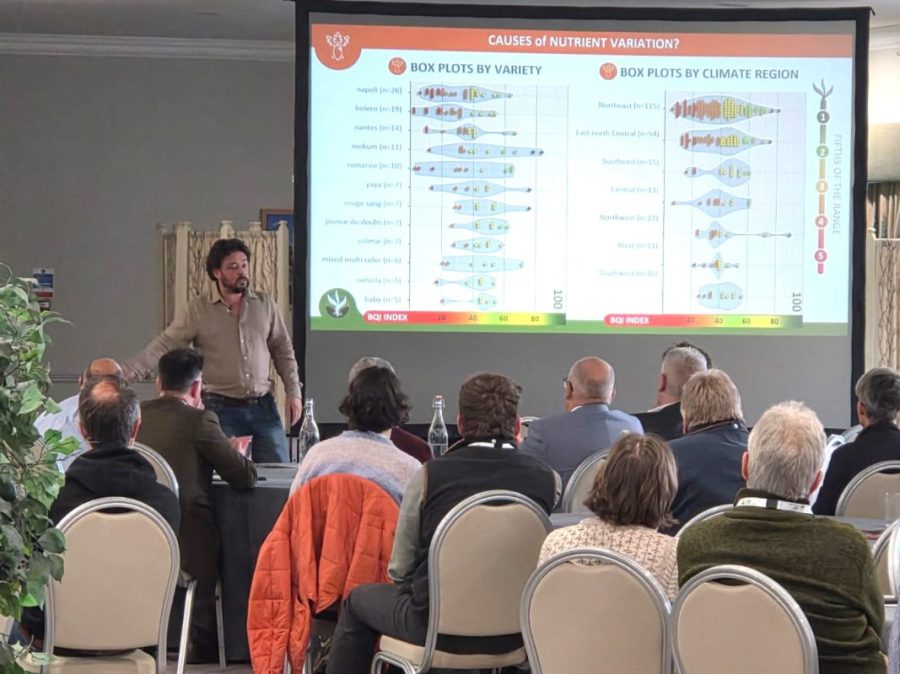
Using a metric called BQI – an average of six nutrients and two compounds weighted evenly – Dan’s team has attempted to find correlations between the results for different factors. For example, is there any relationship to genetics, climate zone, type of farming, or produce found in a supermarket compared with a farmer’s market?
For virtually every factor tested, there doesn’t appear to be a relationship between the factor and nutrient levels, he said. “There isn’t a meaningful connection between region, soil type, where you bought your food and what’s in it.”
The exception is the amount of soil life, as tested by measuring the quantity of carbon dioxide released by microbial respiration, he revealed. “So more life in soil equals more nutrients in food.”
Following up to this research has been a more in-depth project to define and measure nutrient density in beef. “We chose beef because it has the largest ecological footprint of any food product on the planet,” he said.
The goal was to identify measurable biomarkers that could define quality in beef beyond just fat content or aesthetics. The project collected samples from four continents, including steaks from at least three animals on the farm, stool samples for microbiome assays, and samples of plants the animals ate and the soil they grew in. A full set of management practices and genetics were taken for each sample, while the beef was also fed to humans to compare physiological impacts.
After crunching the data, statisticians identified approximately eight biomarkers that serve as a definition for nutrient density in beef, explained Dan. “We have the full spectrum of genetics, management practices, climate zones, and can categorically see connections in the biomarkers to how the animals are reared, their stress hormones and wellbeing, what they were fed and the ecosystem,” he explained.
“And if you want the simple answer, it’s the number of plants the animal has access to that correlates, not whether you’re in the desert or low wetland swamp.”
With more funding, he hopes to expand this principle to other produce, with wheat his next target. Once defined, the idea is to calibrate the handheld meters using the biomarkers to allow consumers and the supply chain to test produce – creating a race to the top based on measurable nutritional value, he concluded.
Farmer and hospital doctor Hannah Fraser, who’s completed a Nuffield Scholarship studying nutrient density, offered a practical perspective on how management decisions on-farm could directly impact the nutritional quality and health benefits of food.
Like Dan, Hannah also suggested soil health could impact nutrient density, pointing to a small trial by David Montgomery and Anne Biklé from America that compared 10 regenerative farms with conventional neighbours growing the same variety of various crops. Their work found that quite often, the regen farm-produced crop had greater nutritional content.
Adopting no-till establishment could also have a positive impact of health benefits, added Hannah, highlighting that disturbing soil through tillage damages fungal networks. This is because fungi produce ergothioneine, she explained. “Mushrooms are rich in ergothioneine, and people that eat lots of mushrooms have less heart attacks and lower risk of dementia.”
Furthermore, trials had also suggested that crops grown in fungi-rich soils could take up ergothioneine. “So it could be in your wheat or oats.”
ROLE OF NITROGEN
Applying too much nitrogen could have a detrimental impact on beneficial phytochemicals. “A few trials have looked at this in wheat, cabbage and basil. They showed when a crop has access to lots of nitrogen, they switch off genes producing these defence chemicals, including polyphenols.”
The flip side was that plants require nitrogen to grow, she acknowledged. “When plants are grown without nitrogen, they also have low levels of phytochemicals, so it’s about appropriate nutrition.”
While outside of immediate farmer control, she noted genetics affect nutrient density, pointing to modern wheat varieties being less micronutrient-rich than older varieties. “HarvestPlus is working in some lower economic countries where they have severe deficiencies of minerals like zinc, and so are selecting varieties of rice or wheat that are naturally higher in these minerals.
“It can be done; we can breed for better nutrition. But breeders have told me nobody asks for it, so it’s not what we focus on.”
More research on these topics was critical, she stressed, particularly the link between soil health and nutrient density. “If we can be sure that better soil produces more nutritious food, then we don’t have to test every food item, which is expensive. We can test soils on farm, explain to customers these soils are healthier, and food coming from this farm is likely to be richer in nutrients.”
Improving soil health has been a key focus on Hannah’s organic farm in West Yorkshire. “I might not be getting financial reward for improving soil health tomorrow, but I think it could be coming in the future,” she concluded.
This article was taken from the latest issue of CPM. Read the article in full here.
For more articles like this, subscribe here.
Sign up for Crop Production Magazine’s FREE e-newsletter here.