
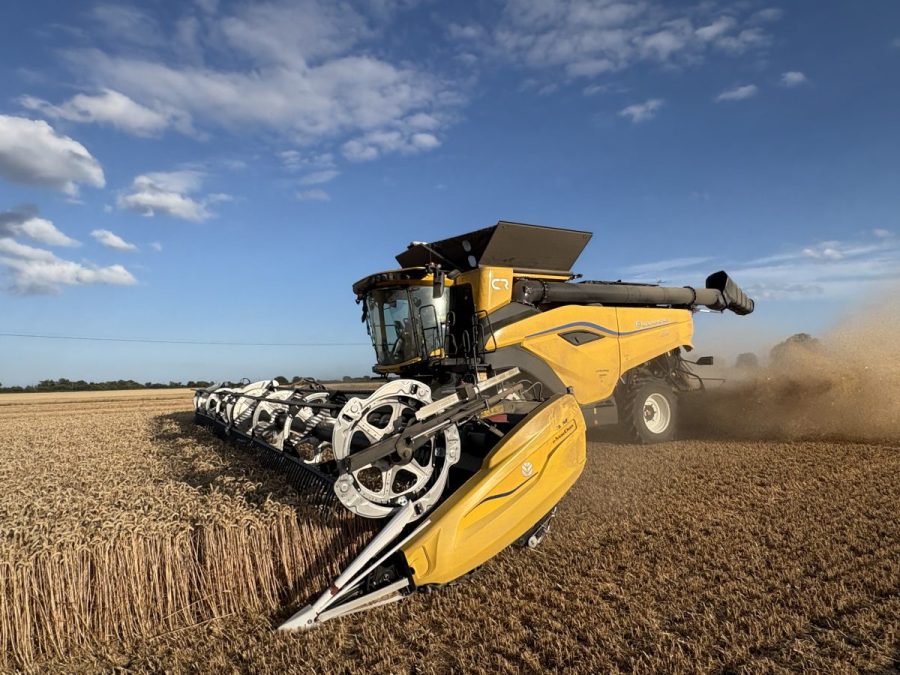
One Kent farm has replaced its combine, the largest model in the New Holland range when purchased, with the second biggest in the brand’s new flagship line. CPM visited to learn why the highest output option wasn’t the choice this time around.
“Before we make any change to our system that involves significant investment, we have to know it’ll make us more efficient without incurring greater cost elsewhere.” CLIVE WREATHALL
By Martin Rickatson
When a new flagship machine is launched, the focus is inevitably on its statistics and how far it takes the numbers at the top of the table to a new level. But of course, while farms are growing larger, not every business requires or wants additional capacity. Instead, the desire for greater efficiency often drives an upgrade.
That was the case when Kent farmers JP Wreathall and Sons replaced their combine, moving from what had been the largest in the New Holland range to the second largest in the new generation of flagship CR Twin Rotor models.
While the price of a newer model is always higher than the one it replaces, the desire to keep kit up to date but systems simple is driven by the desire to keep costs low and efficiency high, says Clive Wreathall. Alongside a Christmas turkey enterprise, he and his brother Andrew farm 1200ha of wheat, barley, oilseed rape and peas.
“As a tenanted farm, we have to make a decent margin before accounting for our rent, and aim to minimise costs while only spending where necessary,” says Clive.
“We’re not averse to technology, but have to see a prompt return. For crop establishment, we’ve used the same system for 25 years, based on a Simba SLD disc/tine/disc/press cultivator and Simba Freeflow drill, and for power we run simple but high-output articulated tractors – currently a Case IH Quadtrac 620 and a dual-wheeled New Holland T9.600.
“Our soils here on Romney Marsh retain moisture and yield well consistently, and we find this establishment process gets the best from them, so we don’t tend to mess with it. We keep things simple: combine and work the land in good conditions, drill at the right time into a good seedbed, get our pre-ems on in good time and our nutrition right.
“Before we make any change to our system that involves significant investment, we have to know it’ll make us more efficient without incurring greater cost elsewhere,” he comments.
This philosophy has been behind the most recent change to the farm’s machinery fleet. Previously, the Wreathalls ran the largest combine then available from New Holland – a 2017 653hp CR10.90 with twin 2.6m-long rotors and 14,500-litre grain tank. Since then, the maker has released two new models sitting above this – the CR10 and CR11, both offering more capacity than the former flagship in terms of separation area and tank capacity.
“Being able to cut more per hour when the moisture is right minimises drying costs and helps preserve milling quality, which is great, but there’s a point where a certain level of extra harvesting capacity would mean having to alter other parts of our system – our grain trailers, for example. And, of course, the larger the machine the smaller the second hand market for it,” points out Clive.
So when the CR10.90 came due for renewal, rather than take a big step up to the new flagship New Holland CR11 combine, the Wreathalls chose its slightly smaller CR10 sibling, giving them a performance upgrade but without having to restructure aspects like their haulage system.
Technically-speaking, the CR10 gives the same longer 3.6m rotors as the CR11, and the same larger 8.7m2 sieve area compared with the CR10.90’s 6.5m2.
“With the CR11, though, the grain tank is about one-third larger at 20,000 litres, whereas with the CR10 we get another 1500 litres, at 16,000 litres, making a tankful still a good fit for our existing grain trailers without having to upgrade them as well, or swamp our grain store.
“At 635hp, it’s pretty much the same as the CR10.90, which is plenty adequate for our mostly flat land. And as we swath most of our straw we don’t particularly need the extra 140hp of the CR11 for chopping. The combine produces decent baling straw, despite the fact it’s a rotary and the straw passes through the chopper at low speed even when swathing,” he explains Clive.
Having stayed with a New Holland CR, he says he hasn’t found a design that’s any better, benefiting from added support from both the manufacturer and the dealer, Haynes. “As this was one of the first of the CR10/11s sold here, we’ve also received support from the Belgian factory engineers.
“Plus something else that’s really helped us to maximise output is the 12m MacDon FlexDraper header. It’s been transformational and I wouldn’t have anything else now. We purchased it when running the CR10.90, which it worked for one season before we sold that combine but retained the header. I reckon its ability to feed crop into the elevator heads-first – and lift flat crop when needed – has boosted output by 15%.”
Operator Nick Burrows joined the team in 2024 – the year Clive chose to focus on general harvest management and give up the combine seat. While this was Nick’s first season on the CR10, experience of a CR10.90 on his previous farm has given him good grounds for comparison.
“Although it was in the same county, it was on very different land,” says Nick. “In the perfect conditions we’ve mostly had this season, I’d say there wasn’t much of a noticeable difference, but where things were tougher and perhaps the straw was still green, I could really push on. Everything is just bigger – larger rotors, much larger sieve area and more grain tank volume – and that additional capacity makes the difference.”
The combine’s capacity limit is something Nick believes he hasn’t yet found, although he has once tested it via another new feature. From the elevator, the crop is fed to New Holland’s Dynamic Feed Roll (DFR) system, which can now be reversed simultaneously with the elevator and the rotors. This works well without leaving the seat confirms Nick, having just once experienced a blockage that was rapidly regurgitated.
The DFR accelerates the crop and splits it to feed the two broader, longer 3.6m threshing and separating rotors. Each features 40 standard rasp bars and 12 spiked units, interspersed by eight HX hybrid raspbars. A greater sidewall angle helps accelerate crop flow in the stepped rotor cage, between the threshing zone and separation zones.
Vane angle is adjustable from the cab to vary threshing intensity, while new rotor cages feature a stepped design with broader cage and higher vanes in the separation area, for greater crop mat movement and improved separation. There are two sets of three lightweight threshing concaves and separation grates, and two sets of six lightweight grates.
A new TwinClean cleaning shoe comprises two sequential sieve systems, each with its own upper and lower sieve and clean grain auger, and is based around a large grainpan with an increased fallstep to the first upper sieve. Two automatic cross distribution mechanisms, one on the grainpan and one on the upper sieves, are designed to ensure an even cleaning shoe load.
Then, pressure sensors on the grainpan and on the upper sieves continuously measure cleaning shoe load to address any material distribution left/right anomalies. Lateral movement of the grainpan and sieves evens material over the cleaning shoe’s full width, with the cleaning shoe compensating for uneven feeding and side slopes up to 28%.
While the CR11 retains the CR10.90’s 15.9-litre engine but boosts power to 775hp, the CR10’s powerplant is actually a smaller displacement 12.9-litre unit, but producing just a shade less power, than the CR10.90, at 635hp versus 653hp.
In the CR10/11 the engine sits longitudinally, which New Holland says minimises power losses. Harvesting engine speed is 1900rpm, versus the CR10.90’s 2100rpm, reducing fuel consumption and noise, complemented by a 1300rpm engine speed at maximum travel rate.
“There’s plenty of power for our situation, so I don’t think the small difference is noticeable,” says Nick. “And while the combine is physically bigger because of the longer rotors, it turns tighter – I can easily get round on a four-pass headland.
“The adjustable ratio steering New Holland offers on its tractors would be a nice addition though; steering a combine this size can be quite heavy, and it requires about five spins lock to lock.”
Other cab features come in for praise, including a redesigned armrest and the new IntelliView 12 touchscreen, rated easier to use than its predecessor. It also has the IntelliSense system, which automates threshing, separation and cleaning shoe settings according to whether operator wants to maximise throughput, minimise losses, optimise grain quality or work to a consistent fixed throughput.
“It’s a good system, altering settings continuously as conditions change, but we prefer to set and alter things manually,” highlights Nick.
Given that the Wreathalls’ CR10 was one of the UK’s first, there was a fair amount of initial scrutiny from both dealer and manufacturer, and it’s benefited from a number of subsequent upgrades now featuring on current machines.
“It had about a week’s post-harvest attention, beefing up the intake fan housing, changing a radiator seal and replacing a rotor gearbox,” explains Nick. “The chaff spreaders were modified and received new radar sensors to distribute more evenly and address ridging on the outsides in OSR residue. And the unloading auger extension was removed, as we’d found it unnecessary for this 12m header, and it had meant the tractor/trailer were travelling on a straw swath.
“We’d also found the air intake beneath the combine for the internal fan was occasionally blocking with straw and chaff, and New Holland also modified this to address the issue.”
Aside from those niggles, he believes it’s a good machine. “Its internals seem more than matched to keeping up with what’s put in front of it, and there are other handy features such as the ability to shut off the cross augers to fully empty the unloading auger.
“But it’s also easy to maintain. Sealed bearings aren’t perfect – we’ve had one go on the elevator – but I like that there are no daily service points. There’s a 100-hour grease point on one of the main left-side pulleys, plus a couple on the front axle at the same timing, and little else that needs attention short-term. It takes longer to service the header, but for what that adds to the whole combine package that’s time well spent,” he concludes.
This article was taken from the latest issue of CPM. Read the article in full here.
For more articles like this, subscribe here.
Sign up for Crop Production Magazine’s FREE e-newsletter here.