
Several seasons after CPM first visited Herefordshire grower Ally Hunter Blair to discuss his move into strip-till establishment, we return to find out whether the system is still delivering – and why another grower has since invested in the next generation of Mzuri drill.
“I still don’t think there’s another machine that quite does what this one does in the same way.” ALLY HUNTER BLAIR
By Charlotte Cunningham
It’s no secret that machinery replacement is becoming an increasingly difficult balancing act on many arable farms. With margins tighter than they’ve been for years and machinery prices continuing to climb sharply, replacing kit simply because it’s reached a certain age is becoming harder to justify.
Instead, growers are increasingly looking for equipment capable of bedding itself into the system for the long haul. In practical terms, this means machinery that not only works well today, but still stacks up practically and financially several seasons down the line.
It was a topic very much front of mind when CPM visited Ally Hunter Blair at Weir End Farm in Herefordshire back in 2022 to discuss his move into strip-till establishment with a Mzuri drill.
At the time, the focus centred around improving timeliness, reducing labour pressure and building a more resilient establishment system on the farm’s lighter land. Several seasons on – and despite considerable change within the wider Mzuri business itself – Ally says the reasons for sticking with the system remain largely unchanged. “Fundamentally, it still does exactly what I need it to do,” he says. “I still don’t think there’s another machine that quite does what this one does in the same way.”
GRANT FUNDING
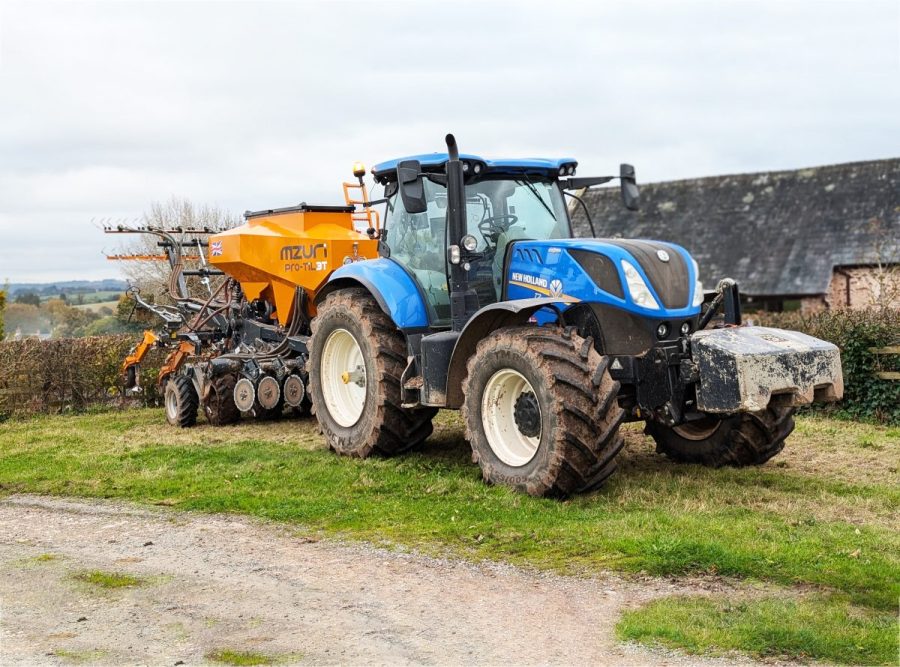
Since CPM’s original visit, the drill itself has changed – although perhaps not entirely in the way many might expect. “We updated to a newer model in 2024,” explains Ally. “But being completely honest, the reason we changed was because of grant funding.
“The figures just stacked up in a way that made it almost silly not to change. With the productivity grant support and the trade-in value of the old machine, it cost very little to move into a brand-new drill.”
That timing coincided with significant change within the wider Mzuri business, with UK production ending and manufacturing consolidating under Mzuri World in Poland – a move which initially left many existing users questioning what the future might look like, admits Ally. “There was definitely uncertainty among Mzuri users about what was happening. A lot of us were asking questions.”
However, while the manufacturing side may have shifted, he says support for existing UK-built machines has remained reassuringly familiar. “The service side has actually stayed really good,” he explains. “Orange Drill Support has come out of it, but it’s still a lot of the same people in the same place and they’re committed to supporting all of the British-built machines.”
The updated drill itself remains broadly similar to the original machine Ally first moved into several years ago, although a number of refinements have been introduced along the way. Among the most noticeable is a redesigned front disc arrangement mounted independently on a hydraulically controlled toolbar, rather than directly ahead of the leg itself.
“The old setup could block between the disc and the leg in certain conditions,” explains Ally. “Now there’s much more clearance, and you can hydraulically drop the discs in and out depending on conditions, which has actually turned out to be a really useful feature.”
That flexibility has proven particularly valuable when drilling into grassier headlands or heavier trash situations where additional cutting action is required ahead of the leading leg, he adds.
Despite those changes, Ally believes the broader strengths of the system remain exactly where they always were – particularly around the leading leg design, contour following ability and consolidation behind the drill. “There are lots of strip-till systems out there now,” he says. “But for me, this still sits in a really practical middle ground.”
FLEXIBLE APPROACH
That pragmatism perhaps underpins much of Ally’s wider thinking around establishment too. While the farm has moved increasingly toward lower disturbance techniques alongside cover cropping and soil improvement work, he remains cautious about the idea of fully committing to no-till systems. “I probably imagined when I first bought the drill that within 10 years we’d be fully no-till,” he admits. “But actually, chatting to people locally who’ve tried it and then moved back again, I think you sometimes have to listen to your soils.
“There are years where full no-till absolutely works, but there are also years where it doesn’t. As a tenant farmer, I can’t afford crop failures.”
Instead, he believes the Mzuri system offers enough soil movement to reduce establishment risk without reverting back to a full cultivation approach. “There’s enough movement there to create a consistent establishment environment without going backwards into intensive cultivations,” he says. “We’re definitely seeing soil improvements now we’re six or seven years into the system, but at the same time, the drill still gives us a bit of a safety net.”
That balance has become increasingly important given the realities of workload and labour availability on farm and for Ally, one of the main long-term benefits remains the ability to comfortably operate as a ‘one-man’ system during drilling periods. “If we went back to a more conventional two-pass system, you suddenly become much more dependent on weather windows and labour availability again.”
Versatility has also become an increasingly important part of the system as rotations and environmental work evolve. Alongside cereals, the drill is now being used across peas, cover crops and environmental seed mixes, with the rear-mounted Stocks applicator opening up additional flexibility. “We’ll sometimes put around 70% of a mix through the legs and then trickle the rest out the back,” explains Ally. “It works particularly nicely with grasses because it helps to fill the gaps between the rows.”
The drill’s dual metering capability has also created opportunities for mixed cropping systems, with neighbouring dairy farmers using separate metering systems to establish peas and barley simultaneously while maintaining more accurate placement. “They’ll put the peas down the front leg and the barley through the main system,” he says. “It avoids some of the separation issues you can get when mixing seed in the hopper.”
However, despite the positives, Ally remains realistic about the compromises which still come with the system. “It’s still heavy as hell,” he laughs. “There’s no getting away from that. A 240hp tractor on a 3m drill is ridiculous really.”
SOIL HEALTH
Even so, he believes the wider system changes are beginning to offset some of those concerns. “The soils are definitely becoming easier to work over time,” he continues. “You can see more life in them now. That’s not just the drill obviously, that’s the whole system with cover crops and reduced disturbance, but it all works together.”
While Ally represents a grower still firmly backing the system several years after first investing, Scottish arable farmer Neil White offers a slightly different perspective – having recently invested in one of the first new-generation Polish-built Mzuri drills arriving into the UK.
Farming around 230ha close to the Scottish border near Berwick-upon-Tweed, Neil runs a diverse rotation including winter barley, oilseed rape, winter wheat, spring barley, oats, beans and peas across a range of soil types from clay loam through to lighter sandy land.
Like Ally, his move away from a conventional establishment system was initially driven less by ideology and more by practicality. Originally operating a plough-based system, Neil says labour pressure and timeliness increasingly became limiting factors. At the same time, introducing OSR into the rotation prompted questions around whether full inversion tillage was always necessary.
“You’d have these lovely clean starts after OSR or beans, and it seemed crazy to turn that upside down and beat it with metal just to recreate the same thing again,” he says.
After researching various systems, Neil eventually purchased a second-hand Mzuri drill in 2015 following a successful on-farm demonstration. Importantly though, the transition happened gradually rather than across the entire farm immediately. “I started by using it on around 20% of the farm,” he explains. “We still ran both systems side-by-side for a while, which actually became really useful because I could directly compare results.”
Over time, those comparisons became increasingly difficult to ignore. “For all the extra effort involved with the plough-based system, I wasn’t getting any more yield,” he says. “There wasn’t really any quality difference either, so eventually it just became a bit of a no-brainer.”
Today, all crops across the farm are established using the Mzuri system, and while Neil had originally intended to keep his existing drill running for longer, uncertainty surrounding the UK manufacturing changes prompted him to proactively engage with the Polish operation directly.
INTERNATIONAL SERVICE
Through that process, Neil made contact with Wojciech Zurek from Mzuri World in Poland, who he says was proactive in engaging with existing UK users following the changes to the business.
“I phoned Mzuri World directly because a lot of us were wondering what was going to happen,” explains Neil. “Wojciech came across and met a group of us, talked through the changes they’d made and showed us the direction they wanted to take the drill.
“I think that reassured people because it was clear they weren’t just continuing production – they were actively developing it.”
Neil says that relationship continued as discussions progressed, including a subsequent visit to the Polish factory to see the operation first-hand. “The level of investment was honestly quite mind-blowing,” he says. “There’s huge amounts of development going on, stress testing, crop trials and continual improvements to the design.”
That confidence ultimately led Neil to invest in a new-generation 3m Pro-Til (3.33T) machine earlier this spring, replacing his original drill – and support didn’t stop once the drill arrived into the UK either. “Wojciech actually came back over and set up the drill himself,” says Neil. “He even stayed while we drilled the first fields with it.”
Early impressions have been positive, particularly when drilling into heavier cover crop situations where the previous design may have struggled. “It was actually a really good first test because I wasn’t entirely sure how it would cope,” he says. “But it made a fantastic job.”
Crucially, Neil echoes Ally’s views around the system sitting somewhere between conventional cultivations and full no-till. “I’ve never really seen this as a stepping stone toward full no-till,” he says. “I think moving that little bit of soil with the leading leg just removes some of the risk.”
What’s more, with the current climate, reducing risk is becoming increasingly important. “There are systems out there where in perfect conditions you can travel faster, use less fuel and maybe cover more ground,” he admits. “But farming isn’t really in a position now where I’m prepared to take significantly more risk just to chase that.”
Instead, Neil believes the system offers something perhaps increasingly valuable in modern arable businesses – consistency. “The drill still gives me the output, but it also gives me the workload benefits and flexibility alongside that.
“I can comfortably manage the area I have, I can react quicker when conditions are right, and I’m not adding unnecessary risk into the system. At the end of the day, that balance is probably more important now than it’s ever been.”
This article was taken from the latest issue of CPM. Read the article in full here.
For more articles like this, subscribe here.
Sign up for Crop Production Magazine’s FREE e-newsletter here.