

Limagrain may be a global player, but its roots remain firmly in the fields of central France. CPM visited the co-operative’s headquarters and research platforms in Limagne to explore how investment in genetics is being translated into practical solutions for UK growers.
“With farmers inside the governance, we stay grounded.” SÉBASTIEN CHAUFFAUT
By Charlotte Cunningham
Arriving in central France on an early March morning and the blue skies and warm sunshine are a welcome treat for the English souls slightly withered by such a long, wet winter.
The route from Clermont-Ferrand to Domaine de Mons doesn’t take long, but it says plenty. Beyond the airport, the Limagne plain opens out quickly, with the volcanic outline of the region on the horizon, and on this occasion, wall-to-wall sunshine doing its best to flatter everything in sight.
At the centre of it sits Mons itself – a striking château which, despite its age and grandeur, is far from a museum piece. For Limagrain, it’s where much of the story began.
“This was the first research centre of the group, everything started here,” explains Limagrain Europe CEO, Sébastien Chauffaut.
The building dates back some five centuries and once belonged to Blaise Pascal’s family, but Limagrain has occupied the site for around 60 years. More importantly, it marks the point where a group of farmers first chose to take control of their own seed production.
That decision continues to shape the business today. Limagrain may now operate globally, but it remains a French co-operative at its core, owned and directed by farmers from a defined area of central France. “Everything started, and everything continues, with our farmers,” says Sébastien. “They’re at the heart of everything we do.”
That influence is embedded in the structure of the business. Of the group’s 15 board members, 14 are farmers, and that farmer-led approach is mirrored throughout the organisation. Each part of the business operates as a tandem – pairing a salaried commercial lead with a farmer representative – ensuring decisions remain grounded in practical agriculture. “It’s led by farmers,” he says. “The board takes the strategic decisions.”
The model dates back to the 1960s when 65 farmers chose to move from seed multiplication into breeding and ownership. Today, that same principle underpins how Limagrain operates – not just in governance but in how it prioritises research and development.
In a sector where bringing a new variety to market can take eight years or more, that long-term structure is critical. But just as importantly, it keeps the business anchored to practical farming. “The risk for a director is to go too far from reality,” says Sébastien. “With farmers inside the governance, we stay grounded.”
That grounding is reflected in the group’s focus. Despite spanning field seeds, vegetable seeds and food ingredients, Limagrain’s strategy is deliberately centred on genetics. “We’re a seed company at our core, and we’re committed to genetics and improving plant performance.”
That focus is backed by scale – across the group, more than 2200 staff work in scientific roles, supported by over 100 research stations worldwide and annual R&D investment exceeding €320M. Around half of that is directed into field seeds, with an impressive genotyping laboratory at Limagrain’s research centre in Chappes placing the breeders right at the forefront of innovation.
Upon visiting Chappes, that investment is visible in the level of technology deployed – from high-throughput genotyping and phenotyping platforms through to bioinformatics and gene discovery. These tools allow breeders to identify desirable traits more quickly and accurately, accelerating the development of varieties with improved disease resistance, stress tolerance and input efficiency.
But while the footprint is global, the thinking remains closely tied to the farm. For UK growers in particular, the relevance lies in how that investment translates into practical outcomes – varieties and systems that perform under real-world conditions, not just in controlled environments.
That connection between research and reality becomes clearer out in the field, and while standing in the Limagne valley, the emphasis shifts from theory to application. While much of Limagrain’s breeding work sits within its research centres, the next stage – understanding how those genetics perform within whole farming systems – is just as critical.
“We sit just after the research phase,” explains Sara Greze, head of agronomic production. “Our role is to take those genetics and understand how they work in real farming conditions, and how we deploy them for farmers.”
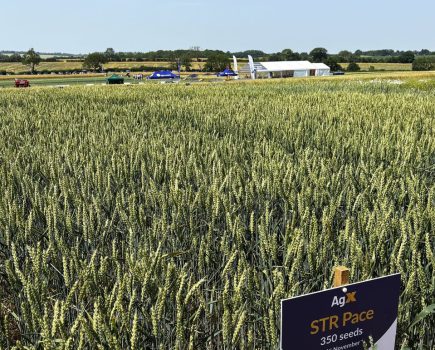
That work is centred on the Matrix platform – a 49ha, long-term systems trial designed to run over 12 years. “This is a long-term project,” says Sara. “The objective is to identify systems that are both agronomically and economically viable for the future.”
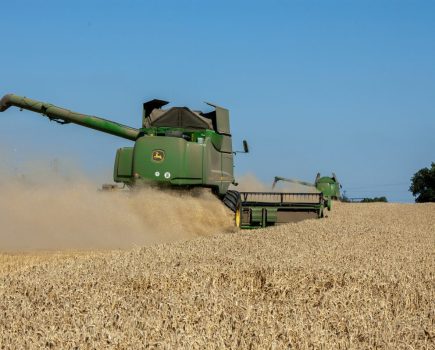
Rather than isolating individual variables, Matrix takes a whole-system approach. More than 60 field-scale plots are managed using commercial machinery, alongside replicated trials, allowing both practical and statistical evaluation.
“These are real farming conditions,” says agronomy engineer Amandine Dellac, experimentation technician. “We’re using the same equipment as farmers.”
Across the site, seven rotations are being tested, reflecting regional systems built around combinations of cereals, oilseeds and break crops, and tailored to a range of soil types from heavier, moisture-retentive clays through to lighter, drought-prone profiles. Some systems are irrigated, others not, allowing direct comparison of water-limited and non-water-limited performance.
Crucially, each system is also assessed under different input strategies. Alongside a standard approach, scenarios include a 50% reduction in nitrogen compared with standard farm practice, a 50% cut in plant protection products, and a combined reduction of both, enabling assessment of input response, system robustness and economic resilience.
“We want to understand how crops behave with fewer inputs, but also what that means for yield, quality and end use,” says Amandine.
Measurements extend beyond yield alone, incorporating grain quality, nitrogen use efficiency, input response, crop development, rooting behaviour and soil performance, helping build a clearer picture of how each system functions agronomically and economically.
That end-use element is central. Crops aren’t simply assessed at harvest, but followed through into processing to understand how agronomic decisions impact final product performance. “With wheat for example, we assess milling and baking quality,” says Sara. “The system has to work through the whole value chain.”
Alongside output, resilience is a key focus. The trials are designed to explore how systems perform under pressure – from climate variability to tightening regulation and input availability.
Water use is another critical factor, particularly given the variation in soils across the site. Systems are assessed for their ability to retain moisture, improve water use efficiency and maintain performance under drought conditions, helping to identify approaches better suited to increasingly variable seasons.
At the same time, a wide range of environmental metrics are captured, including soil organic matter, carbon dynamics, biodiversity and soil fertility. More than 10,000 data points are collected annually, supported by detailed soil sampling and digital tools to manage and interpret results. “We’re generating a huge amount of data,” says Sara. “And the idea is not just to collect it, but to use it.”
For Limagrain, that level of investment – around €7M – reflects a clear objective. As a farmer-owned business, innovation must deliver in practice. “The requirement from our board is very strong,” says Sara. “We must guarantee agronomic viability, but also economic viability.”
It’s a principle that links back directly to the co-operative structure outlined at Mons. Because while the science may be complex, the end goal remains straightforward – to define which combinations of genetics, rotation and input strategy deliver the best balance of yield, margin and resilience.
And for UK growers facing many of the same pressures around input use, climate variability and system resilience, the message is clear – the value of this work won’t be judged by what happens in France, but by how effectively it translates into practical gains back home.
This article was taken from the latest issue of CPM. Read the article in full here.
For more articles like this, subscribe here.
Sign up for Crop Production Magazine’s FREE e-newsletter here.